
Telit Cinterion launches SE250C4 module with on-device AI for edge devices
Nov 12, 2026
Chips
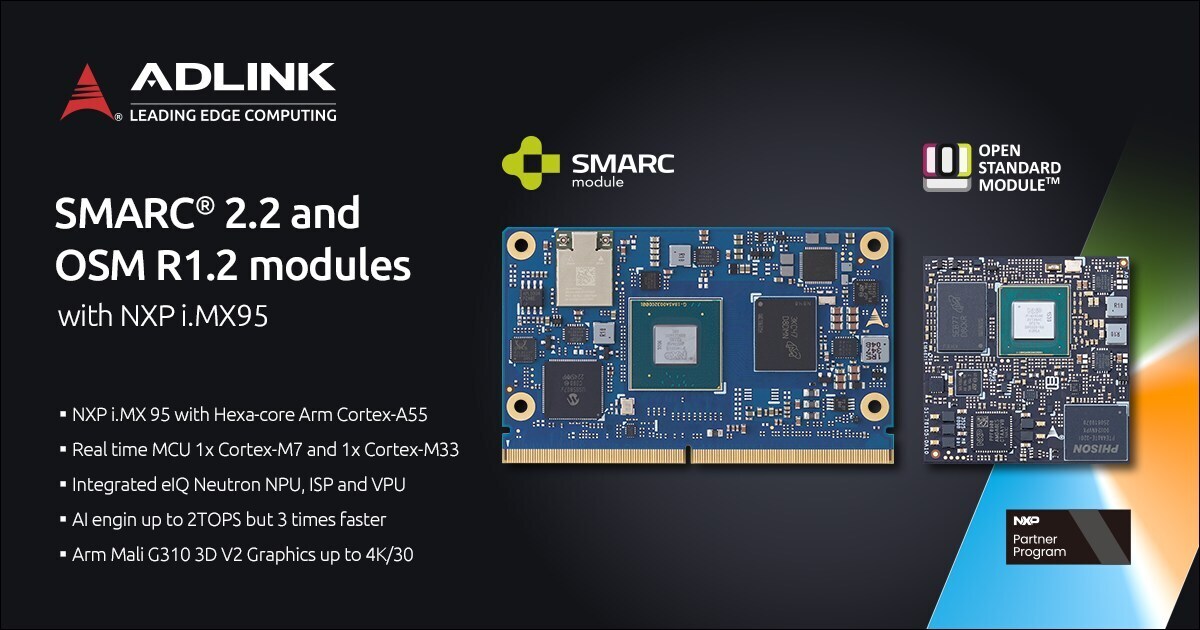
ADLINK Technology has introduced its latest NXP-based IMX95 modules, powered by the NXP i.MX 95 applications processor family, announced in a press release. The modules are designed for use in aerospace, automotive edge, commercial IoT, industrial, medical, and networking sectors.
The new lineup includes two models: the OSM-IMX95 and the LEC-IMX95. The OSM-IMX95 is a compact module built for embedded edge systems, while the LEC-IMX95 targets scalable industrial IoT applications. Both feature a six-core Arm Cortex-A55 processor with an integrated Neutron NPU for AI inference and support for immersive 3D graphics.
The modules offer extensive connectivity options and are engineered for long-term deployment, featuring a 15-year product lifecycle. ADLINK positions these solutions to deliver performance, security, and efficiency for advanced edge and embedded computing environments.
Consider subscribing to one of our newsletters like Silicon Brief, Industrial AI Weekly or Daily AI Brief.
Also, consider following us on social media:
Weekly coverage of AI hardware developments including chips, GPUs, cloud platforms, and data center technology.
 Tensordyne
This Tensordyne whitepaper presents Napier, an inference-focused AI processor and rack-scale system based on the company’s TDN Math logarithmic number system. It examines infrastructure requirements for large mixture-of-experts and agentic models, compares major inference architecture approaches, and details the TDN AIP processor, TDN72 pod, TDN Link fabric, and Napier Ultra configuration. The paper reports simulation-based performance, cost, and accuracy-validation results, including Tensordyne’s projected comparison of one Napier rack with a nine-rack Nvidia Rubin plus Groq deployment; the chip is reported as taped out and in fabrication.
Read moreDaily AI Brief: the AI news that matters, in your inbox.