ADNOC signs with OpenAI and G42 as Abu Dhabi and OpenAI strike four AI agreements
Nov 02, 2026
Enterprise
OpenAI CEO Sam Altman says advanced AI models are now mostly smarter than leading scientists and can perform significant parts of many white collar jobs, according to Anadolu Agency. He spoke at the opening ceremony of the Abu Dhabi International Petroleum Exhibition and Conference (ADIPEC) on Monday. "At the start of this year, AI was mostly not as smart as our smartest scientist, and now it's mostly smarter than them," he said.
Altman said people must retain control over how AI is used, including decisions that require human judgment, creativity and accountability. He described AI as a tool that should serve people rather than decide what is best for them.
Altman identified electricity supply as the largest constraint on AI growth because computing infrastructure requires substantial physical power capacity. He said global token use has risen to about 100,000 tokens per person each month, while the largest institutional users consume about 500 billion tokens monthly.
Altman said around 80% of young people in the UAE use ChatGPT weekly. During the event, OpenAI announced agreements with G42 and ADNOC, which Anadolu describes as the first global deployment of OpenAI's frontier models by an energy company.
Consider subscribing to one of our newsletters like Silicon Brief or Daily AI Brief.
Also, consider following us on social media:
Weekly coverage of AI hardware developments including chips, GPUs, cloud platforms, and data center technology.

 Tensordyne
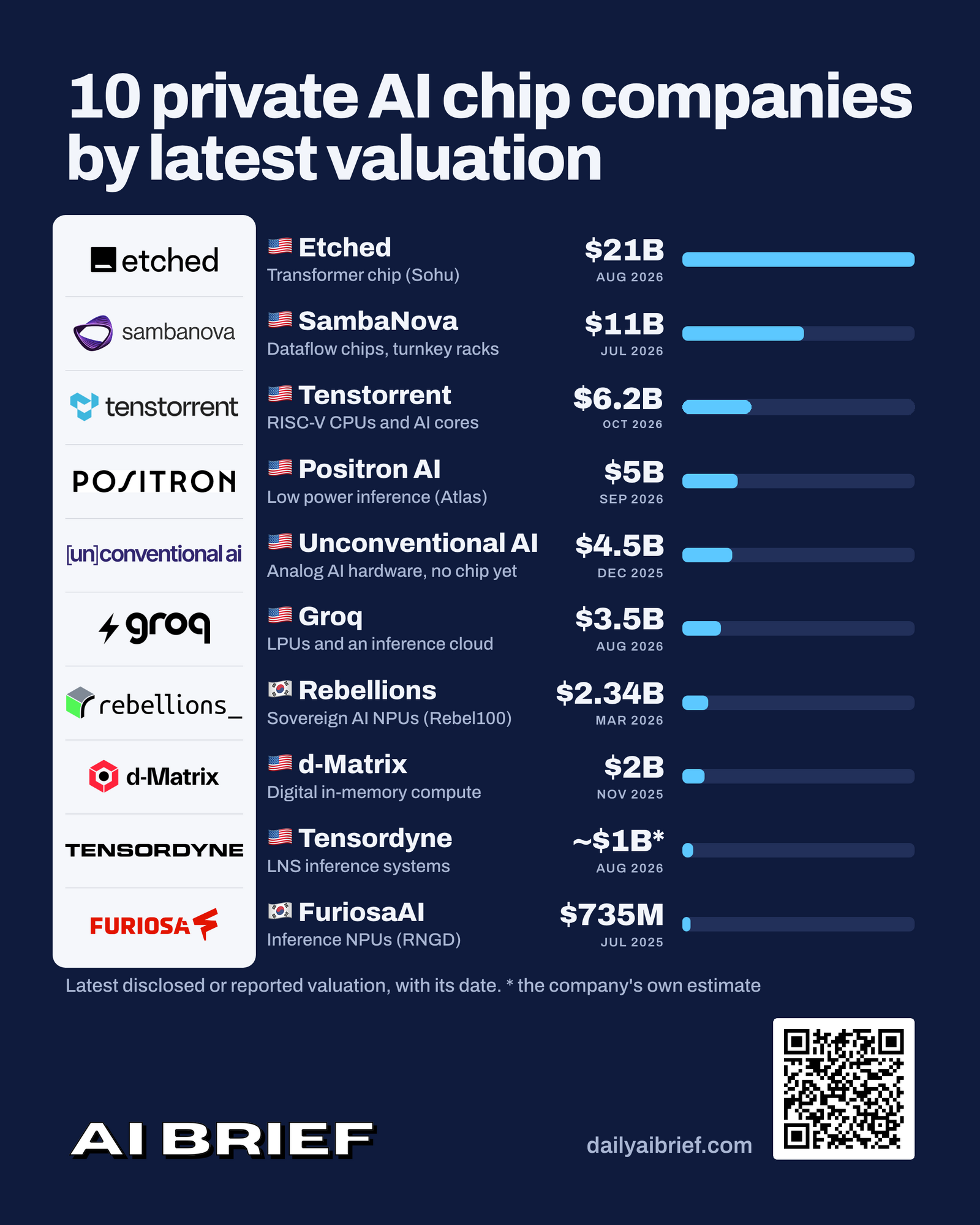
This Tensordyne whitepaper presents Napier, an inference-focused AI processor and rack-scale system based on the company’s TDN Math logarithmic number system. It examines infrastructure requirements for large mixture-of-experts and agentic models, compares major inference architecture approaches, and details the TDN AIP processor, TDN72 pod, TDN Link fabric, and Napier Ultra configuration. The paper reports simulation-based performance, cost, and accuracy-validation results, including Tensordyne’s projected comparison of one Napier rack with a nine-rack Nvidia Rubin plus Groq deployment; the chip is reported as taped out and in fabrication.
Read moreDaily AI Brief: the AI news that matters, in your inbox.