AI voice generators and text to speech services
Current speech synthesis products for content creators and developers
Updated Oct 2026
These products turn supplied text into generated audio through a studio, API or licensed deployment. Entries are alphabetical and describe the available workflow, not a ranking of voice quality. Product evidence was checked on 5 September 2026.
Choosing a speech service
Choose the workflow first: a studio for edited voiceovers, an API for application audio or an arranged deployment for enterprise use. Compare the actual language, voice and output options you need. Availability does not imply that every voice or preview feature is included in every plan.
Services in alphabetical order
 Amazon Polly
Amazon Web Services operates Amazon Polly, a cloud speech service for applications such as news readers, games, learning tools and accessibility software. It converts text into audio and offers four voice engine types: standard, neural, long form and generative. Developers can select among multiple languages and voices, and use SSML through the console or command line.
Polly charges for the text it synthesizes. Generated speech can be cached and replayed without another synthesis charge. This lets an application reuse a fixed announcement, lesson or other repeated passage after generating it once, under the service's caching and playback terms.
For script control, Polly accepts Speech Synthesis Markup Language, including tags for pauses, pronunciation and delivery. Tag support differs between voice engines, so an existing marked up script may need changes when switching engines. The neural engine also has a Newscaster speaking style for specific English and Spanish voices. The service includes time driven prosody controls for adjusting speech to fit a specified duration, including localized narration used with video.
 AppTek
 sells neural speech synthesis for dubbing and real time applications, with a contact route for enterprise buyers. It offers configured voices and adaptation from customer recordings. Deployments can process batches or live requests, either on customer infrastructure or cloud, and can be tuned for processing speed or audio quality.
 Async
Async, formerly called Podcastle, sells a voice API for developers building spoken applications. Its catalog includes more than 500 voices across over 15 languages, with Flash and Pro model options. Developers can define pronunciations, insert timed pauses, change speech rate and read numbers digit by digit.
The API has a free tier without a credit card, and Async advertises pricing starting at $0.50 per hour. It also offers voice cloning from a three second sample. Integrations cover LiveKit, Pipecat and Twilio, while a WebSocket connection can carry multiple conversation contexts for applications managing parallel conversations.
 AudioStack
 sells an audio production platform for media and advertising teams. Its API combines scripts with voices, music and sound effects through content libraries and Audioform. Teams can assemble mixed audio programmatically or use the company's editor interfaces.
In Pro Editor, users paste a script, preview voices and add generated speech to a voice track. They can edit the text, change speed or switch voices, then mix the result with music and sound effects. Splitting a speech clip converts it into an audio file and removes direct text editing. AudioStack offers buyers a demo booking route.
 CAMB.AI
 offers MARS speech generation through a text to speech API. Developers supply a script, voice ID and language, then receive streamed audio; requests accept 3 to 3,000 characters. The model menu includes MARS Flash, Pro and Instruct, alongside MARS 8.1 beta models.
Delivery controls depend on the model. MARS Instruct accepts style and tone instructions, while the 8.1 beta variants support inline pronunciation and nonverbal tags. Output formats also vary: MARS Instruct excludes MP3 output. Developers can start through the company's API quickstart and Studio, which sit within its wider translation and dubbing platform.
dubbing · translation · localization
 Cartesia
 sells Sonic, a streaming speech generation API, alongside a playground for trying voices before integrating them into an application. The current model is Sonic 3.6, with 44 languages and pronunciation dictionaries for names and specialist terms. Its customer EliseAI runs more than five million voice calls a month on Cartesia, according to the company's customer account on its homepage.
The free plan has 20,000 monthly credits. Pro costs $5 a month and includes 100,000 credits, commercial use and instant cloning. Cartesia estimates that allocation at about 133 minutes of speech. Startup costs $49 a month for 1.25 million credits and adds professional cloning and organizations. Speech generation and transcription draw from the same model credit pool.
Plan limits also govern capacity: Pro allows three concurrent TTS requests, Startup five, and Scale fifteen, with custom limits for Enterprise. Scale costs $299 a month for eight million credits and priority support. Professional clone slots start at two on Startup and four on Scale; free and Pro accounts exclude professional clone slots.
low-latency · sonic · model
 Deepdub
 offers a standalone speech synthesis API with a free trial key and selectable voice presets. Its quickstart generates an MP3 from text using the dd-etts-3.0 model, with Python and JavaScript examples. The company's broader catalog includes dubbing and localization tools for entertainment, language services and corporate training.
 Deepgram
's current speech synthesis model is Flux TTS, which supports streaming and batch generation for voice agents, customer service and recorded audio. Its voice catalog covers English and many other languages, including Dutch, Hindi, Japanese and Spanish. Aura 2 remains available with voices in seven languages, while the original Aura has English voices only.
Usage pricing puts Flux TTS at $0.045 per 1,000 characters, Aura 2 at $0.03 and Aura 1 at $0.015 on the pay as you go plan. New accounts receive $200 in introductory credit. The Growth plan starts at $4,000 in annual prepaid credits and offers lower synthesis rates. Flux uses a newer endpoint than Aura, with WebSocket and REST access.
 ElevenLabs
 sells text to speech tools for video voiceovers, audiobooks, podcasts and spoken responses inside applications. Creators can work in its browser studio, while developers can use APIs and SDKs to generate speech inside their own products. The product also has iOS and Android apps for generating audio on mobile devices. Its customers include language learning company Praktika, which uses ElevenLabs for AI tutors.
The free plan includes 10,000 credits a month. Starter has a regular price of $6 a month for 30,000 credits, with commercial rights and instant cloning. Creator costs $22 a month at its regular rate and adds professional voice cloning with 121,000 monthly credits. Credits are shared across its products, so spending on other audio tools reduces the balance available for speech.
For teams, Scale costs $299 a month and includes three seats, three professional voice clones and 1.8 million monthly credits. Pro, at $99 a month, adds 44.1 kHz PCM API output; Enterprise has custom pricing. Annual billing charges for ten months of service and provides two months free.
quality-leader · cloning · api
 Fish Audio
 provides hosted speech generation for creators and an API for developers. Requests can select a reference voice and adjust speed, volume, audio format and sampling settings. Developers create an account and API key through the Fish Audio dashboard.
The web free tier includes 8,000 monthly credits and limits each generation to 500 characters. Plus costs $132 billed annually, equivalent to $11 a month, for 250,000 monthly credits, commercial use and private voices. It allows up to 15,000 characters per generation. Pro costs $900 billed annually and adds three team seats, two million monthly credits and longer generation limits.
 Google Cloud Text to Speech
Google Cloud operates Cloud Text to Speech, including Gemini models that generate one or multiple speakers from scripts. Text prompts control style, accent, pacing, tone and emotional delivery. Buyers can also choose other voice families, including Chirp 3 HD and WaveNet, through the service's model catalog. Using the service requires billing on the Cloud project.
Gemini 2.5 Flash TTS costs $0.50 per million input tokens and $10 per million output audio tokens. Pro costs $1 per million input tokens and $20 per million audio tokens. These Gemini models have no free usage allowance. Chirp 3 HD instead has a monthly free allowance of one million characters, followed by $30 per million characters.
For Gemini requests through the Cloud TTS API, text and prompt fields each have a 4,000 byte limit. Output is capped at roughly 655 seconds and longer audio is truncated. The newer Gemini 3.8 Flash and Flash Lite TTS models are previews available through the Gemini Enterprise API only, with separate access from Cloud TTS.
 Gradium
 offers a hosted text to speech API with REST and WebSocket access, voice selection, voice design and pronunciation dictionaries. Its optional public beta targets difficult strings such as phone numbers, email addresses, bank account numbers and spoken time expressions. Existing voices work with the beta, while the production model remains the default.
The free plan supplies 45,000 credits each month; paid tiers add commercial use, and custom arrangements cover dedicated inference and customer infrastructure deployments. The company extended its seed funding to $100 million in July 2026, adding NVIDIA among its investors. Gradium's hosted API sits alongside Phonon, its separate open model for devices.
 Inworld
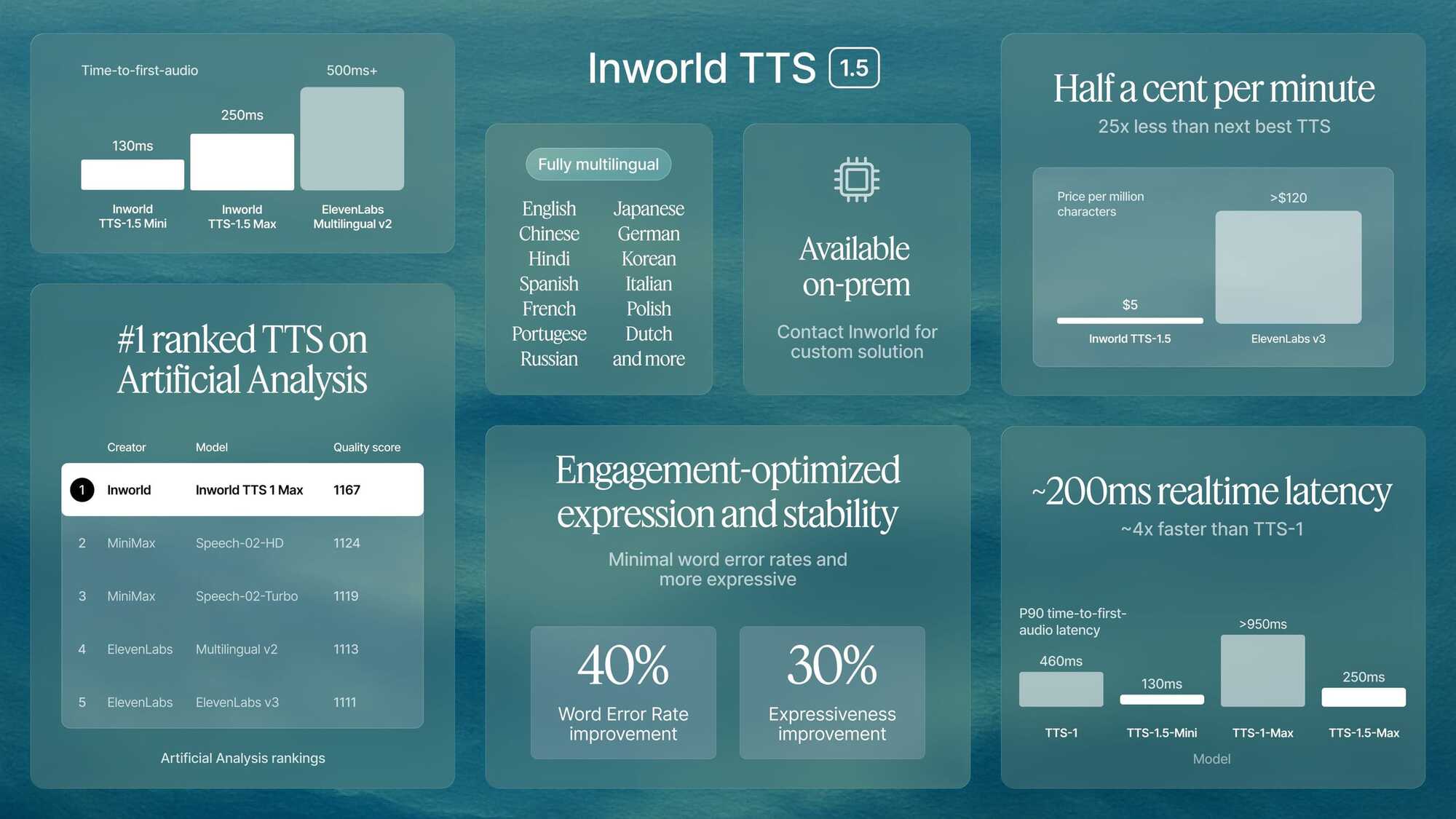
 has a speech generation playground and API for testing voices, creating clones and building applications. Its current models are Realtime TTS 2 and Flash, both offered for production use with more than 200 languages and locales. The larger model supports natural language steering, while Flash targets applications needing faster responses.
The on demand plan charges $25 per million characters for TTS 2 and $15 for Flash. It includes up to 70 minutes of TTS to start, commercial rights and voice cloning. Developers can choose streaming for live playback or generate complete audio responses. Older TTS 1 and TTS 1 Max models have been discontinued, with requests automatically routed to newer models.
 Microsoft Azure Speech
Microsoft operates Azure Speech in Foundry Tools, with speech generation through SDKs, REST APIs and command line tools. Standard neural voices are available in over 100 languages and locales. Teams can use those voices directly after creating an Azure subscription and Speech resource, or apply for custom voice access to create a brand voice.
For people producing narration without code, the Audio Content Creation tool in Speech Studio lets users enter and tune scripts. It supports adjustments to pronunciation, breaks, pitch, rate and intonation, with downloadable generated audio. The same workflow uses SSML to define how individual passages are spoken. The editor is free to access, with charges for the underlying Speech usage.
The free F0 tier includes 500,000 neural characters monthly. Paid synthesis uses character based billing, while professional custom voice has separate charges for training and hosting as well as synthesis. Custom voice is a limited access feature, and approval is required before using the professional fine tuning workflow. Standard catalog voices are available without that application.
 MiniMax
 sells speech synthesis through its developer platform. The current synchronous endpoint offers Speech 2.8 HD and Turbo, accepts voice and audio settings, and returns streamed or complete audio. Scripts must stay below 10,000 characters, with streaming recommended for text over 3,000 characters.
Speech 2.8 HD costs $100 per million characters, while Turbo costs $60. Longer narration can use an asynchronous endpoint that accepts up to one million characters. Voice design costs $3 per voice and rapid cloning $1.50 per voice, charged when each voice is first used for synthesis. Speech 2.8 also accepts inline pronunciation overrides, pause markers and tags for nonverbal sounds.
 Mistral Voxtral TTS
Mistral AI offers Voxtral TTS 3 for speech generated from complete scripts, plus a separate realtime model. The script workflow supports preset or cloned voices, inline emotion and pace tags, custom pronunciation and streamed audio responses. Output formats include MP3, WAV, PCM, FLAC and Opus, while general natural language style instructions are unavailable at launch.
The earlier March 2026 Voxtral TTS model is listed at $16 per million characters, and its downloadable weights carry a noncommercial Creative Commons license. Its original speech generation guide is now in the deprecated documentation. New integrations can use the current speech generation workflow.
 Murf AI
Murf has a browser voiceover studio for training, advertising, podcasts and audiobooks, plus APIs for developers. Its streaming API uses the Falcon family for conversational applications; the separate synthesis workflow returns complete audio files. Murf names Nestlé and Air France among the organizations using its tools through customer testimonials.
The API offers a free trial, usage billing and custom plans. The documented Gen2 synthesis plan costs $0.03 per 1,000 characters, with a $2 minimum purchase. Developers can set pronunciation, speed, pitch and output format, and request Base64 audio with zero retention. That option returns the audio directly rather than storing a generated file on Murf's servers.
business · voiceover · studio
 Narakeet
Video Puppet Limited operates Narakeet, which turns scripts into audio through web tools and an API with 900 voices in 100 languages. Buyers purchase one time capacity top ups, billed by generated duration. API access is included for eligible commercial accounts; free accounts cannot get keys.
 NaturalReader Commercial
 is a browser voice generator for creators, educators and businesses distributing narration. Its license covers public content and internal training or classroom materials. It uses Gemini, OpenAI, Azure and ElevenLabs voice models, with prompt and pronunciation controls.
Starter costs $29 per user monthly, or $198 per year, and includes 500,000 credits a month. Creator costs $49 monthly or $297 annually for two million monthly credits. Plans include up to four cloned voices and MP3 and WAV downloads. The commercial web app and personal reading apps have separate subscriptions; mobile use of the commercial product is through a browser.
 OpenAI Speech API
OpenAI's Speech API turns text into audio for narration and application playback, with file or streaming responses. Streaming begins playback before generation has finished, using chunked transfer so an application can start playing the initial audio while the rest arrives. Its speech models are deprecated and shut down January 6, 2027. OpenAI directs new integrations to gpt-realtime-2.1-mini through the Realtime API, which requires a different API workflow.
Until shutdown, gpt-4o-mini-tts accepts prompts for accent, emotional range, speed, tone and other delivery controls. The endpoint has built in voice choices and supports MP3, Opus, AAC, FLAC, WAV and raw PCM output. Its voices are optimized for English, with multilingual speech generation also supported. Output defaults to MP3 audio. The request limit is 4,096 input characters.
GPT 4o Mini TTS costs $0.60 per million text tokens plus $12 per million output audio tokens. Custom voices use an approved speaker's consent recording and a matching audio sample. OpenAI requires applications to disclose AI generated voices to end users.
 Respeecher
 Space provides a text to speech API with selectable voices and a playground where developers create API keys. It returns audio through a bytes endpoint, server sent events or a WebSocket stream. The company's standalone speech API is offered alongside its film, television and other voice production services.
film · speech-to-speech · media
 Rime
Rime sells speech generation for conversations, including voice agents, telephone systems and interactive applications. Its Coda catalog has 313 cloud voices across ten languages, with cloud and private deployments. Developers can control delivery, pacing, spelling and pronunciation, then stream or download audio.
The free plan supplies $50 of usage monthly. Flex has no monthly fee and charges $0.05 per minute for Coda v2 or $0.03 for Mist v3. Scale costs $100 a month, includes $100 in credit and discounts usage rates by 20%. Unused Scale credit rolls over to $200. For private infrastructure, Rime supports deployments using Docker Compose or Kubernetes.
 Sarvam AI
 offers Bulbul speech generation for applications using Indian languages. Bulbul v4 Flash is the current model, with browser voice previews and a developer API. Teams can generate short clips through REST or stream through HTTP and WebSockets. The standard REST path handles up to 2,500 characters.
Bulbul v4 Flash costs ₹1 per 1,000 characters on pay as you go across realtime, streaming and WebSocket access. Bulbul v3 remains available at ₹3 per 1,000 characters. New accounts receive free credits, and a shared balance covers the supported model APIs. Pro, Growth and Business plans have lower usage rates, while Enterprise offers custom throughput and limits.
 Smallest AI
 sells Lightning text to speech through its Waves API, with file generation and streaming speech access. Its pricing page lists Lightning v3.1 Pro at $0.175 per 10,000 characters, with more than 14 languages, 44.1 kHz output and cloning from a five second sample. Developers start with a console API key.
 Speechify Studio
 is a voiceover production subscription for creators making videos, podcasts, audiobooks and training materials. Users can change pauses, pitch, speed and pronunciation, and add their own music. Studio and Speechify's personal text reader have separate subscriptions.
Studio Starter costs $100 per year for 86,400 Studio credits, more than 1,000 voices and commercial rights. Creator costs $300 per year with 345,600 Studio credits. Voiceover generation consumes one credit per second; changing pitch, speed or emotional delivery uses more generation credits. Exporting unchanged content uses no extra credits. The free plan includes 600 credits, while downloads and commercial publishing require a paid plan.
consumer · reader · studio
 WellSaid
 is a script based voiceover studio for learning teams, marketers and product content creators. Its voice library starts with licensed recordings from voice actors. Users can organize scripts, select voices and work together in shared projects with comments. A shared pronunciation library covers product names, acronyms and other repeated terms in training.
Starter costs $19 a month when billed monthly. It includes unlimited generation, ten projects, all English voices and commercial rights, with a limit of 20 downloaded minutes per month. The allowance measures finished audio downloaded, and extra minutes are available. The free trial includes three download minutes per month without commercial rights.
Business adds team workspaces, commenting, extra export formats and up to five seats. For longer scripts, Studio can generate all sections together. Its Audition feature takes a description of the voice a user wants and returns ranked matches with previews using their script. Enterprise administrators can export usage data to CSV and view a year of history.
enterprise · ethical · e-learning