Chamelio Raises $26 Million for Legal AI Platform
Sep 25, 2026
Funding
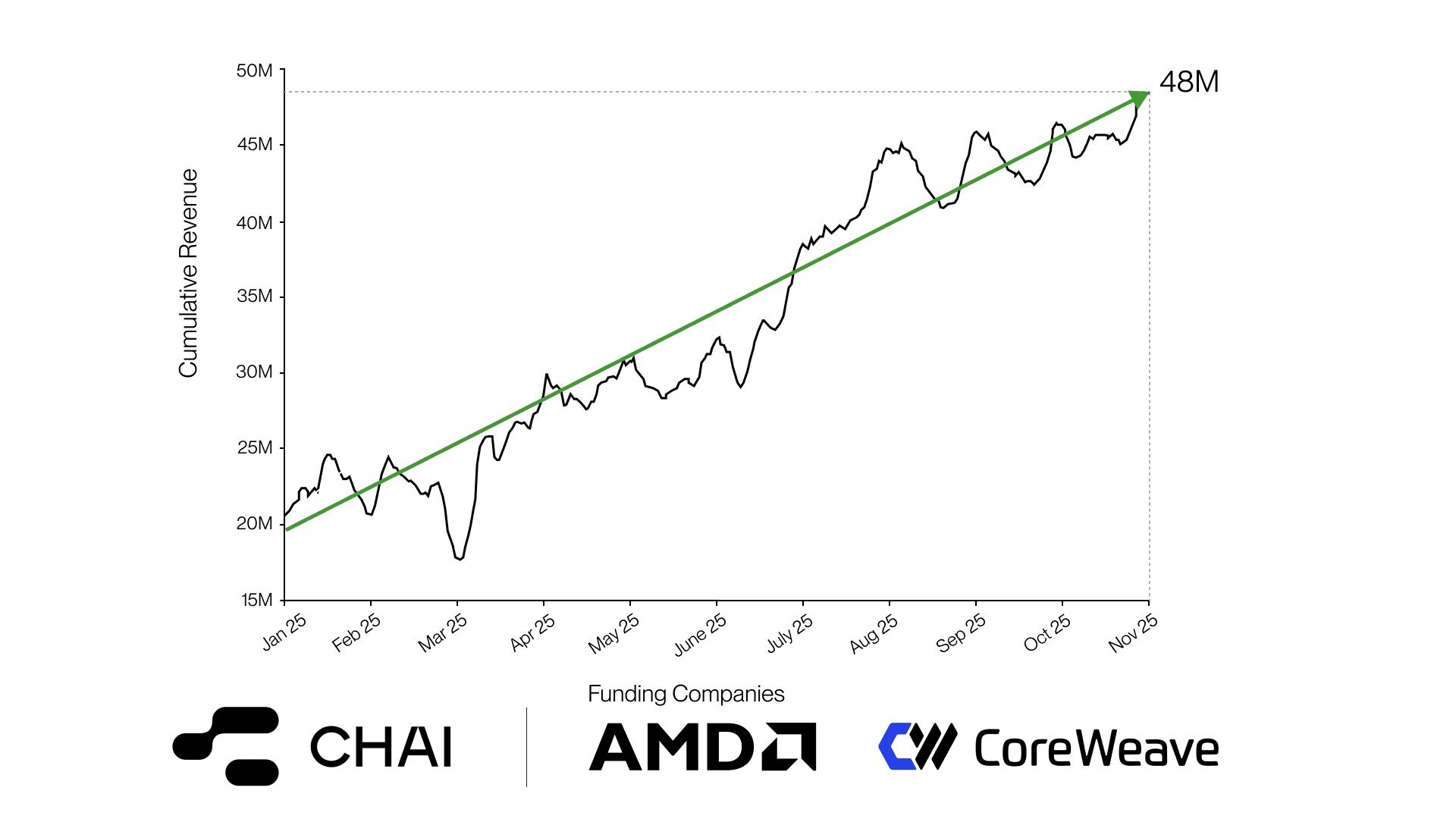
CHAI has surpassed its 2025 revenue target two months early, reaching $48 million by the end of October, announced in a press release. The company now projects over $50 million in annual recurring revenue by the end of the year, up from $20 million at the start of 2025.
The Palo Alto-based social AI platform attributes its growth to a focused user acquisition strategy, AI research partnerships, and product innovation. CHAI redirected capital toward attracting highly engaged users, reducing its customer acquisition payback period to under one year.
To strengthen its AI capabilities, CHAI partnered with Advanced Micro Devices, Inc. (AMD) and CoreWeave, securing both compute and financial resources. These collaborations have accelerated the development of CHAI’s social language models.
Founded by William Beauchamp in 2020, CHAI allows users to create and interact with their own AI chatbots. The company has grown rapidly since its launch, with a strong following among younger users and continued focus on mobile app engagement.
Consider subscribing to one of our newsletters like Enterprise AI Brief, AI Funding Brief or Daily AI Brief.
Also, consider following us on social media:


 Tensordyne
This Tensordyne whitepaper presents Napier, an inference-focused AI processor and rack-scale system based on the company’s TDN Math logarithmic number system. It examines infrastructure requirements for large mixture-of-experts and agentic models, compares major inference architecture approaches, and details the TDN AIP processor, TDN72 pod, TDN Link fabric, and Napier Ultra configuration. The paper reports simulation-based performance, cost, and accuracy-validation results, including Tensordyne’s projected comparison of one Napier rack with a nine-rack Nvidia Rubin plus Groq deployment; the chip is reported as taped out and in fabrication.
Read moreDaily AI Brief: the AI news that matters, in your inbox.