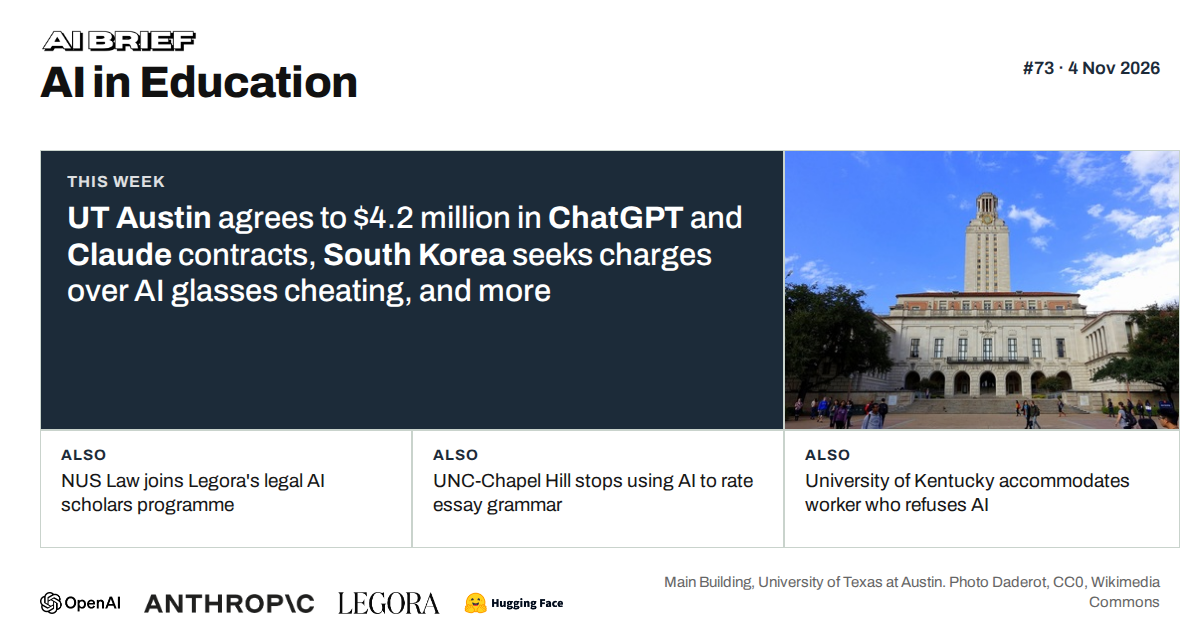
UT Austin agrees to $4.2 million in ChatGPT and Claude contracts, South Korea seeks charges over AI glasses cheating, and more - AI in Education #73
In this edition, covering 28 October to 3 November:
- The University of Texas at Austin agreed to spend about $4.2 million on two year ChatGPT Edu and Claude Edu contracts for students and employees.
- South Korea's Education Ministry plans to seek criminal investigations and trials for students who use AI powered glasses to cheat on the College Scholastic Ability Test.
- A broad majority in the Dutch lower house supports a motion to ban primary school pupils from using generative AI.
This spot is open for 2027. One company puts its name on every AI in Education, which has 1,300+ subscribers. See what's included
Universities

The University of Texas at Austin agreed to spend about $4.2 million on two year ChatGPT Edu and Claude Edu contracts, giving students and employees campus access to both services. The OpenAI contract costs about $1.1 million a year. The Anthropic agreement includes a $2 million commitment and a separate $73,000 premium services contract. The National University of Singapore Faculty of Law joined Legora's academic programme, which gives faculty and students access to the legal AI platform, training and course support. NUS Law will introduce it after students learn core legal skills. UT Austin · NUS Law and Legora
UNC-Chapel Hill stopped using Slate's Reader AI tool to score grammar and writing quality in application essays, after growing student use of AI made the ratings less useful. Admissions officials will focus on the substance, perspectives and experiences applicants share. The University of Kentucky granted administrator David Durman, a nontheistic Humanist, an accommodation that lets him avoid using AI at work. The university said it reviews such requests individually and may reassess them as job duties and technology change. UNC-Chapel Hill · University of Kentucky
Stanford will give departments grants of up to $750,000 from winter 2027 to redesign undergraduate majors for AI. Stanford
Exams and integrity
South Korea's Education Ministry plans to seek criminal investigations and trials for students who use AI powered glasses to cheat on the College Scholastic Ability Test. It also plans to extend retest bans from one year to up to three years, place specialists at all 1,312 testing sites and assess radio frequency detectors for future exams. Türkiye's Ministry of National Education plans to use AI to score open ended answers from middle and high school students in Turkish, mathematics and science. South Korea · Türkiye
Dartmouth Provost Santiago Schnell resigned and left the university after a faculty committee found he used AI in academic and public writing without the required disclosures. The committee said he violated publication policies, was not fully forthcoming about his AI use and fell short of Dartmouth's ethics standards. Matthew Delmont will serve as interim provost through June 2028. Dartmouth
Rules for schools
A broad majority in the Dutch lower house supports a Volt and CDA motion to ban primary school pupils from using generative AI. Schools could still teach children about AI and its risks. The PO-Raad supports clearer rules but said it was surprised by a complete ban and noted that AI can also have educational uses. Hong Kong will gradually introduce a weekly information and innovation technology subject in primary schools from September 2028, covering digital literacy, coding, robotics, AI concepts and prompt writing, with full implementation planned for the 2030 to 2031 school year. Netherlands · Hong Kong
SETDA's 2026 State EdTech Trends Report finds that 79% of US state education leaders rank AI as a top technology priority, and 23% of states now require AI guidance under state law. Ministers of the East African Community approved regional strategies for AI and digital transformation, plans for foundational AI training in undergraduate programmes and a Regional Artificial Intelligence Network of Universities, with measures that include teacher training and Kiswahili certification. SETDA report · East African Community
Teens and chatbots
Two US surveys found wide chatbot use among children and teenagers. Common Sense Media reported that nearly half of 9 to 12 year olds and nearly three quarters of 13 year olds had used chatbots. A JED Foundation survey of 5,500 students aged 9 to 17 found that 90% had used one, often for schoolwork, companionship or emotional support. Emotional use was associated with poorer mental health and a greater history of suicidal thoughts or attempts, although the findings do not establish causation. OpenAI will limit weapons related information for users under 18, restrict detailed reconstructions of past mass attacks for all users and allow ChatGPT to end chats that show signs of fixation on violence. It will publish a community safety report every six months, the first in early 2027, and said it made more than 200 law enforcement referrals in the third quarter of 2026. Surveys · OpenAI
Research and learning products
The George Washington University is a founding partner in Hugging Face's Project ProtoStar, which works with research institutions to make publicly funded datasets, models and code easier for people and AI systems to find, understand and reuse. GW's Open Source Program Office will help researchers share work through Hugging Face and bring the project's open science challenges to students and instructors. Digital Science acquired Jenni AI, an academic writing platform used by more than 8 million students and researchers in 189 countries. Jenni AI will remain a standalone product and gain access to Digital Science's Dimensions database of 171 million publications to help users verify research citations. Project ProtoStar · Digital Science and Jenni AI
McGraw Hill will let higher education and school district customers with Microsoft 365 Copilot licenses use its course content through a plugin built on the Model Context Protocol, so educators and students can create study aids, lesson plans and other course resources. A limited beta begins in early 2027. McGraw Hill
We hope you enjoyed this article
Consider subscribing to one of our newsletters like AI in Education or Daily AI Brief.
Also, consider following us on social media:
More from AI in Education
Nov 5 Mindmax raises £2.5 million for AI exam tutor Nov 4 Google Reverses Plan to Link School Search Access to AI Nov 2 Enrollify launches AI training hub for higher education staff Nov 2 NUS Law joins Legora legal AI scholars program Nov 1 East African Community adopts regional AI strategy and university training planAI in Education
Weekly newsletter about AI in education. Covers AI-driven software for educators, schools, general innovations and regulatory updates.