Google Introduces Gemini 3.8 Flash and Flash Cyber
Sep 03, 2026
Cybersecurity
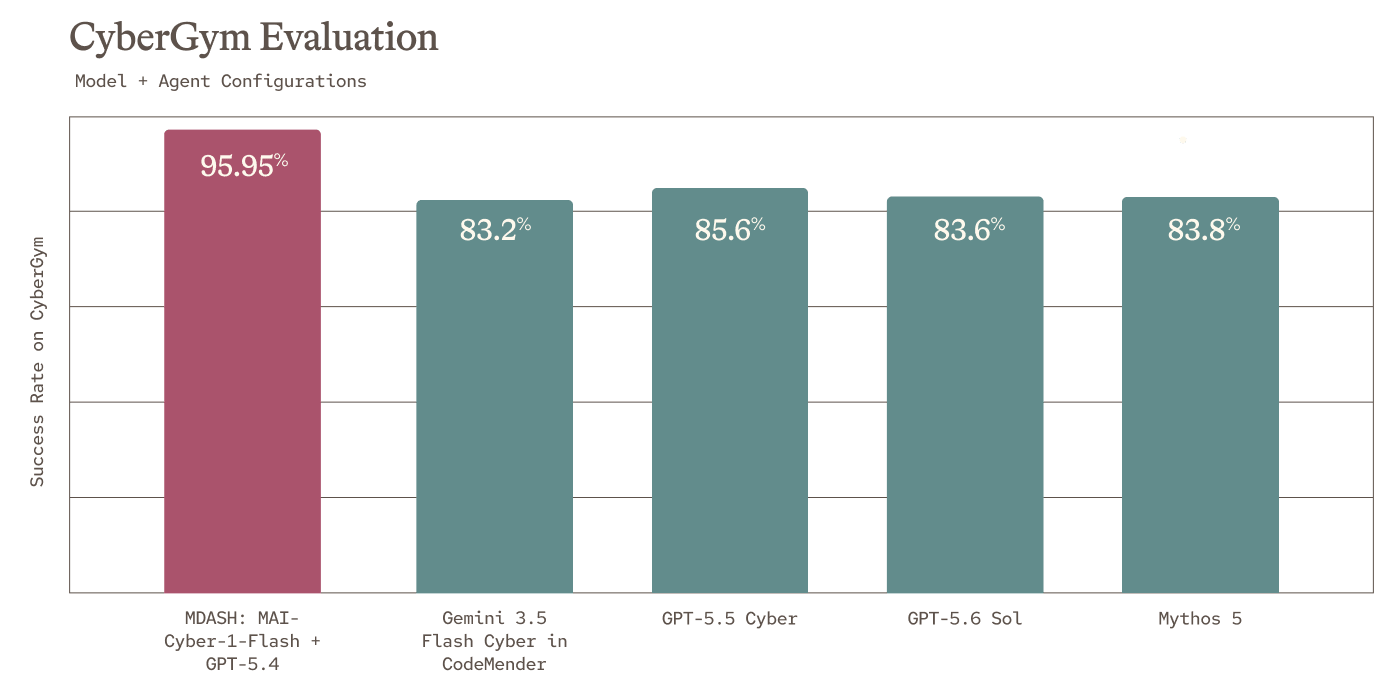
Microsoft announced in a company post MAI-Cyber-1-Flash, its first cyber model, and Perception, a new agent system for security workflows. MAI-Cyber-1-Flash is built to find vulnerabilities in complex codebases and is integrated into MDASH, Microsoft’s harness for vulnerability identification and remediation.
Microsoft said MDASH uses MAI-Cyber-1-Flash for up to 90% of tasks and uses GPT-5.4 for the hardest remaining tasks. The company said the combined system scored 96% on CyberGym, 12 points above Mythos, and cuts costs by 50% compared with its current MDASH setup using GPT 5.4, 5.4 mini, and 5.3 codex.
Perception provides teams of agents for security workflows in MDASH. Microsoft said the system can monitor, patch, and close new threat vectors, and will also use MAI-Cyber-1-Flash for more security workflows beyond software vulnerability work.
The tools are scheduled to be available in preview on November 3.
Consider subscribing to one of our newsletters like Cybersecurity AI Weekly or Daily AI Brief.
Also, consider following us on social media:
Weekly news about AI tools for software engineers, AI enabled IDE's and much more.


 Tensordyne
This Tensordyne whitepaper presents Napier, an inference-focused AI processor and rack-scale system based on the company’s TDN Math logarithmic number system. It examines infrastructure requirements for large mixture-of-experts and agentic models, compares major inference architecture approaches, and details the TDN AIP processor, TDN72 pod, TDN Link fabric, and Napier Ultra configuration. The paper reports simulation-based performance, cost, and accuracy-validation results, including Tensordyne’s projected comparison of one Napier rack with a nine-rack Nvidia Rubin plus Groq deployment; the chip is reported as taped out and in fabrication.
Read moreDaily AI Brief: the AI news that matters, in your inbox.