California Resources and Bloom Energy Evaluate 1 GW of Fuel Cell Projects
Nov 03, 2026
Data Centers
NTT DATA and Bloom Energy announced in a press release an agreement to deploy 900 MW of onsite fuel cell power across multiple data center projects worldwide. Initial shipments will begin in 2027, and NTT DATA will use the systems as primary power for data centers serving AI infrastructure.
The modular fuel cell systems generate electricity without combustion and can be expanded in phases as data center capacity grows. Bloom Energy says the systems produce low local air emissions, use minimal water and operate quietly.
The companies describe the agreement as Bloom Energy's largest international project to date. The announcement did not name project locations, disclose the agreement's value or give a schedule for the full 900 MW, Converge Digest noted.
NTT DATA operates more than 150 data centers in more than 20 countries and regions, DCD reported. Bloom has also agreed to supply Oracle with up to 2.8GW of capacity and American Electric Power with up to 1GW of fuel cells to power AI data centers.
Consider subscribing to one of our newsletters like Silicon Brief or Daily AI Brief.
Also, consider following us on social media:
Weekly coverage of AI hardware developments including chips, GPUs, cloud platforms, and data center technology.

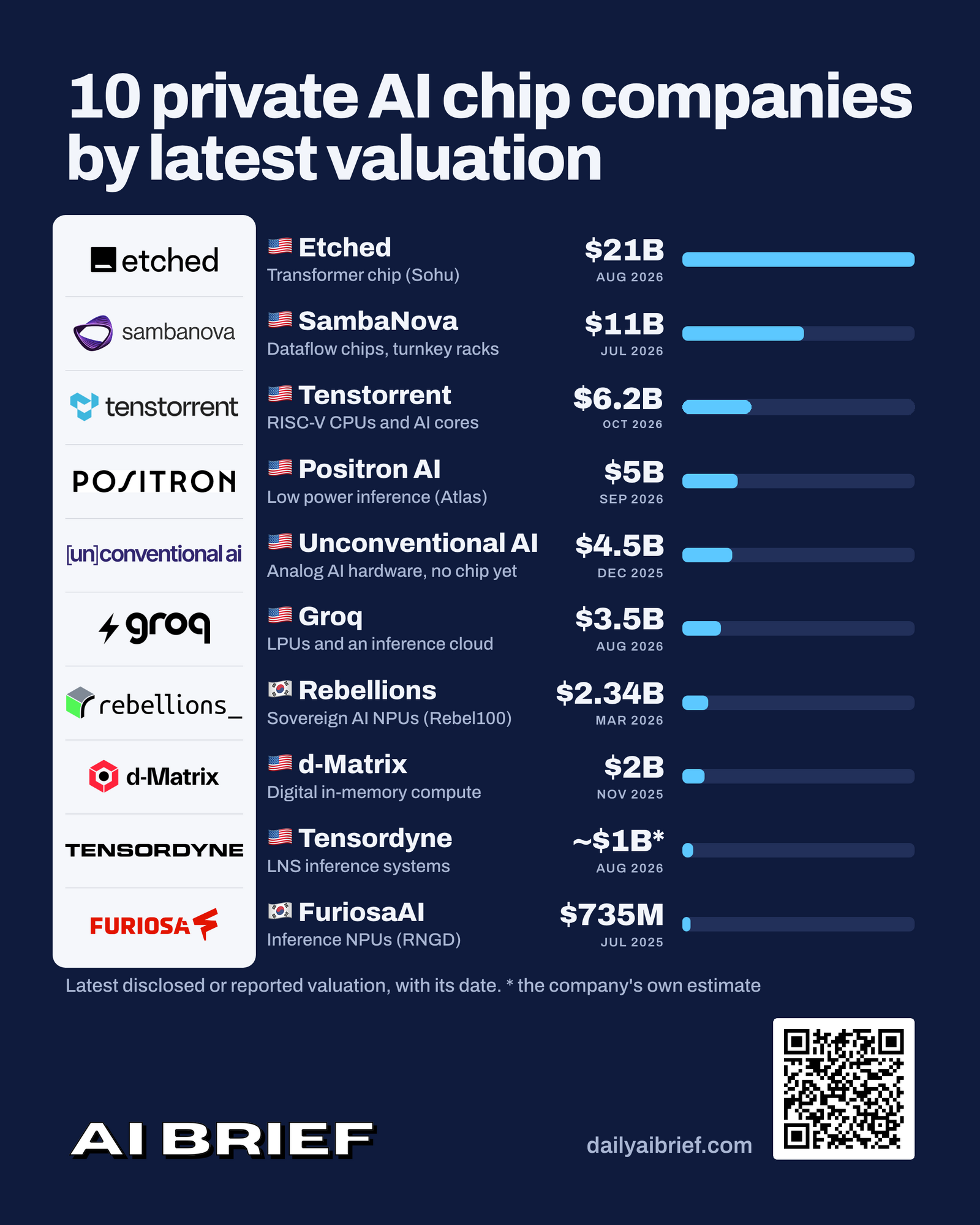
 Tensordyne
This Tensordyne whitepaper presents Napier, an inference-focused AI processor and rack-scale system based on the company’s TDN Math logarithmic number system. It examines infrastructure requirements for large mixture-of-experts and agentic models, compares major inference architecture approaches, and details the TDN AIP processor, TDN72 pod, TDN Link fabric, and Napier Ultra configuration. The paper reports simulation-based performance, cost, and accuracy-validation results, including Tensordyne’s projected comparison of one Napier rack with a nine-rack Nvidia Rubin plus Groq deployment; the chip is reported as taped out and in fabrication.
Read moreDaily AI Brief: the AI news that matters, in your inbox.