Specialty1 Partners Invests in AI for Dental Practice Operations
Oct 16, 2026
Healthcare
World Class Health announced in a press release that The AI Specialty Clinic, an AI native specialty care platform for large self insured employers and third party administrators, is scheduled to go live in January 2027.
The platform uses eligibility, claims, and clinical signals to identify members who may need specialty care 60 to 90 days before a claim appears. A licensed Nurse Navigator contacts the member to discuss the condition, possible procedures, second opinions, provider options, and conservative care where appropriate.
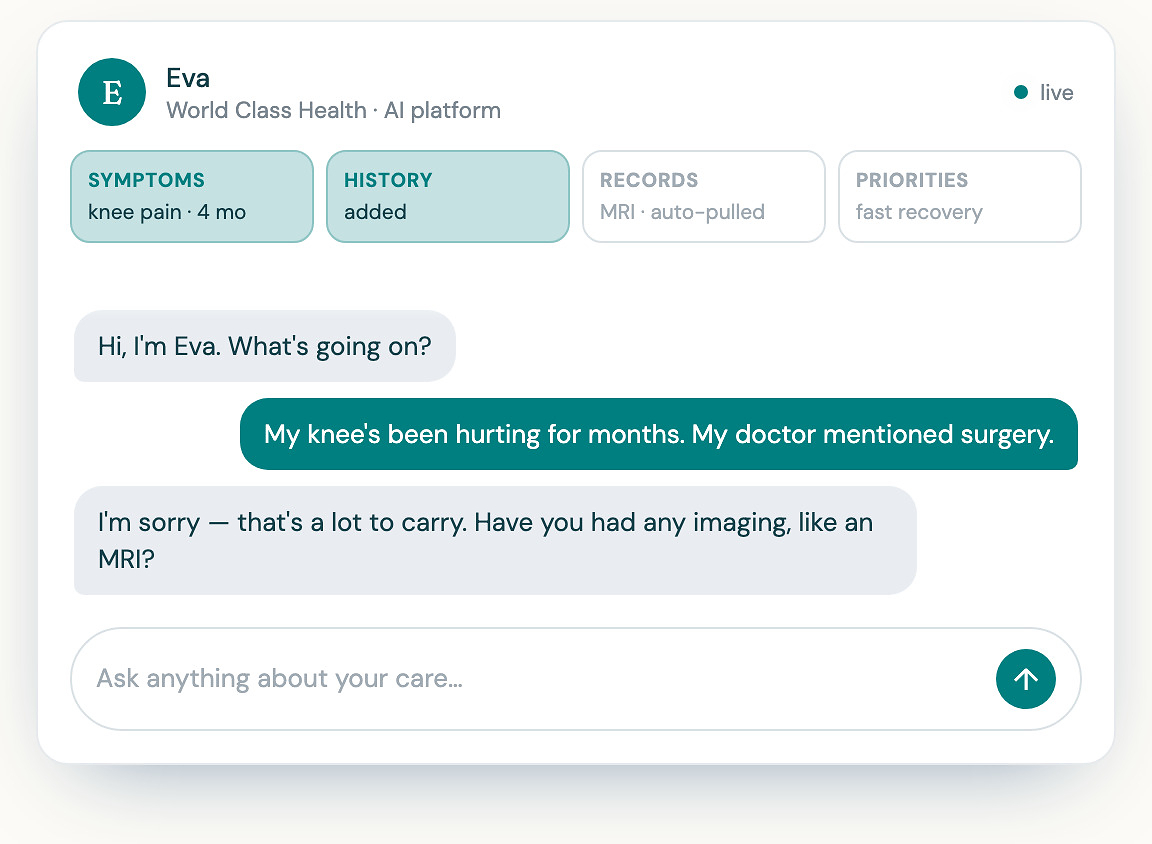
The service includes Eva, an AI member interface that answers questions about diagnoses and procedures at any hour. Eva shows provider information, quality scores, outcomes, and procedure costs before a member chooses care. When a question needs clinical judgment, a licensed Nurse Navigator takes over. Eva does not diagnose conditions or tell members what care to receive.
The AI Specialty Clinic covers orthopedics, spine, cardiac, bariatric surgery, general surgery, gynecologic surgery, imaging, and infusions. World Class Health said it is paid based on verified savings and discloses provider charges along with the benchmark used to calculate savings.
Consider subscribing to one of our newsletters like Finance AI Weekly, Life AI Weekly or Daily AI Brief.
Also, consider following us on social media:
Weekly coverage of AI applications in healthcare, drug development, biotechnology research, and genomics breakthroughs.


 Tensordyne
This Tensordyne whitepaper presents Napier, an inference-focused AI processor and rack-scale system based on the company’s TDN Math logarithmic number system. It examines infrastructure requirements for large mixture-of-experts and agentic models, compares major inference architecture approaches, and details the TDN AIP processor, TDN72 pod, TDN Link fabric, and Napier Ultra configuration. The paper reports simulation-based performance, cost, and accuracy-validation results, including Tensordyne’s projected comparison of one Napier rack with a nine-rack Nvidia Rubin plus Groq deployment; the chip is reported as taped out and in fabrication.
Read moreDaily AI Brief: the AI news that matters, in your inbox.