Noma Security Named Market Shaper in Gartner AI Security Quadrant
Sep 23, 2026
Cybersecurity
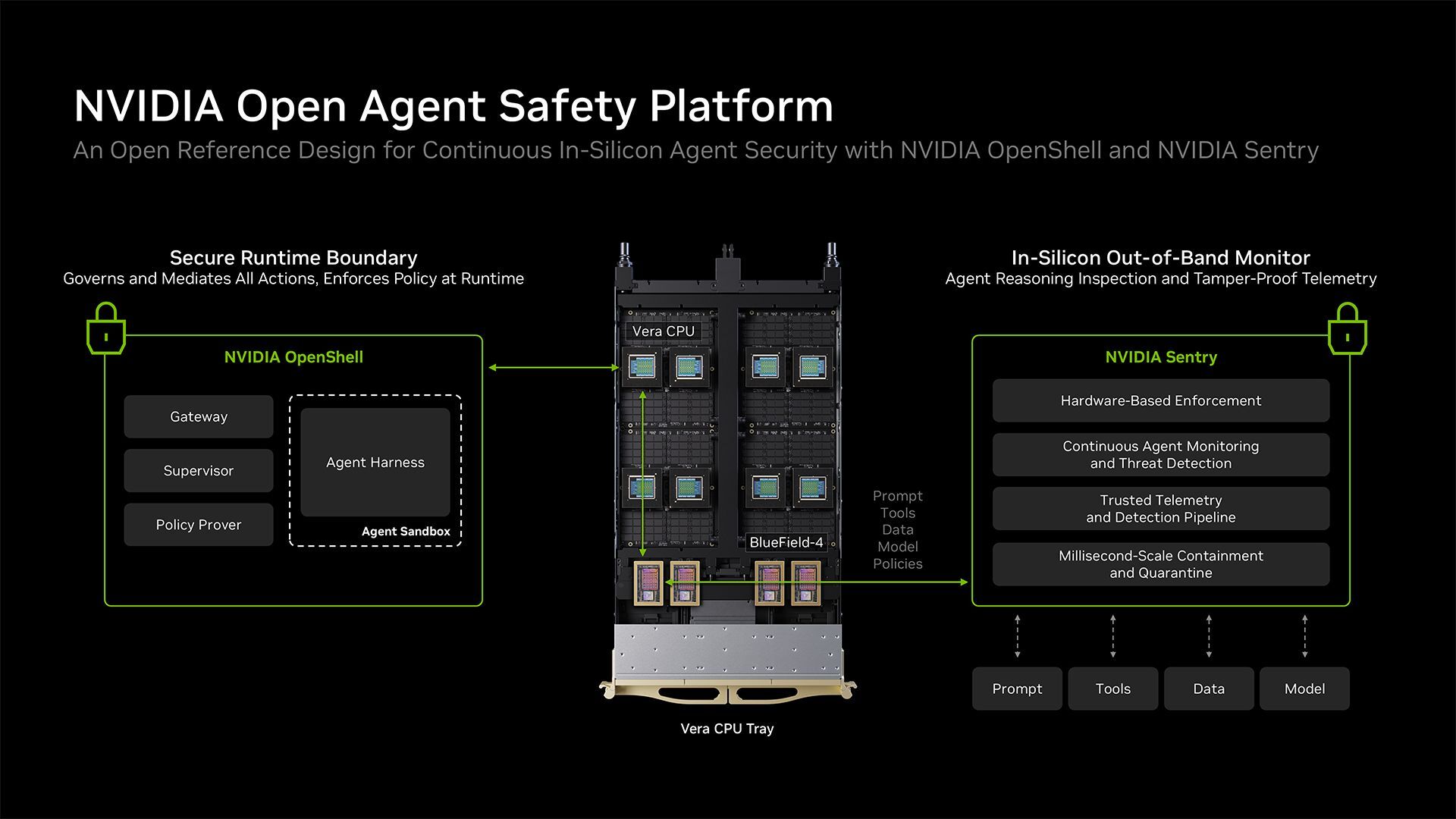
NVIDIA introduces the Open Agent Safety Platform, a reference design for monitoring and controlling AI agents, as detailed in a company blog post. The platform combines OpenShell on NVIDIA Vera CPUs with NVIDIA Sentry on BlueField-4 data processing units.
OpenShell is an open source runtime that places agents in isolated sandboxes. Operators can define which files, networks, tools, processes, and credentials an agent may access, then verify and enforce those limits while the agent runs.
NVIDIA Sentry adds an independent monitoring and enforcement layer using BlueField hardware and NVIDIA DOCA. In Vera Rubin POD systems, BlueField-4 sits on the node's path to the model, where it can record agent activity and enforce policies in real time without giving the agent access to those controls. The platform also supports other hardware systems.
Consider subscribing to one of our newsletters like Cybersecurity AI Weekly, AI Policy Brief or Daily AI Brief.
Also, consider following us on social media:
Weekly newsletter about AI in Cybersecurity.


 Tensordyne
This Tensordyne whitepaper presents Napier, an inference-focused AI processor and rack-scale system based on the company’s TDN Math logarithmic number system. It examines infrastructure requirements for large mixture-of-experts and agentic models, compares major inference architecture approaches, and details the TDN AIP processor, TDN72 pod, TDN Link fabric, and Napier Ultra configuration. The paper reports simulation-based performance, cost, and accuracy-validation results, including Tensordyne’s projected comparison of one Napier rack with a nine-rack Nvidia Rubin plus Groq deployment; the chip is reported as taped out and in fabrication.
Read moreDaily AI Brief: the AI news that matters, in your inbox.