OpenAI Finds GPT-6 Astra Underperforms on Safety Research
Nov 05, 2026
AI Safety
OpenAI has published research on how it used automated red teaming to make GPT-6 Astra and Sol more resistant to jailbreaks in cybersecurity, biology and violent activity. The post on OpenAI's alignment blog calls the goal "fuzzy robustness": how reliably a model withholds disallowed help when someone pushes it with adversarial prompts.
In the setup, an attacker model gets a harmful seed request and keeps rewriting it until the defender model gives an unsafe answer. OpenAI used a helpful-only reasoning model from the GPT-5.6 Sol family as the attacker and GPT-5.4 and GPT-5.5 as defenders. The researchers write that the attacker had no specific training on jailbreaking other models. They then ran reinforcement learning on the rewritten, harder prompts.
OpenAI reports that on a fixed set of earlier jailbreaks in the cyber domain, GPT-6 Astra answered 91.5% safely, compared with 59% for GPT-5.6 Sol. It also says Astra stayed more robust against attackers that adapt over several turns, at every attacker budget it tested, and did not refuse more harmless requests.
All results measure the model alone, without OpenAI's production safeguards. OpenAI gives high-risk capabilities to vetted users through access programs such as Daybreak for cybersecurity and Rosalind for biology. Full results are in the GPT-6 Astra system card.
Consider subscribing to one of our newsletters like Cybersecurity AI Weekly, AI Policy Brief or Daily AI Brief.
Also, consider following us on social media:
Weekly newsletter about AI in Cybersecurity.

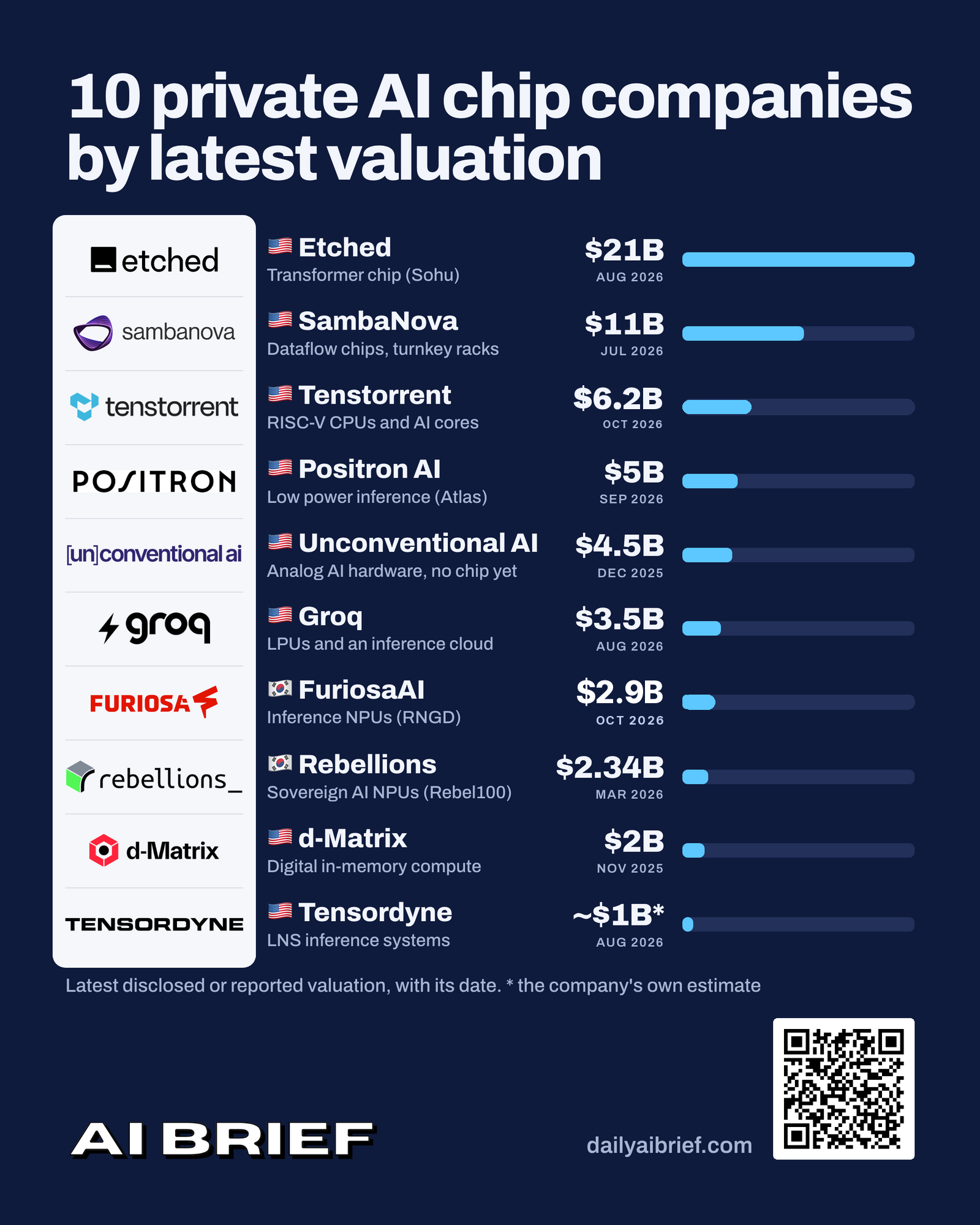
 Tensordyne
This Tensordyne whitepaper presents Napier, an inference-focused AI processor and rack-scale system based on the company’s TDN Math logarithmic number system. It examines infrastructure requirements for large mixture-of-experts and agentic models, compares major inference architecture approaches, and details the TDN AIP processor, TDN72 pod, TDN Link fabric, and Napier Ultra configuration. The paper reports simulation-based performance, cost, and accuracy-validation results, including Tensordyne’s projected comparison of one Napier rack with a nine-rack Nvidia Rubin plus Groq deployment; the chip is reported as taped out and in fabrication.
Read moreDaily AI Brief: the AI news that matters, in your inbox.