Daimon Robotics Demonstrates Tactile AI Stack at IROS 2026
Sep 30, 2026
Robotics
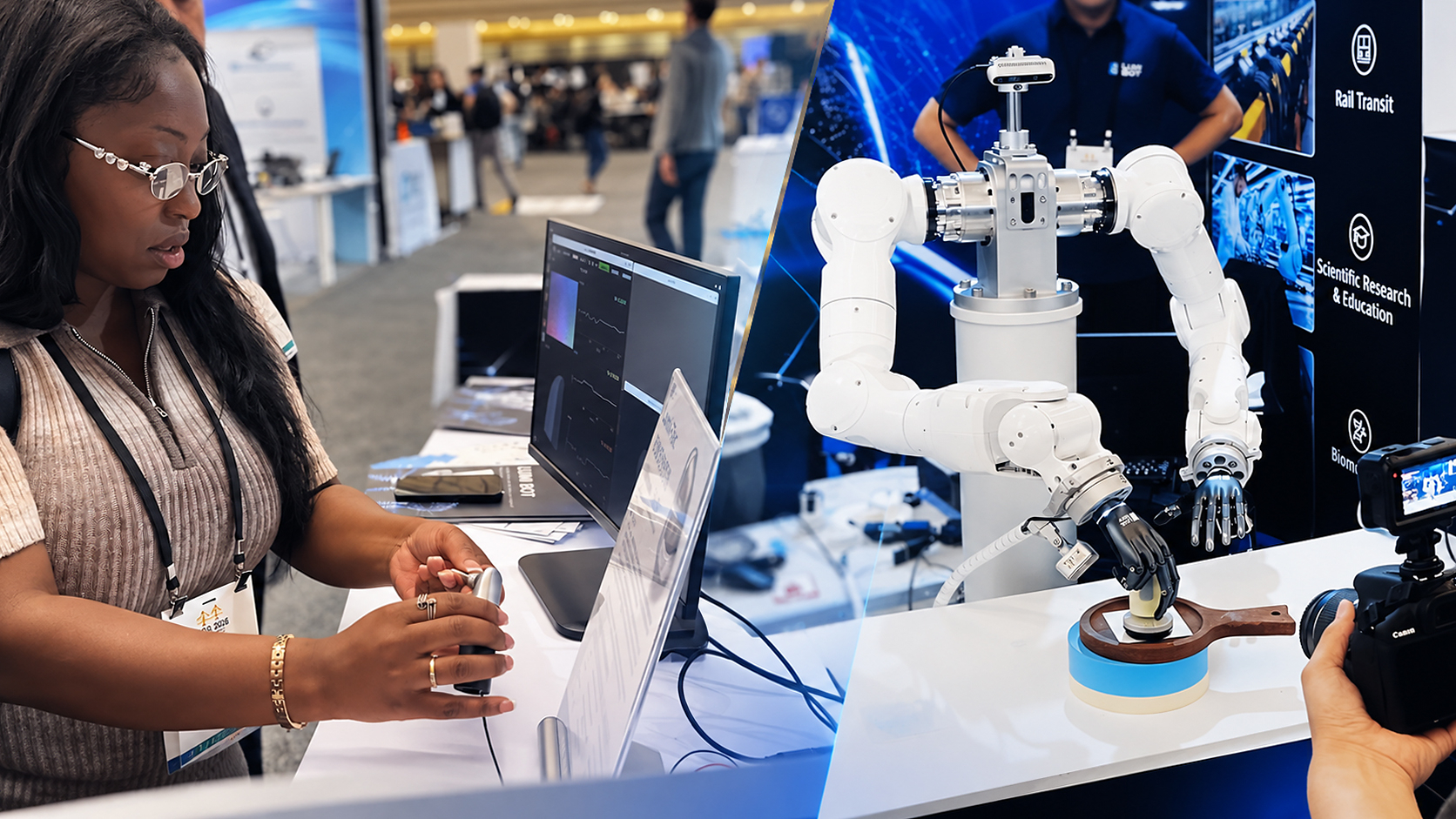
LumiBot showcased its Lumi-Dex robotic hands, Lumi-Tac tactile sensor and Lumi-Mind manipulation model at IROS 2026, the company said in a press release. The Lumi-Dex-21 hand combines linkage and direct drive mechanisms, while the Lumi-Tac V2 sensor offers 10 micron spatial resolution, 0.02 N force detection accuracy and a frame rate of 120 frames per second.
LumiBot demonstrated a Lumi-Dex-11 hand using the Lumi-Mind model to complete a sequence involving a stamp, tray and card. The model adjusted its plan when people interfered with the task. Lumi-Mind combines vision, touch, language and action inputs through a Mixture of Transforms architecture.
The company also presented a data pipeline that combines egocentric video, robot teleoperation and automated data cleaning. LumiBot is testing its hardware and systems for automotive manufacturing, electronics and life sciences applications.
Consider subscribing to one of our newsletters like Robotics Brief or Daily AI Brief.
Also, consider following us on social media:
Weekly coverage of AI-driven robotics advances in industrial automation, autonomous vehicles, and robotic systems.


 Tensordyne
This Tensordyne whitepaper presents Napier, an inference-focused AI processor and rack-scale system based on the company’s TDN Math logarithmic number system. It examines infrastructure requirements for large mixture-of-experts and agentic models, compares major inference architecture approaches, and details the TDN AIP processor, TDN72 pod, TDN Link fabric, and Napier Ultra configuration. The paper reports simulation-based performance, cost, and accuracy-validation results, including Tensordyne’s projected comparison of one Napier rack with a nine-rack Nvidia Rubin plus Groq deployment; the chip is reported as taped out and in fabrication.
Read moreDaily AI Brief: the AI news that matters, in your inbox.