Goodfire Launches Internal AI Agent Monitors on Baseten
Oct 09, 2026
Cybersecurity
Goodfire AI introduced mechanistic shaping, a training framework that uses a model's internal representations to control which concepts it relies on and expresses, according to a company research post. The framework adds penalties to the training objective for relying on or expressing selected concepts.
Goodfire tested the method on a vision model trained to identify collapsed lungs in chest X-ray images. The training data linked collapsed lungs with visible chest drains, which could cause the model to use the drain rather than features of the lung. Researchers used a sparse autoencoder and a language model agent to find internal features associated with drains, then penalized the model for relying on them.
The researchers report that this reliance shaping method outperformed standard training and several earlier methods. It also exceeded the accuracy of a model trained on balanced data in the experiment.
Goodfire separately used mechanistic shaping to limit sycophancy and reward hacking in language models while retaining capability gains from training. The researchers found that targeted concepts remained detectable after shaping across their experiments, although monitoring sometimes required a newly trained probe.
Consider subscribing to one of our newsletters like AI Policy Brief or Daily AI Brief.
Also, consider following us on social media:
Weekly report on AI regulations, safety standards, government policies, and compliance requirements worldwide.
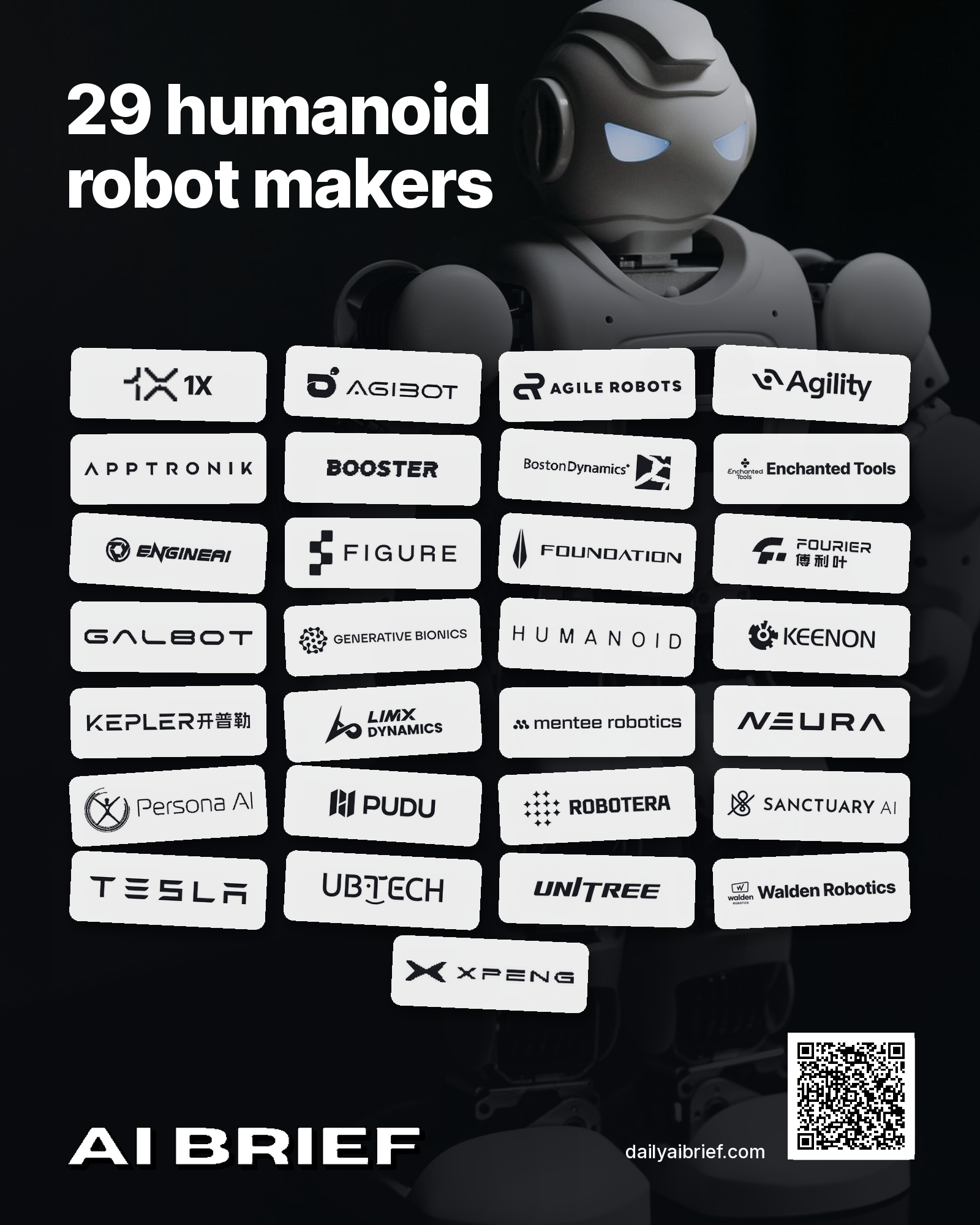
Companies building humanoid robots, from startups to Tesla and Boston Dynamics

 Tensordyne
This Tensordyne whitepaper presents Napier, an inference-focused AI processor and rack-scale system based on the company’s TDN Math logarithmic number system. It examines infrastructure requirements for large mixture-of-experts and agentic models, compares major inference architecture approaches, and details the TDN AIP processor, TDN72 pod, TDN Link fabric, and Napier Ultra configuration. The paper reports simulation-based performance, cost, and accuracy-validation results, including Tensordyne’s projected comparison of one Napier rack with a nine-rack Nvidia Rubin plus Groq deployment; the chip is reported as taped out and in fabrication.
Read moreDaily AI Brief: the AI news that matters, in your inbox.