Replit makes OpenAI default for its agent, OpenCode maker reports API key breach, and more - AI Programming Weekly #73
Over the past two years AI Brief has grown into a website, 19 LinkedIn pages with more than 81,000 followers and 15 newsletters with more than 41,000 subscribers, AI Programming Weekly among them. Thank you for reading, following and passing it on.
Until now, our newsletters were assembled automatically: the news assigned to each newsletter went into a simple template. From this edition, our small team, Maiko, Rene and Stefan, edits every edition so it reads as one storyline: related news together, the important stories explained, the rest kept short. We still use AI tooling throughout, and we decide what goes in and how it is told.
In this edition, covering 13 to 19 October:
- Replit made OpenAI the default model provider for Replit Agent; customers can still use Anthropic's Claude models.
- Anomaly Innovations, the company behind OpenCode, says a breach of a legacy console may have exposed provider API keys for about 1.4% of users.
- DeepSeek released V4.1 Flash 1017 with better coding and agent performance, and off peak API output pricing from $0.60 per 1 million tokens.
Replit, OpenAI and coding models
Replit CEO Amjad Masad said OpenAI is now the preferred partner and default model provider for Replit Agent, citing performance, cost and partnership terms. Customers can still use Anthropic's Claude models. Masad said Replit no longer works with Anthropic, but an unnamed source disputed that the partnership had ended. Replit
DeepSeek launched V4.1 Flash 1017 on its website, app and API. The company says the update of V4.1 Flash completes tasks faster, gives shorter outputs and improves coding, reasoning and agent performance. It is also on Hugging Face and ModelScope, and off peak API output pricing starts at $0.60 per 1 million tokens. DeepSeek
Mindbeam post-trained NVIDIA's 120B-A12B Nemotron 3.5 Super VL for CUDA generation. It says its Litespark Nemotron 3.5 Super VL scored 83.9% on KernelBench Level 1 and 82.1% on Level 2, up from 72.7% and 22.8% before adaptation. Mindbeam also added the model to its Litespark Inference Engine, which it says delivered 962 tokens per second per user on two NVIDIA H200 GPUs in a warm start benchmark. Mindbeam
Agents in the developer workflow
At its first Config event in India, Figma introduced Specs, a Markdown editor for documenting design systems that gives teams and AI agents access to design and code libraries, guidelines and other references. Figma also moved code layers to public beta, expanded MCP support to more than 20 tools and integrated Payload CMS, which it acquired, with Figma Make for dynamic websites. Figma
BAND launched BAND for Developers, with a desktop app that gives engineering teams visibility and control over coding agents across tools, machines and environments. Agents can communicate, delegate work, share context and hand off tasks. Factory made its autonomous software agents, called Droids, available through Databricks Marketplace, where enterprises can use their governed Databricks data and models to build applications, modernize legacy data platforms and address security issues. BAND · Factory
Google Play now lets people in the United States aged 18 or older build apps with Google AI Studio and run them privately on their Android devices. The apps do not appear in search or listings and cannot be shared at first. Google plans to add sharing with trusted groups and a path to public release after safety reviews. Google Play
JetBrains surveys show the share of developers ready to let AI write application logic rose from 18% in April to June 2025 to 50% in May to July 2026. More are also willing to hand over testing and refactoring, while most still want to keep control of debugging and code review. Respondents increasingly expect employers to require AI tool skills, and more worry that AI could reduce demand for developers. CodeTogether, which measures AI code usage, delivery value, team health, costs and delivery risk, now sells its platform as a SaaS subscription after offering it on premises to larger enterprises. JetBrains · CodeTogether
Security
Anomaly Innovations, the company behind OpenCode, says unauthorized access to a legacy console system may have exposed stored provider API keys for about 1.4% of users. It advised affected developers to revoke and replace their keys and says it is investigating with OpenAI, Anthropic and Google. OpenCode
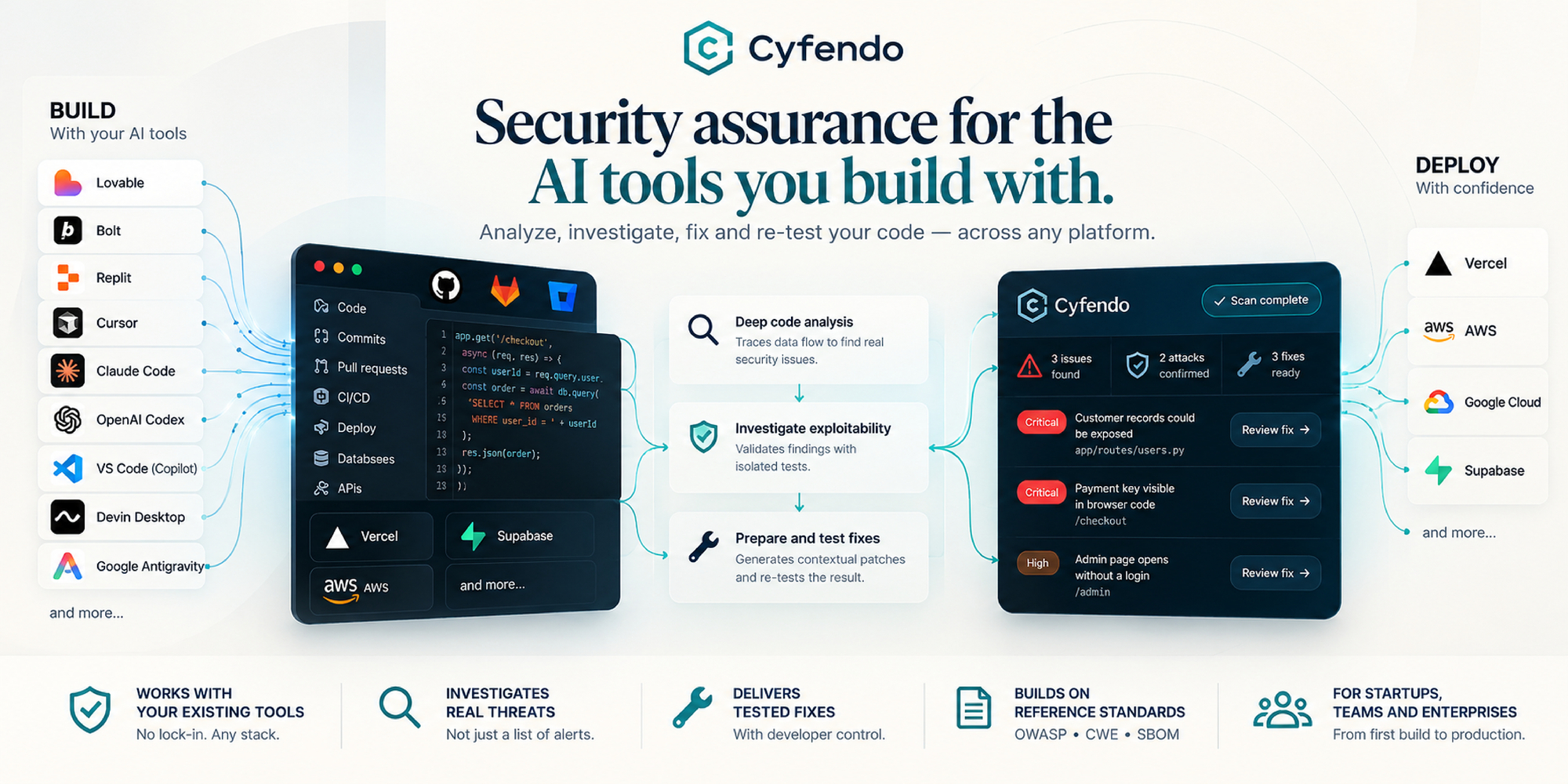
Cyfendo, a Silicon Valley startup founded by former Google and Meta engineering leader Bryan Vuong, launched an application security platform that analyzes source code, investigates exploitable vulnerabilities, prepares proposed patches and retests supported findings. Cyfendo
Claude Code warned a developer who was building a temperature monitor app that an XMRig crypto miner the developer had not installed was running on their Mac, using about 1175% CPU, roughly 12 cores, and overheating the machine. Claude Code
Controls for AI agents
SandboxAQ introduced Switch Trust and Switch ROI, which help enterprises discover, test and monitor AI agents and track costs, outcomes and return on investment across models and providers. Sumsub launched its Know Your Agent Module for MCP, which lets businesses filter data requests, set access and transaction rules, log agent activity and require human liveness checks for sensitive actions. It first supports Amazon Bedrock AgentCore Gateway. SandboxAQ · Sumsub
In healthcare, Notable introduced Flow Compass in Flow Studio. It helps health systems build, test, monitor and improve AI workflows, with conversational answers, performance data, testing tools, audit trails and role based controls. Notable
MCP connectors

Legal research moved into more AI tools. Bloomberg Law's MCP connector lets legal professionals search federal and state court dockets, retrieve filing details, monitor cases and use litigation intelligence through Microsoft Copilot. Harvey customers can now search Midpage's library of US case law, statutes, regulations and agency materials in Harvey Assistant, with cited sources. Legora customers can run Blue J tax research inside Legora, with inline citations, while Blue J runs the research on its own infrastructure. Both of these require subscriptions to the two services. Bloomberg Law · Harvey · Legora
In finance, S&P Global made Visible Alpha's broker sourced consensus estimates, financial line items and segment data available through its AI Data Portal for MCP enabled applications. Omega Point says Anthropic verified its MCP connector after a quality and security review. The connector, now in Claude's marketplace, provides investment risk, performance, stress testing and attribution analysis on each firm's own data. S&P Global · Omega Point
Pluralsight launched its AI MCP at its Pluralsight Shift customer conference, connecting supported AI tools with its learning content, skills data and analytics so leaders can create team learning plans and ROI reports. Electives launched Electives for Everyone, with live classes on AI and human skills, hands on AI simulations and an MCP server for the AI tools employees already use. TrueLoyal opened a read only, opt in MCP beta that lets select Rewards customers query member, transaction, campaign and points liability data, with general availability planned for later in 2026. Arkestro added MCP connectivity to its predictive procurement platform at its Optimal '26 conference, together with Pricing Updates for continuous supplier price reviews. Pluralsight · Electives · TrueLoyal · Arkestro
Acquisitions
Rocket Software acquired Israeli startup Geniez AI, which builds AI agents for managing and modernizing mainframe systems, in a deal estimated at up to $100 million. Geniez AI's technical leadership and engineering team join Rocket Software. Boomi acquired Israeli data observability startup Elementary Data for about $40 to $45 million in cash and stock. Elementary's 17 employees join Boomi, which will add Elementary's data quality, governance and reliability tools to its enterprise platform and keep supporting its open source project. Rocket Software · Boomi
We hope you enjoyed this article
Consider subscribing to one of our newsletters like AI Programming Weekly or Daily AI Brief.
Also, consider following us on social media:
More from AI for Software Engineering
Oct 20 Linux Foundation Survey Finds AI Cuts Coding Time but Adds Low Quality Pull Requests Oct 20 OpenAI Reports Major GPT-6 Coding Gains in COBOL and Fortran Oct 19 doubleAI Raises $200 Million for Maxwell Code Optimization Model Oct 19 doubleAI Unveils Maxwell Code Execution Model Oct 19 Claude Code Detects Crypto Miner Using About 12 Mac CPU CoresMore from Model Context Protocol
Oct 20 Zoom Introduces Unified Context Layer for AI Agents Oct 20 Financial Cents launches MCP server for accounting data Oct 20 Workday Adds Headless Access to Trusted Agent Platform Oct 19 Firmable launches Tech Intelligence for B2B sales teams Oct 19 Harvey Adds Midpage Legal Research ConnectorAI Programming Weekly
Weekly news about AI tools for software engineers, AI enabled IDE's and much more.
