Amazon Plans €4.8 Billion AWS Expansion in Germany
Oct 20, 2026
Data Centers
Alibaba Cloud opens its first public cloud region in the Netherlands with two data centres in Amsterdam, according to Data Centre Magazine. The site is its fourth European region after Frankfurt, London and Paris.
The Amsterdam region offers compute, storage, containers, networking, databases, security, big data and cloud native services. It lets customers store and process data in the Netherlands and the EU, while providing local disaster recovery options and lower latency.
Alibaba Cloud plans to add services for companies operating AI agents at scale. These include ACS Agent Sandbox for hardware level isolation, Agent Security Center, AI Security Guardrails 2.0, Agentic SOC and the STAROps operations platform.
The opening brings Alibaba Cloud to 109 availability zones across 32 regions. The company also plans to open its first region in Finland and expand its data centre capacity in Germany and France within 12 months.
Consider subscribing to one of our newsletters like Silicon Brief or Daily AI Brief.
Also, consider following us on social media:
Weekly coverage of AI hardware developments including chips, GPUs, cloud platforms, and data center technology.


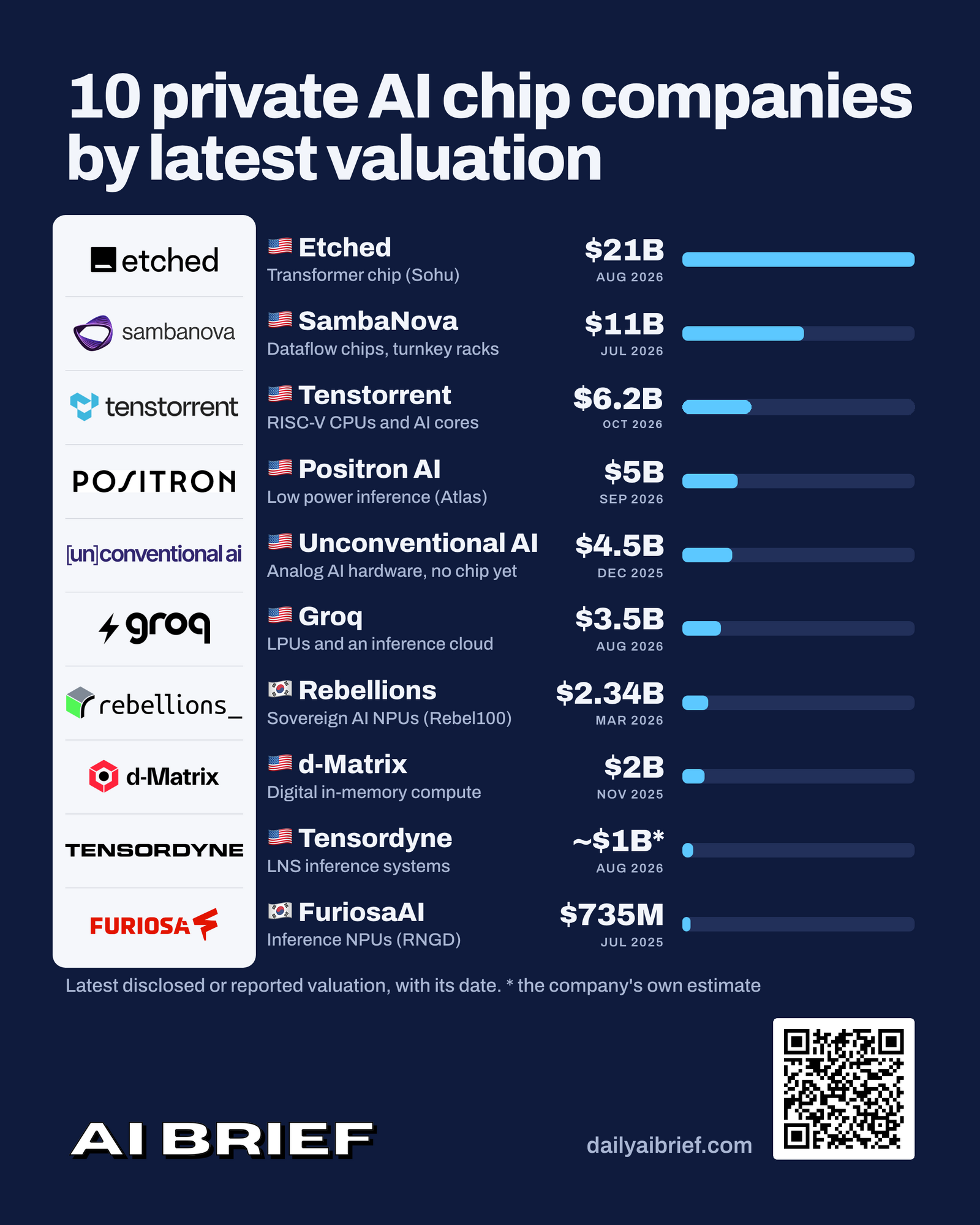
 Tensordyne
This Tensordyne whitepaper presents Napier, an inference-focused AI processor and rack-scale system based on the company’s TDN Math logarithmic number system. It examines infrastructure requirements for large mixture-of-experts and agentic models, compares major inference architecture approaches, and details the TDN AIP processor, TDN72 pod, TDN Link fabric, and Napier Ultra configuration. The paper reports simulation-based performance, cost, and accuracy-validation results, including Tensordyne’s projected comparison of one Napier rack with a nine-rack Nvidia Rubin plus Groq deployment; the chip is reported as taped out and in fabrication.
Read moreDaily AI Brief: the AI news that matters, in your inbox.