ASI raises $325M, NVIDIA signs industrial AI declaration with Germany, and more - Industrial AI Weekly #78
Over the past two years AI Brief has grown into a website, 19 LinkedIn pages with more than 81,000 followers and 15 newsletters with more than 41,000 subscribers, Industrial AI Weekly among them. Thank you for reading, following and passing it on.
Until now, our newsletters were assembled automatically: the news assigned to each newsletter went into a simple template. From this edition, our small team, Maiko, Rene and Stefan, edits every edition so it reads as one storyline: related news together, the important stories explained, the rest kept short. We still use AI tooling throughout, and we decide what goes in and how it is told.
In this edition, covering 15 to 22 October:
- ASI raised $325 million at a $3 billion valuation, Arda $230 million at $1.5 billion and Eka Robotics $150 million at $1.45 billion.
- Germany's federal government and NVIDIA signed a declaration of intent on AI models for physical AI, and Jensen Huang announced planned investments in four German startups.
- Samsung Electronics is testing a bipedal humanoid robot for factory and logistics work in Seoul, JoongAng Ilbo reports.
Funding
ASI, a Boston based company whose AI runs critical infrastructure, raised $325 million in a Series C led by Spark Capital, at a $3 billion valuation. The money goes to deployments in transportation, energy, defense and logistics and to larger research and engineering teams in Boston. ASI
Arda, founded by former OpenAI research chief Bob McGrew, raised $230 million in a round led by Altimeter Capital, Accel and Khosla Ventures, at a reported $1.5 billion valuation. It builds AI software for manufacturing engineers and has deployed its models with the defense technology company Anduril. Arda
Eka Robotics closed a $150 million Series A led by Andreessen Horowitz and F Prime, at a $1.45 billion post money valuation. The startup, founded by MIT professor Pulkit Agrawal and former Google DeepMind researcher Tuomas Haarnoja, is developing a force sensing gripper and a vision force action model. Its robots are being tested on industrial pick and place and wire handling. Eka Robotics
NVIDIA and its partners in Europe
At the Invest in Germany Summit, Germany's federal government signed a Joint Declaration of Intent with NVIDIA for a joint initiative on AI models for physical AI. Jensen Huang also announced planned investments in Agile Robots, Avelios Medical, Mirelo and Reflex Aerospace, part of a commitment of nearly $10 billion across Europe. NVIDIA and Germany
NVIDIA added Agile Robots' Agile ONE SN humanoid reference platform to its Isaac open robotics platform. The system uses NVIDIA Isaac GR00T and Jetson Thor, with planned integration of the Halos safety stack. NVIDIA also introduced Isaac OS, Isaac Lab 3.0, new datasets and open source workflows for robot training, simulation and deployment. NVIDIA Isaac
Mistral and NVIDIA will build AI engineering workflows on Mistral models, NVIDIA accelerated computing and physics modeling tools. The work covers faster simulation, CAD to simulation workflows, 3D scene generation and public benchmarks for physics AI and engineering agents in CAE and EDA, for aerospace, automotive and semiconductor uses. Mistral and NVIDIA
At NVIDIA GTC Berlin 2026, TÜV SÜD and Accenture presented the concept of a Physical AI Safety Suite that uses digital twins, AI agents and simulation to assess factory and warehouse automation before it goes live. It is meant to speed up safety certification of autonomous mobile robots that work next to people, with TÜV SÜD still responsible for independent certification. TÜV SÜD estimates production could start up to 30% sooner. TÜV SÜD and Accenture
Teradyne Robotics and Sereact agreed in Berlin to deploy Sereact's Cortex physical AI platform on Universal Robots arms for returns handling, piece picking and replenishment in retail, logistics and manufacturing. The companies say dual arm systems already run at Zalando fulfillment centers in Germany and Poland through CEVA Logistics. Teradyne and Sereact
Robots on the factory floor

Samsung Electronics is testing a bipedal humanoid robot at its research campus in Seoul for manufacturing and logistics tasks, JoongAng Ilbo reports. Samsung is considering showing it at CES 2027 and plans to prove its robotics in industrial settings before moving to household and service robots. Samsung
AGCO will pilot Agility Robotics' Digit humanoid robot at its manufacturing plant in Hesston, Kansas, starting in 2027. The robot will sort and stack parts and place totes into storage. AGCO says the robots will assist employees with repetitive and physically demanding work rather than replace them. AGCO and Agility Robotics
At the China International Industry Fair (CIIF) in Shanghai, Suzhou based Jodell Robotics unveiled the Mozart five finger dexterous hand, visuo tactile sensors and a data acquisition kit for embodied intelligence, designed for research institutes, humanoid developers and manufacturers. Jodell recently received an industrial investment from Midea Group. Shanghai Electric showed 19 integrated solutions at the same fair, from intelligent robotics and industrial AI to computing infrastructure, wind power, battery manufacturing, gas turbines and nuclear equipment. Jodell Robotics · Shanghai Electric
Food production
Chef Robotics says its AI guided robot arms have handled more than 120 million food servings in production. According to the company, Café Spice raised line output to 30 trays per minute and cut excess food by 67%, and Amy's Kitchen reported a 17% gain in labor productivity. Chef rents its robots to food manufacturers and plans to move into smaller kitchens, airline catering and later fast casual restaurants. Chef Robotics
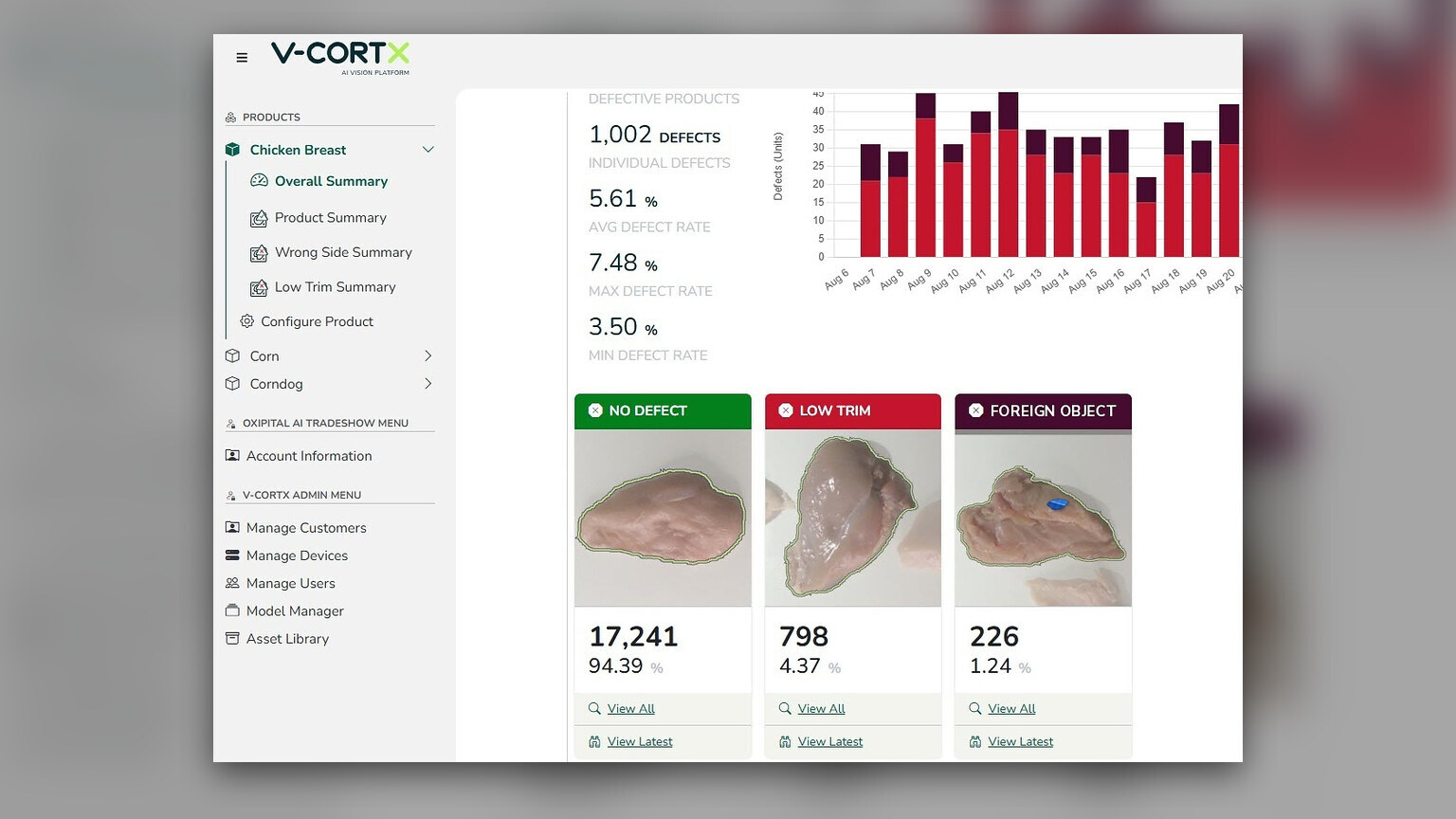
Oxipital AI launched foreign material detection for high speed food lines. The system finds and classifies contaminants in real time, can trigger automated line responses and records inspection data in its V CORTX analytics platform. The company says it already runs in food plants with up to 99% detection accuracy. Oxipital AI
Engineering and design
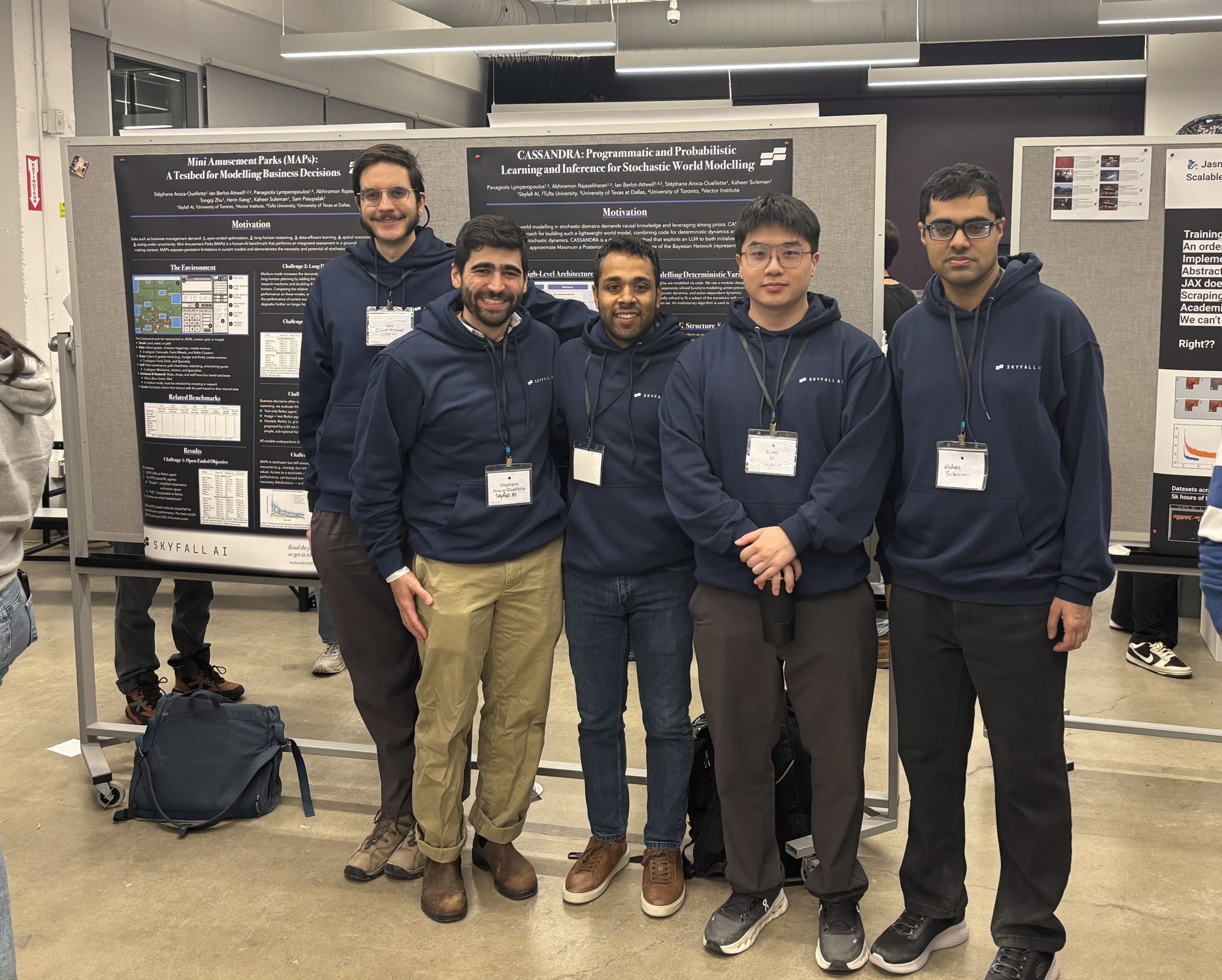
Skyfall AI introduced SKY-001, a research preview world model that plans hierarchical CAD and BIM designs from text or 2D sketches. The company claims 100 times faster inference and 150 times lower compute costs than leading AI models, but has not published the benchmarks behind those figures. Commercial deployment is planned for early 2027. Skyfall AI
Mach9 in San Francisco raised a $34 million Series A led jointly by First Round Capital and Bessemer Venture Partners, bringing its total funding to $49 million, for software that turns 3D infrastructure scans into engineering drawings. In Oslo, Solvera raised $6.3 million in a pre seed round led by Seedcamp. It sells MEP engineering services in which AI systems automate tasks and experienced engineers make the key decisions, and it is opening a London office. Mach9 · Solvera
Plant software

Rockwell Automation introduced FactoryTalk Conductor, an AI orchestration platform that connects agents, skills, workflows and software across industrial design, development, testing and maintenance. It will be previewed at Automation Fair 2026 in Boston, with commercial availability planned for the first quarter of 2027. Rockwell Automation
Germany's eschbach launched Problem Solving, an application in its Seqonis Intelligent Operations Platform for pharmaceutical, chemical and process manufacturers. It uses AI guided workflows, voice interaction, pattern recognition and automatic documentation for root cause analysis and corrective actions. Vector Solutions launched Skills Intelligence, an AI enabled platform for manufacturers to track validated workforce skills, find coverage gaps and assign training across roles, sites and shifts. eschbach · Vector Solutions
Supply chain and procurement

TraceLink added OPUS Brain capabilities to its OPUS Agents, turning agent instructions into optimized, verifiable Semantic Inference Plans, along with versioned Agent Profiles, dependency tracking, operational logs, dashboards and cost visibility for no code supply chain agents. The Boston based company also set up dedicated global commercial, R&D and services teams for its Track and Trace Compliance and its Supply Chain Agentic Business Process businesses. OPUS Agents · TraceLink teams
NVIDIA plans to expand manufacturing capacity with Amkor Technology, IBIDEN, King Yuan Electronics, Samsung Electro Mechanics, Siliconware Precision Industries and Unimicron Technology. The plans include a 2.5 times increase in substrate capacity over three years, more than 300% growth in Amkor's advanced packaging capacity by the end of 2028, new US testing facilities supported by a $1.1 billion advance to King Yuan Electronics, and a 15 times increase in Siliconware Precision Industries' optical engine capacity by mid 2027. NVIDIA supply chain
Overhaul reports that more than $150 million in AI equipment has been stolen in 2026 and that thefts of AI chips, computing components and data center equipment have risen 34% since 2024, with deception used in 92% of high value technology shipment thefts. The company also launched the Helix Consortium with Navium and Lloyd's of London underwriters to provide insurance and tracking for AI infrastructure cargo. Overhaul
Pactum launched Intake Agent, which lets employees submit purchase requests in plain language and completes and checks requisitions against company policy inside Microsoft Teams, Coupa and SAP Ariba. Pactum says it cuts cycle time by 90%. Opply raised $7.5 million in a round led by Chalfen Ventures for its AI platform that handles sourcing, procurement, financing and supply chain work for consumer packaged goods brands. Pactum · Opply
Lucas Systems and Carnegie Mellon University are working on research to help warehouse supervisors plan workforce and tasks with data analysis and prediction models. Students in CMU's Spring 2026 applied data science cohort studied hundreds of attributes of warehouse users and their behavior. Lucas Systems and CMU
Maintenance and fleets
The U.S. Army is piloting Artificial Intelligence Assisted Maintenance, a cloud system that digitizes about 7,500 maintenance manuals and helps soldiers troubleshoot equipment, complete paperwork, order parts and reach experts. About 4,000 soldiers have tested it, and the Army plans to expand it across the service, though limited access to government issued hardware slows the rollout. U.S. Army
Boeing launched Dataliner, an AI platform built with Microsoft that combines airline maintenance and fleet data for fleet wide analysis. It runs on Azure AI Foundry and includes new maintenance tools, connections to existing Boeing services and controls that let airlines decide what data to share. Boeing
Motive Technologies launched AI Agents that predict fleet safety, maintenance and compliance issues and then act, for example by warning drivers, creating work orders or restricting vehicle use. Existing customers can deploy them from 19 October. DrillDocs extended its CleanSight computer vision system to Valaris' DS 9 drillship in Angola and the Hebron platform in Eastern Canada, after deployments in Guyana. Motive · DrillDocs
Körber is taking a stake in NAiSE, whose software coordinates automated guided vehicles, autonomous mobile robots and manually driven industrial trucks in warehouses and factories. Körber and NAiSE
We hope you enjoyed this article
Consider subscribing to one of our newsletters like Industrial AI Weekly or Daily AI Brief.
Also, consider following us on social media:
More from Industrial Automation AI
Oct 22 Tractian Raises $130 Million at $1.4 Billion Valuation Oct 22 Singapore Commits S$45 Million to Manufacturing AI Adoption Oct 22 L2L Launches AI Shop Floor Execution Platform Oct 22 AGCO to Test Agility Robotics Humanoids in Kansas Factory Oct 21 Boeing Launches Dataliner AI Maintenance Platform With MicrosoftMore from AI in Supply Chain Management
Oct 22 Vertice Launches Procure to Pay Platform Oct 22 Körber Invests in NAiSE for Mixed Robot Fleet Management Oct 21 NVIDIA Expands Chip Packaging and Testing Capacity Oct 21 Overhaul Reports $150 Million in AI Equipment Theft in 2026 Oct 21 Teradyne Robotics and Sereact Partner on Industrial Robot AIIndustrial AI Weekly
The latest advancements in smart manufacturing, predictive maintenance, AI-driven quality control, supply chain & more.
