Virtus Integrates Outmarket AI to Streamline Insurance Consulting Workflows
Jul 22, 2026
Insurance
Vitria Technology, Inc. has announced a significant advancement in IT management for financial services with the launch of its VIA AIOps platform, announced in a press release. This platform aims to revolutionize how financial firms handle complex IT environments by shifting from traditional reactive monitoring to a proactive, autonomous incident resolution model powered by Generative AI and agentic AI.
Dale Skeen, CTO and Co-Founder of Vitria Technology, Inc., highlighted the importance of integrating AI to manage the scale and complexity of modern financial systems. The platform uses structured knowledge, or knowledge graphs, to enhance AI capabilities in accuracy, reasoning, explainability, and safety. These graphs, expressed in RDF, provide comprehensive insights into IT systems, enabling AI to detect, analyze, and resolve issues autonomously.
Vitria's approach promises to minimize downtime, reduce human error, and optimize resource allocation, marking a paradigm shift in financial services IT management. The use of knowledge graphs not only improves AI accuracy and reasoning but also ensures that AI operations are explainable and verifiable, fostering trust and confidence in these systems.
Consider subscribing to one of our newsletters like Finance AI Weekly or Daily AI Brief.
Also, consider following us on social media:
Weekly newsletter about AI in finance. Covers AI-driven trading, fintech innovations, and data analytics transforming markets

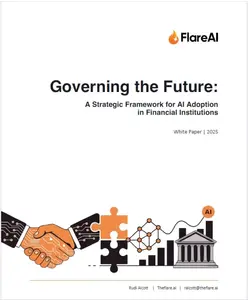
This whitepaper explores the transformative impact of artificial intelligence on the financial industry, focusing on the governance challenges and regulatory demands faced by banks. It provides a strategic framework for AI adoption, emphasizing the importance of a unified AI approach to streamline compliance and reduce operational costs. The document offers actionable insights and expert recommendations for banks with fewer than 2,000 employees to become leaders in compliant, customer-centric AI.
Read more