
S&P Global Adds Visible Alpha Data to AI Data Portal
Oct 15, 2026
Financial Services

NatureAlpha has launched Geoverse 2.0, its most comprehensive nature risk platform, announced in a press release. This enhanced analytics platform is designed to transform how companies and investors measure natural world risks, providing a holistic and reliable evaluation across asset classes.
Geoverse 2.0 addresses the complexity of nature data and regulatory disclosures by aligning with the Taskforce on Nature-Related Financial Disclosures (TNFD) framework. The platform offers multidimensional, automated nature risk and impact analytics, supported by AI, to deliver unprecedented levels of granularity and reliability.
Key features of Geoverse 2.0 include the analysis of 8.5 million asset locations worldwide with 99.5% accuracy, using 28 geospatial layers. The platform's automation reduces human intervention, facilitating competitive pricing and enabling rapid updates to reflect corporate activities such as mergers and acquisitions.
The platform's evolution focuses on three components: coverage, velocity, and refinement. It provides extensive coverage across asset classes, computes billions of calculations per second, and is future-proofed for regulatory disclosures. Geoverse 2.0's dynamic data capabilities allow for real-time updates, ensuring that companies and investors can make informed decisions to mitigate nature-related risks.
Consider subscribing to one of our newsletters like Daily AI Brief.
Also, consider following us on social media:
Daily report covering major AI developments and industry news, with both top stories and complete market updates
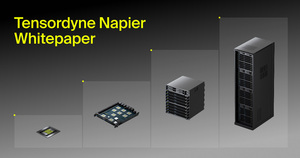
 Tensordyne
This Tensordyne whitepaper presents Napier, an inference-focused AI processor and rack-scale system based on the company’s TDN Math logarithmic number system. It examines infrastructure requirements for large mixture-of-experts and agentic models, compares major inference architecture approaches, and details the TDN AIP processor, TDN72 pod, TDN Link fabric, and Napier Ultra configuration. The paper reports simulation-based performance, cost, and accuracy-validation results, including Tensordyne’s projected comparison of one Napier rack with a nine-rack Nvidia Rubin plus Groq deployment; the chip is reported as taped out and in fabrication.
Read moreDaily AI Brief: the AI news that matters, in your inbox.