GenRobot AI raises $100 million for robot training data platform
Nov 03, 2026
Funding
Bengaluru-based Humyn Labs, which collects real-world data to train robots, has raised $47 million in Series A financing to serve US AI and robotics companies, TechCrunch reports. The round combines $26 million in equity led by Accel, with Prosus Ventures, Bajaj Finance's Finserv Intelligence, Jump Trading and others, and $21 million in venture debt led by Lighthouse Canton.
Humyn Labs built its own two-camera hardware to record people doing everyday tasks, then uses software to label the footage and track hand movements and interactions with objects so AI models can learn from it. It collects data in more than 20 countries across Latin America and Asia, with Brazil, India and South Korea as its main hubs.
The company says it has 12 paying customers, including frontier AI labs, robotics companies and world model developers, with about 90% of revenue from the US. It generated $10 million in revenue between April and October and has another $20 million in signed contracts, co-founder Manish Agarwal said. The venture debt covers the gap between paying data collectors weekly and waiting 30 to 60 days for customer payments.
Agarwal, former CEO of Nazara Technologies, founded the company in February with Ishank Gupta, according to TechCrunch.
Consider subscribing to one of our newsletters like Robotics Brief, AI Funding Brief or Daily AI Brief.
Also, consider following us on social media:
Weekly coverage of AI-driven robotics advances in industrial automation, autonomous vehicles, and robotic systems.
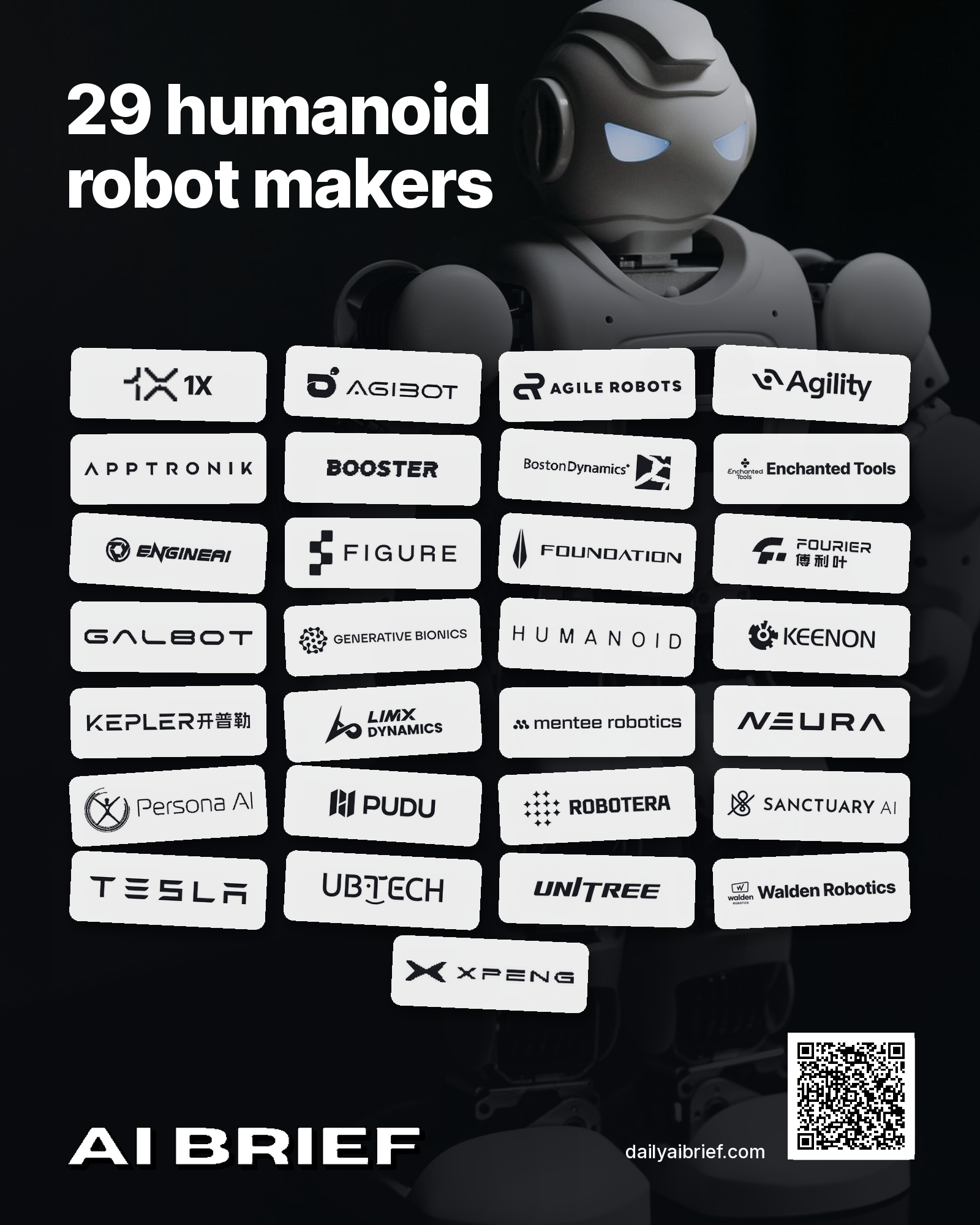
Companies building humanoid robots, from startups to Tesla and Boston Dynamics

 Tensordyne
This Tensordyne whitepaper presents Napier, an inference-focused AI processor and rack-scale system based on the company’s TDN Math logarithmic number system. It examines infrastructure requirements for large mixture-of-experts and agentic models, compares major inference architecture approaches, and details the TDN AIP processor, TDN72 pod, TDN Link fabric, and Napier Ultra configuration. The paper reports simulation-based performance, cost, and accuracy-validation results, including Tensordyne’s projected comparison of one Napier rack with a nine-rack Nvidia Rubin plus Groq deployment; the chip is reported as taped out and in fabrication.
Read moreDaily AI Brief: the AI news that matters, in your inbox.