Zipline Raises $1.5 Billion at $21.5 Billion Valuation
Nov 05, 2026
Funding
Zipline and Uber have started commercial drone delivery for Uber Eats in Spring, Texas, a Houston suburb, TechCrunch reports. It is the first commercial launch under the partnership the two companies announced earlier this year, and the service will next expand to Dallas.
The companies plan to add dozens more US cities, with a goal of making one million deliveries a day with Zipline's drones by the end of 2029. Zipline's long-range autonomous drones will carry food orders of up to eight pounds, flying about 300 feet above the ground at up to 70 miles per hour. The drones do not land; they lower each order to the customer in a small protective pod on a tether.
Uber Eats customers in the service area will see a new drone icon in the app listing participating restaurants. At launch these include national chains such as Jersey Mike's and Zaxby's and dozens of local restaurants, Uber said.
"In partnership with Uber Eats we're going to create a new expectation for delivery in America," Zipline's CEO and co-founder said.
Uber has also invested in Zipline, though neither company has disclosed the amount. Zipline said last week it raised $1.5 billion in a round led by Paradigm, WCM Investment Management and Layer Global, with Uber among the backers. Drone delivery plans from Zipline and rivals such as Alphabet's Wing and Amazon's Prime Air have met complaints from some residents about noise, wildlife, safety and privacy, according to TechCrunch.
Consider subscribing to one of our newsletters like Enterprise AI Brief, Robotics Brief or Daily AI Brief.
Also, consider following us on social media:
Weekly coverage of AI-driven robotics advances in industrial automation, autonomous vehicles, and robotic systems.
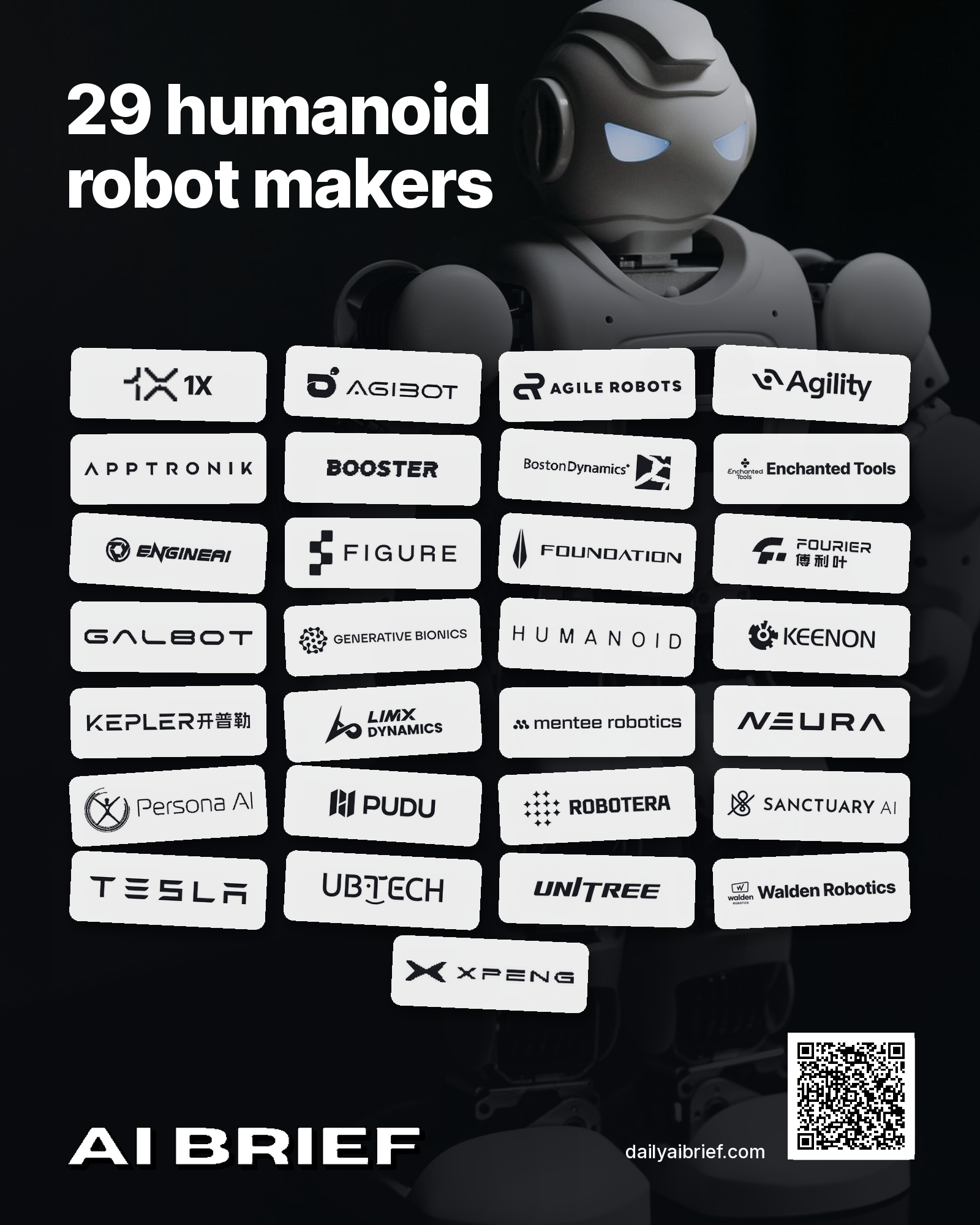
Companies building humanoid robots, from startups to Tesla and Boston Dynamics

 Tensordyne
This Tensordyne whitepaper presents Napier, an inference-focused AI processor and rack-scale system based on the company’s TDN Math logarithmic number system. It examines infrastructure requirements for large mixture-of-experts and agentic models, compares major inference architecture approaches, and details the TDN AIP processor, TDN72 pod, TDN Link fabric, and Napier Ultra configuration. The paper reports simulation-based performance, cost, and accuracy-validation results, including Tensordyne’s projected comparison of one Napier rack with a nine-rack Nvidia Rubin plus Groq deployment; the chip is reported as taped out and in fabrication.
Read moreDaily AI Brief: the AI news that matters, in your inbox.