
Google opens Gemini 4 Carbon to developers at $2 per million input tokens until December
Nov 10, 2026
Cybersecurity
Google announced on its blog the Gemini Decisions API, a new endpoint powered by the Gemini Decision 1 model. It evaluates up to 1,000 yes or no, multiple choice and rubric scoring questions in one request without generating text token by token.
The API accepts shared inputs across text, images, audio, video and PDFs, with context of up to 256,000 tokens. It returns probabilities and confidence scores for supplied options, supporting tasks such as model routing, tool selection, policy checks and context grading.
Google reports total latency of 150 to 250 milliseconds, including median model processing time of 50 to 100 milliseconds for contexts up to 16,000 tokens. Gemini Decision 1 costs $0.10 per million input tokens, with no output token charge, and is available through the Gemini API in Google AI Studio.
Google says teams inside the company already use it. Gemini Notebook routes incoming queries to a model tier with it, serving everyday queries with up to 40% lower latency, and Google Search uses it as a safety check for MCP tools. On Google's own benchmark suite, the company says Decision 1 is nearly five times cheaper than Gemini 3.5 Flash-Lite. RuntimeWire and AlphaSignal describe it as a model for the routing and policy layer that sits in front of larger generative models.
Consider subscribing to one of our newsletters like Daily AI Brief.
Also, consider following us on social media:
Daily report covering major AI developments and industry news, with both top stories and complete market updates
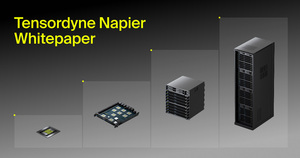
 Tensordyne
This Tensordyne whitepaper presents Napier, an inference-focused AI processor and rack-scale system based on the company’s TDN Math logarithmic number system. It examines infrastructure requirements for large mixture-of-experts and agentic models, compares major inference architecture approaches, and details the TDN AIP processor, TDN72 pod, TDN Link fabric, and Napier Ultra configuration. The paper reports simulation-based performance, cost, and accuracy-validation results, including Tensordyne’s projected comparison of one Napier rack with a nine-rack Nvidia Rubin plus Groq deployment; the chip is reported as taped out and in fabrication.
Read moreDaily AI Brief: the AI news that matters, in your inbox.