
Telit Cinterion launches SE250C4 module with on-device AI for edge devices
Nov 12, 2026
Chips
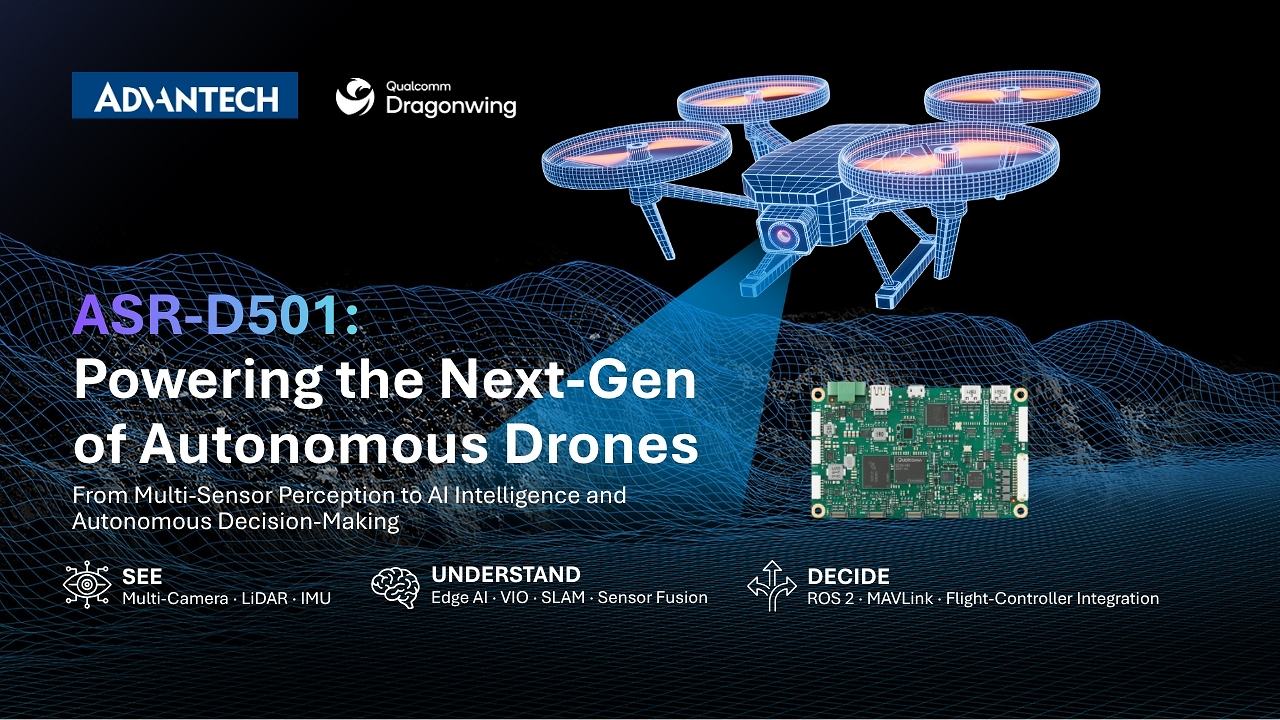
Advantech launches the ASR-D501 AI companion and mission computer for autonomous drones, the company announced in a press release. The compact system uses the Qualcomm QCS6490 processor to provide up to 12 TOPS of AI performance while consuming less than 10 watts.
The ASR-D501 processes object detection, tracking, visual localization, sensor fusion, mapping and obstacle awareness on the drone. It includes five MIPI CSI camera interfaces, 2.5 GbE, two USB Type C ports, CAN FD, UART, I2C and GPIO. Optional connectivity includes Wi-Fi 6E, Bluetooth and 4G or 5G cellular service.
The fanless board measures 100 by 60 millimeters and weighs about 50 grams without a heatsink. It supports Ubuntu 24.04 LTS and Advantech's Robotic Suite for Drone, which connects ROS 2 applications with PX4 and ArduPilot flight controllers through MAVLink, MAVSDK and MAVROS.
Consider subscribing to one of our newsletters like Robotics Brief, Silicon Brief or Daily AI Brief.
Also, consider following us on social media:
Weekly coverage of AI-driven robotics advances in industrial automation, autonomous vehicles, and robotic systems.

 Tensordyne
This Tensordyne whitepaper presents Napier, an inference-focused AI processor and rack-scale system based on the company’s TDN Math logarithmic number system. It examines infrastructure requirements for large mixture-of-experts and agentic models, compares major inference architecture approaches, and details the TDN AIP processor, TDN72 pod, TDN Link fabric, and Napier Ultra configuration. The paper reports simulation-based performance, cost, and accuracy-validation results, including Tensordyne’s projected comparison of one Napier rack with a nine-rack Nvidia Rubin plus Groq deployment; the chip is reported as taped out and in fabrication.
Read moreDaily AI Brief: the AI news that matters, in your inbox.