Pew finds 60% of Americans uncomfortable with local data centers
Nov 11, 2026
Data Centers
US data center power demand has increased 19% annually since 2000, while electricity grid capacity has expanded 2% per year, insurance broker Howden said in research accompanying its report on insuring data centres. Data centers accounted for 5% of total US grid capacity in 2025, up from 0.1% in 2000.
Power constraints are adding 24 to 72 months to some data center construction schedules. Howden estimates that delays at the largest projects could result in $800 million to $2.4 billion in lost revenue.
At current growth rates, data centers would need to obtain as much as 58% of their power, equal to 110 gigawatts, from behind-the-meter sources by 2030 to maintain their current share of grid capacity. Operators are considering on site natural gas, renewable energy, battery storage and nuclear power as grid connection delays continue.
Consider subscribing to one of our newsletters like Silicon Brief or Daily AI Brief.
Also, consider following us on social media:
Weekly coverage of AI hardware developments including chips, GPUs, cloud platforms, and data center technology.

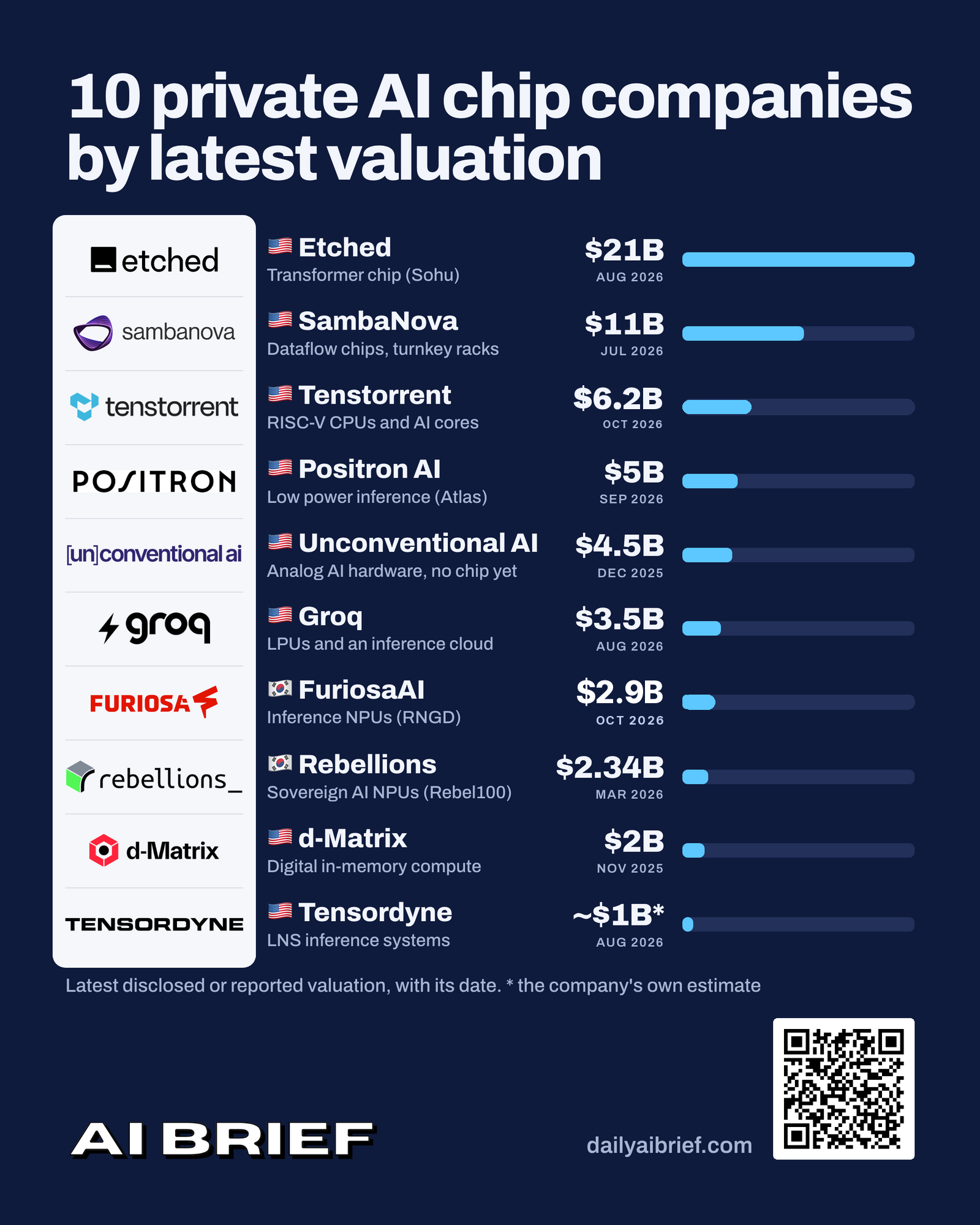
 Tensordyne
This Tensordyne whitepaper presents Napier, an inference-focused AI processor and rack-scale system based on the company’s TDN Math logarithmic number system. It examines infrastructure requirements for large mixture-of-experts and agentic models, compares major inference architecture approaches, and details the TDN AIP processor, TDN72 pod, TDN Link fabric, and Napier Ultra configuration. The paper reports simulation-based performance, cost, and accuracy-validation results, including Tensordyne’s projected comparison of one Napier rack with a nine-rack Nvidia Rubin plus Groq deployment; the chip is reported as taped out and in fabrication.
Read moreDaily AI Brief: the AI news that matters, in your inbox.