Altman Says OpenAI Will Aim Its Robots at Building Data Centers
Oct 29, 2026
Data Centers
OpenAI CEO Sam Altman told about 50 senior executives from Samsung that near-term demand for AI infrastructure could be uneven, TokenPost reported. The group, from Samsung Electronics and its financial and biotech affiliates, asked whether demand for AI, memory chips and data centres could slow over the next five to ten years.
Altman said OpenAI and Anthropic were the only companies currently driving major demand growth, and warned of possible supply shocks and a period of uncertainty. Over the longer term he expects AI use to keep growing as models write custom software in real time and spread into robotics, spacecraft and science. As an example, he said the top user's monthly token use rose from about 100,000 in early 2020 to 100 billion at the start of 2026.
He named chip supply and data-centre infrastructure as the biggest constraints for the next several years, along with financing, safety and public acceptance. Asked about profitability, he said OpenAI aims to build low-cost, vertically integrated infrastructure, including its own chips, and sell tokens in high volume at low margins.
Consider subscribing to one of our newsletters like Silicon Brief or Daily AI Brief.
Also, consider following us on social media:
Weekly coverage of AI hardware developments including chips, GPUs, cloud platforms, and data center technology.

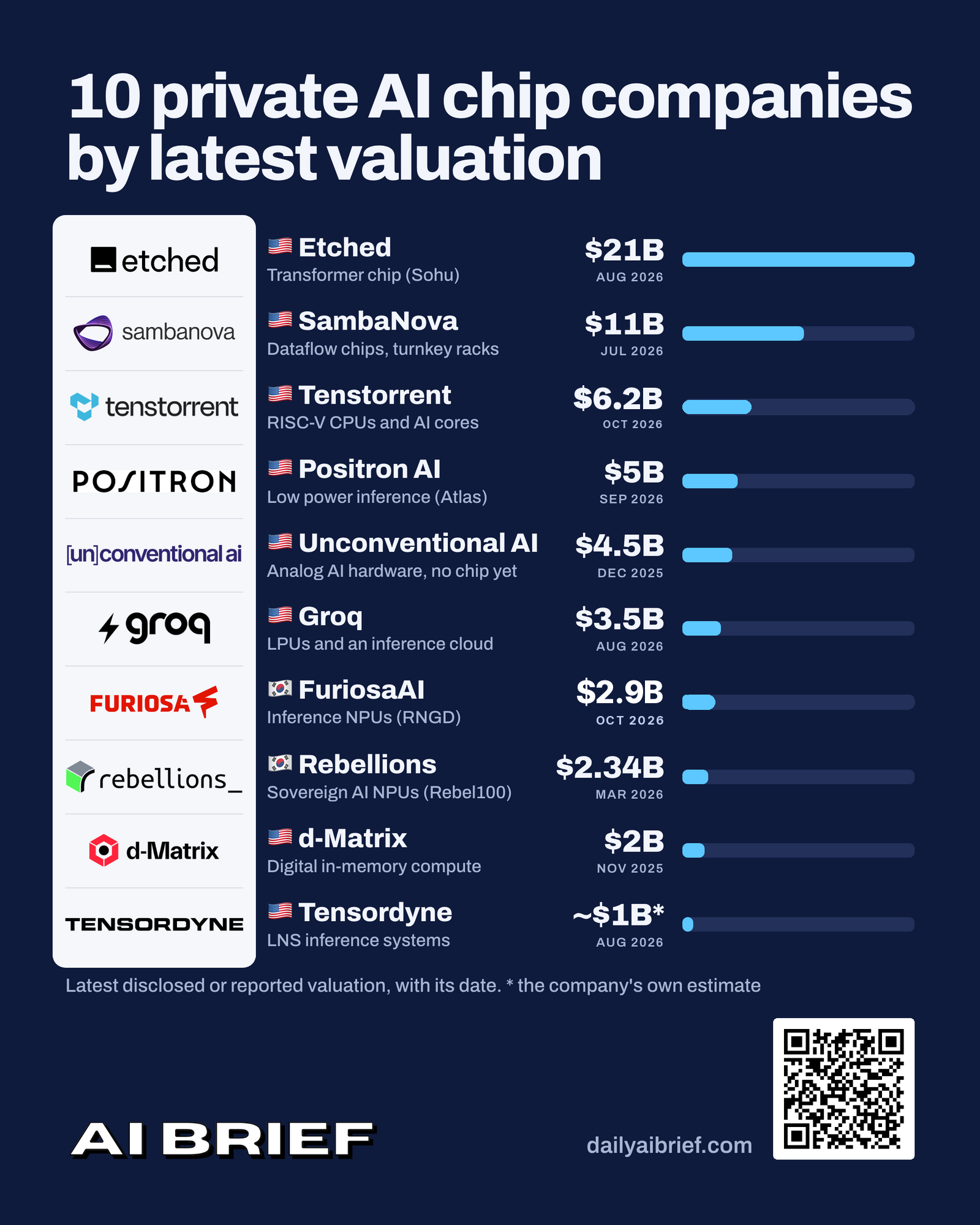
 Tensordyne
This Tensordyne whitepaper presents Napier, an inference-focused AI processor and rack-scale system based on the company’s TDN Math logarithmic number system. It examines infrastructure requirements for large mixture-of-experts and agentic models, compares major inference architecture approaches, and details the TDN AIP processor, TDN72 pod, TDN Link fabric, and Napier Ultra configuration. The paper reports simulation-based performance, cost, and accuracy-validation results, including Tensordyne’s projected comparison of one Napier rack with a nine-rack Nvidia Rubin plus Groq deployment; the chip is reported as taped out and in fabrication.
Read moreDaily AI Brief: the AI news that matters, in your inbox.