OpenAI releases GPT-6.2 Astra and Sol, cutting Astra's API prices by 20%
Nov 17, 2026
AI for Software Engineering
OpenAI has released an updated Astra for Law, now built on GPT-6.2 Astra, and opened it to every ChatGPT Enterprise customer on request, LawNext reports. Since its September launch, access had been limited to a handful of Trusted Access firms, including Cooley, Ropes & Gray and Sullivan & Cromwell.
Astra for Law is not a separate model but a configuration of Astra with legal-specific instructions, tools and a search index. The update enlarges that index and adds instructions for researching a question, weighing authorities and writing an answer.
OpenAI says it scored highest on LAB-AA, Artificial Analysis's version of Harvey's Legal Agent Benchmark, which gives credit only when an answer meets every requirement of an assignment without a material hallucination. Astra for Law earned full credit on 20.8% of the 120 assignments, against 15.0% for the base GPT-6.2 Astra and 13.1% for the best model from another developer. It averaged 0.03 material hallucinations per assignment, against 0.59 for Anthropic's Claude Opus 5.5, OpenAI said.
On Vals AI's Legal Research Bench it answered 53.8% of 208 questions fully correctly, making it a top performer but not the leader. "Astra for Law 6.2 is a material improvement over prior Astra models across our benchmarks," said Julio Pereyra, head of legal research at Harvey, in a statement published by OpenAI, according to LawNext.
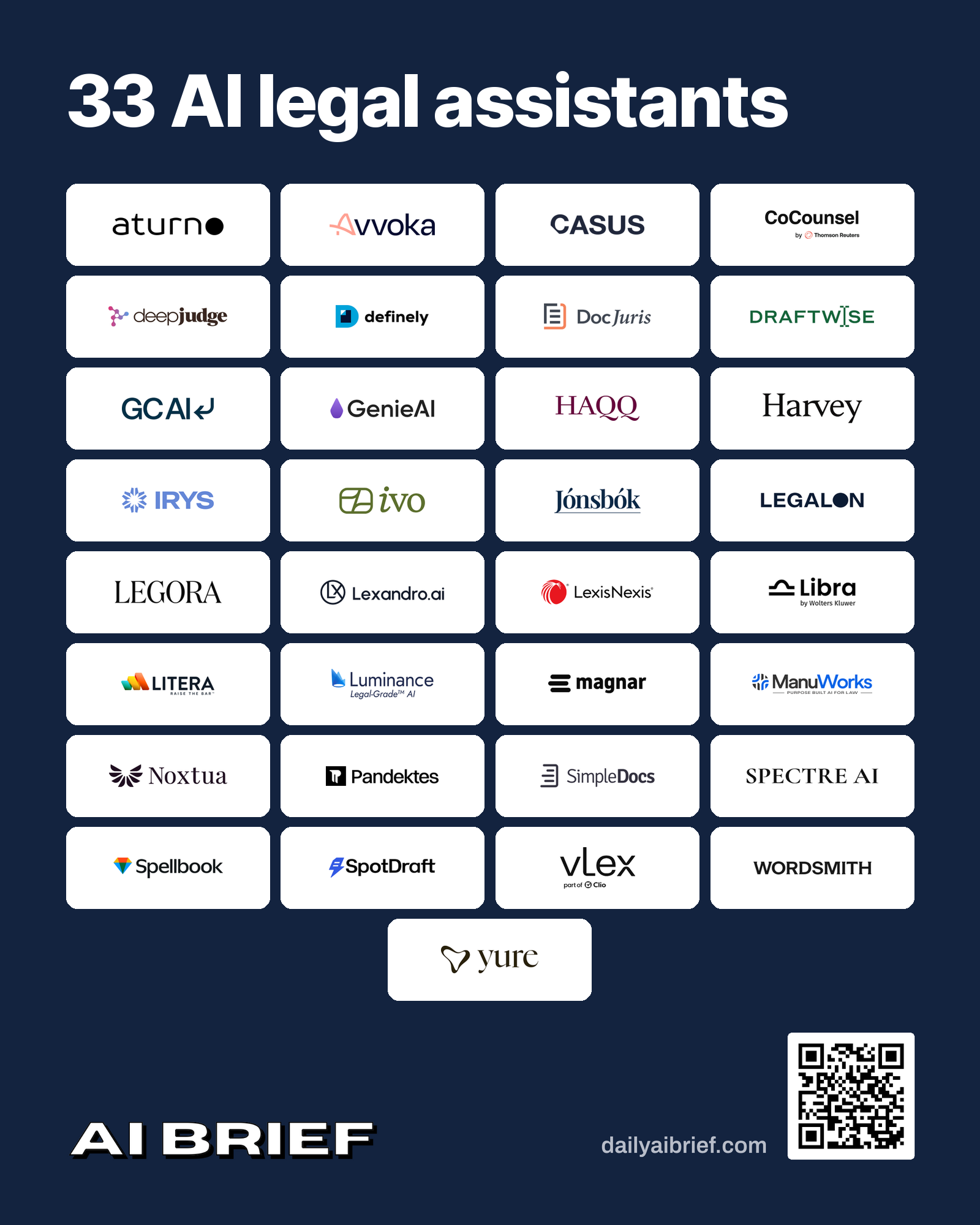
Consider subscribing to one of our newsletters like Legal AI Weekly or Daily AI Brief.
Also, consider following us on social media:
The source for the Legal AI software news, analysis, emerging applications: contract review, e-discovery, research.

 Tensordyne
This Tensordyne whitepaper presents Napier, an inference-focused AI processor and rack-scale system based on the company’s TDN Math logarithmic number system. It examines infrastructure requirements for large mixture-of-experts and agentic models, compares major inference architecture approaches, and details the TDN AIP processor, TDN72 pod, TDN Link fabric, and Napier Ultra configuration. The paper reports simulation-based performance, cost, and accuracy-validation results, including Tensordyne’s projected comparison of one Napier rack with a nine-rack Nvidia Rubin plus Groq deployment; the chip is reported as taped out and in fabrication.
Read moreDaily AI Brief: the AI news that matters, in your inbox.