
Vals: open-weight DeepSeek nears OpenAI's restricted cyber model in simulated network attacks
Nov 07, 2026
Cybersecurity
Use of OpenAI's models at three US national laboratories has grown sharply in the first year of Los Alamos National Laboratory's partnership with OpenAI, the laboratory says. From mid-February to late August 2026, weekly token throughput on Venado-GPT, the service that runs OpenAI models on Los Alamos' Venado supercomputer, grew 20-fold to more than 3 billion tokens. User accounts across Los Alamos, Lawrence Livermore and Sandia tripled, and weekly successful requests rose from about 1,200 to more than 41,200.
The service hosts three experimental OpenAI models in the laboratory's secure computing environment, running entirely on Venado's local GPUs. Los Alamos researchers use it with URSA, an open source agentic software package developed at the laboratory, to support certification workflows, while Lawrence Livermore uses it to translate simulation models to a newer code. "We've seen tremendous growth in the tri-laboratories' use of Venado-GPT," said Los Alamos director Thom Mason. In the second year, the partners plan to improve how the models read file attachments, make the APIs more dependable and support more complex coding workflows.
Consider subscribing to one of our newsletters like Defense AI Brief or Daily AI Brief.
Also, consider following us on social media:
Your weekly intelligence briefing on the technology shaping modern warfare and national security.
 Tensordyne
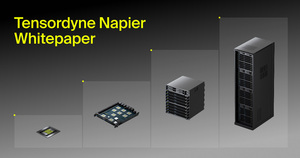
This Tensordyne whitepaper presents Napier, an inference-focused AI processor and rack-scale system based on the company’s TDN Math logarithmic number system. It examines infrastructure requirements for large mixture-of-experts and agentic models, compares major inference architecture approaches, and details the TDN AIP processor, TDN72 pod, TDN Link fabric, and Napier Ultra configuration. The paper reports simulation-based performance, cost, and accuracy-validation results, including Tensordyne’s projected comparison of one Napier rack with a nine-rack Nvidia Rubin plus Groq deployment; the chip is reported as taped out and in fabrication.
Read moreDaily AI Brief: the AI news that matters, in your inbox.