Google.org Awards $36 Million to 17 AI Science Projects
Oct 21, 2026
Scientific Research
AI Research Foundations, a pan African program for advanced AI education, launched in South Africa on November 9 at Stellenbosch University, as reported by EdNews Africa. The program will train university lecturers to deliver advanced AI courses across 30 universities in Ghana, Kenya, Nigeria and South Africa, with a target of reaching 30,000 students.
Google.org funds the program, while FATE Foundation serves as the main grant holder and the African Institute for Mathematical Sciences South Africa handles academic implementation. Google DeepMind developed the curriculum, with University College London contributing teaching expertise and resources.
The curriculum covers deep learning, neural networks, generative language models, transformers and responsible AI. Lecturers will learn to deliver courses, create teaching materials and supervise student projects. The Stellenbosch workshop runs from November 9 to 13 and is one of four planned across South Africa, following in person training in Ghana, Nigeria and Kenya.
Consider subscribing to one of our newsletters like AI in Education or Daily AI Brief.
Also, consider following us on social media:
Weekly newsletter about AI in education. Covers AI-driven software for educators, schools, general innovations and regulatory updates.
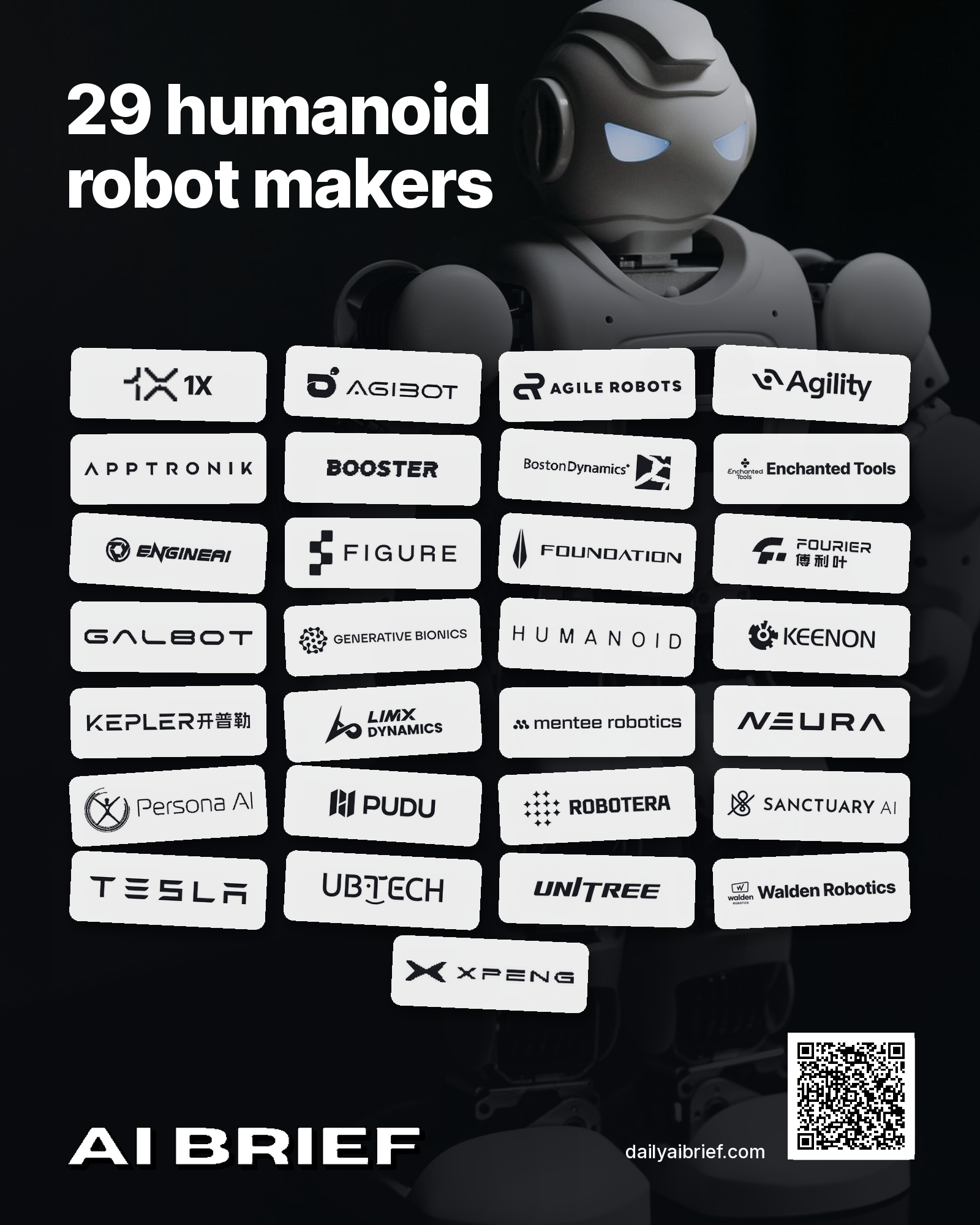
Companies building humanoid robots, from startups to Tesla and Boston Dynamics

 Tensordyne
This Tensordyne whitepaper presents Napier, an inference-focused AI processor and rack-scale system based on the company’s TDN Math logarithmic number system. It examines infrastructure requirements for large mixture-of-experts and agentic models, compares major inference architecture approaches, and details the TDN AIP processor, TDN72 pod, TDN Link fabric, and Napier Ultra configuration. The paper reports simulation-based performance, cost, and accuracy-validation results, including Tensordyne’s projected comparison of one Napier rack with a nine-rack Nvidia Rubin plus Groq deployment; the chip is reported as taped out and in fabrication.
Read moreDaily AI Brief: the AI news that matters, in your inbox.