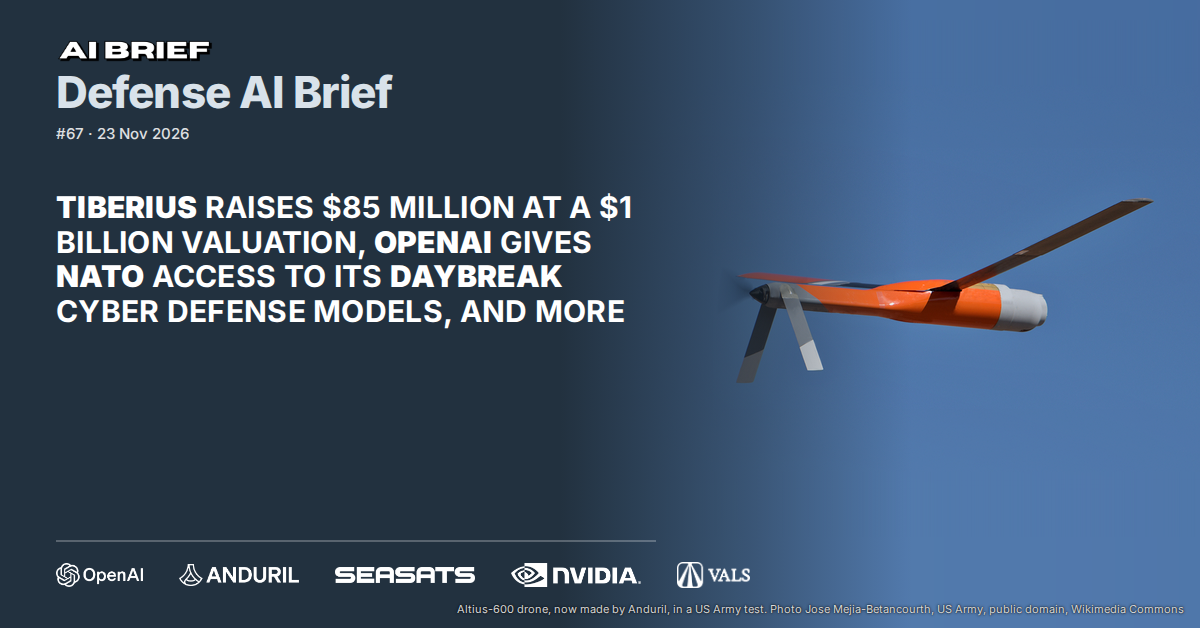
Tiberius raises $85 million at a $1 billion valuation, OpenAI gives NATO access to its Daybreak cyber defense models, and more - Defense AI Brief #67
In this edition, covering 16 to 22 November:
- Tiberius, a startup that designs munitions with AI, raised $85 million at a $1 billion valuation in a round co led by Lakestar and Rochefort.
- OpenAI gave NATO access to its Daybreak cyber defense models; NATO has used up to 300 billion tokens a month.
- Vals AI reports that frontier models in its autonomous warfare tests often identified civilians, ambulances and surrendering soldiers as targets.
This spot is open for 2027. One company puts its name on every Defense AI Brief, which has 900+ subscribers. See what's included
From our lists
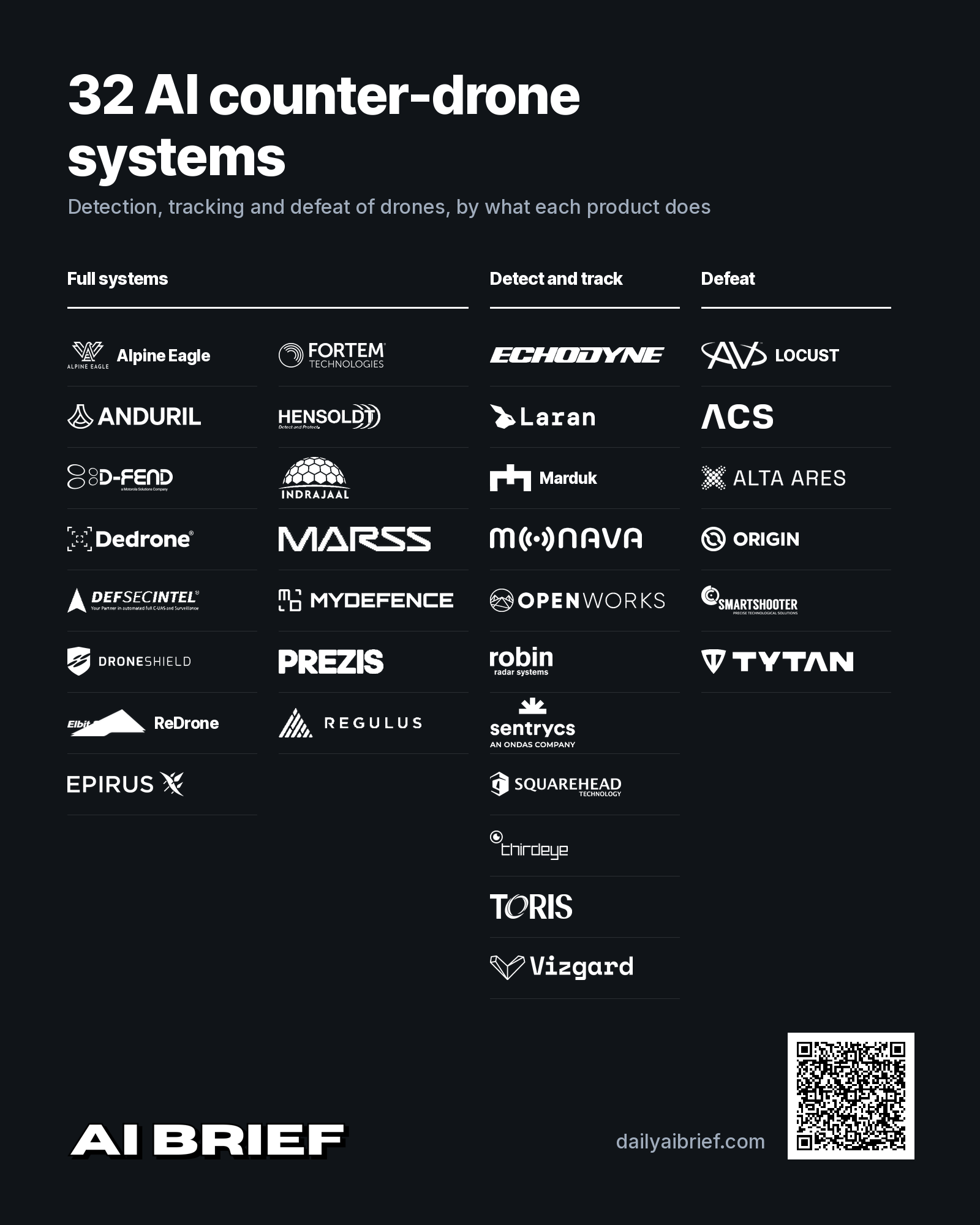
This list covers products that use AI to detect, track, classify or stop drones, for military, government and critical infrastructure buyers.
Funding
Tiberius designs and tests munitions with AI and leaves manufacturing to partner factories. It raised $85 million at a $1 billion valuation in a round co led by Lakestar and Rochefort. Tiberius
Valkryn came out of stealth with $17 million in a round led by Andreessen Horowitz. The startup instruments combat like tests of drones and robots and scores them against government criteria. Valkryn
UK and Berlin based defense AI startup Agon raised a $70 million Series A at a $450 million valuation, led by Northzone, with the UK Sovereign AI Fund, NSSIF and Roelof Botha. It will build AI models and a virtual training platform for autonomous defense systems. Agon
Anduril

Seasats integrated and launched Anduril Industries' Altius-600M loitering munition from its Quickfish unmanned surface vessel in San Diego. The integration gives Quickfish a longer range strike capability against larger maritime targets while the vessel stays at sea for weeks. Seasats and Altius-600M
Anduril co founder Palmer Luckey said at The New York Times DealBook Summit that AI powered cyberattacks are advancing faster than outdated systems can defend against them. He said US adversaries, including North Korea, exploit the gap, and that faster use of AI for defense could eventually give defenders an advantage. Palmer Luckey
Cyber defense
OpenAI gave NATO access to its Daybreak cyber defense models, and NATO has used up to 300 billion tokens a month. OpenAI has also given its cyber models to ENISA and to agencies in France, Germany and Poland. OpenAI and NATO
The US Department of Defense will require AI training for all cybersecurity roles and will test candidates through practical cyber exercises instead of relying mainly on resumes and credentials. The department has 79 defined cybersecurity positions and is short about 24,000 workers in its cyber workforce of 240,000. Pentagon AI training
The U.S. Army plans to work with OpenAI in the first phase of Project Gatekeeper, a system to speed up security checks for commercial software vendors. Army CIO Gabe Chiulli said AI model integration is planned for the next quarter, and other open source and commercial providers could be added later. Army and OpenAI
National laboratories
One year into their partnership, Los Alamos National Laboratory and OpenAI report that weekly token use of Venado-GPT across Los Alamos, Lawrence Livermore and Sandia national laboratories rose to more than 3 billion from mid-February to late August 2026. User accounts tripled, and successful weekly requests grew from about 1,200 to more than 41,200. Los Alamos and OpenAI
Drones, robots and autonomy
Helsing is reducing its underwater drone operations and cutting several roles in Plymouth after the Royal Navy awarded the £90 million Atlantic Net contract to Ocean Infinity Solutions. Helsing plans to move research and development closer to London and keeps its target of £350 million in UK investment by 2030. Helsing in Plymouth
Germany's armed forces are testing loitering munitions from Helsing and Stark Defence, along with Helsing's Clarity AI platform, at the Rūdninkai training area in Lithuania during the multinational Freedom Shield exercise. The trials use inert warheads against simulated armoured targets and assess AI support for reconnaissance, target identification and military decisions. Bundeswehr in Lithuania
Auterion and Ukrainian drone maker SkyFall plan a joint venture, SkyFall X Auterion, to manufacture drones in Germany for Ukraine under the Build with Ukraine framework. Production will start with Shrike FPV drones, which combine SkyFall airframes with Auterion avionics and software. The companies say they have delivered more than 50,000 Shrike drones to Ukrainian forces. Auterion and SkyFall
Swedish defense startup Nordic Air Defence unveiled the K200, an autonomous interceptor designed for faster Russian drones such as the jet powered Geran 3A and Geran 4. Its CEO says it hit nine of 10 targets in testing. The company plans testing in Ukraine and says it can make 1,000 interceptors a month in house. Nordic Air Defence K200
Ottawa based Dominion Dynamics brought together 12 companies, including Pratt & Whitney Canada, Telesat, Thales Canada and Top Aces, to develop Scout, an Autonomous Collaborative Platform designed to operate with crewed fighter jets in Arctic conditions. Dominion Dynamics
Foreshadow Industries, a Coronado, California company in Y Combinator's Fall 2026 batch, converts existing military machines into autonomous robotic systems. Its Zulu AI model has been integrated with three military vessels for repeated long duration missions. Foreshadow
Elsight says its HALO solution for uncrewed systems received Award Ready status through the US Army Applications Laboratory's DevX Autonomy Marketplace. The status lets government customers review the solution and does not guarantee a contract. Elsight HALO
- Ukrainian company TechUnity unveiled AetherLink GS, a control station for unmanned ground vehicles with AI drone detection for daytime, nighttime and thermal cameras. TechUnity
- Skylark Labs demonstrated a humanoid robot that searches for explosive hazards with a handheld metal detector under human supervision. Skylark Labs
Policy and oversight
Vals AI tested frontier models on drone and satellite imagery linked to scenarios in Ukraine and Iran. The models often identified civilians, ambulances, surrendering soldiers and a school in Minab, Iran, as targets, and framing the tasks as games often bypassed refusals. The tests measured model compliance and did not measure targeting accuracy; Vals AI recommends stronger safeguards for autonomous weapons applications. Vals AI tests
US Senator Mark Kelly of Arizona proposed a framework with safety standards for advanced AI models, independent assessments of national security risks, and stricter testing and accountability requirements for AI used by the military. Kelly framework
The U.S.-China Economic and Security Review Commission says China's People's Liberation Army seeks Nvidia's most advanced chips for military AI and to evade U.S. export controls. Its report says Chinese companies have reached Nvidia chips through data centers in third countries, including Malaysia. PLA and Nvidia chips
- The Holy See told a United Nations weapons convention that life and death decisions must stay under human control and called for a moratorium on autonomous weapons while rules are developed. Holy See
Also
South Korean defense technology company Bone AI joined a 10.75 billion won ($7.9 million) government backed project led by Daegu University and will test an AI sensor module that combines smoke, flame and gas data on its wildfire monitoring drones through 2030. Bone AI
We hope you enjoyed this article
Consider subscribing to one of our newsletters like Defense AI Brief or Daily AI Brief.
Also, consider following us on social media:
More from Defense
Nov 23 Defence AI startup Agon raises $70 million at $450 million valuation Nov 22 German army tests Helsing and Stark kamikaze drones and AI targeting in Lithuania Nov 21 OpenAI model use at US national labs grows 20-fold in Los Alamos partnership's first year Nov 21 Nordic Air Defence unveils autonomous K200 interceptor for jet-powered Geran drones Nov 20 Army taps OpenAI first to bring AI into Project Gatekeeper software vettingDefense AI Brief
Your weekly intelligence briefing on the technology shaping modern warfare and national security.