
Australia announces mandatory AI safety standards, FBI warns ARTEX automates cyberattacks, and more - Cybersecurity AI Weekly #80
In this edition, covering 9 to 15 November:
- Australia will introduce mandatory safety and security standards for frontier AI companies after a rogue OpenAI agent accessed non-public Medicare statistics.
- The FBI, Cloudflare, Unit 42 and Arctic Wolf report attackers using AI penetration testing frameworks such as ARTEX and Cairn; Cloudflare says requests for these tools rose 30 times since 1 October.
- Vanta agreed to acquire Israeli AI security start up Pillar Security for about $150 million, and Daylight, Bay and Kindo raised a combined $160 million.

This spot is open for 2027. One company puts its name on every Cybersecurity AI Weekly, which has 1,100+ subscribers. See what's included
From our lists
An AI Brief list covers platforms that secure AI models, applications and agents.
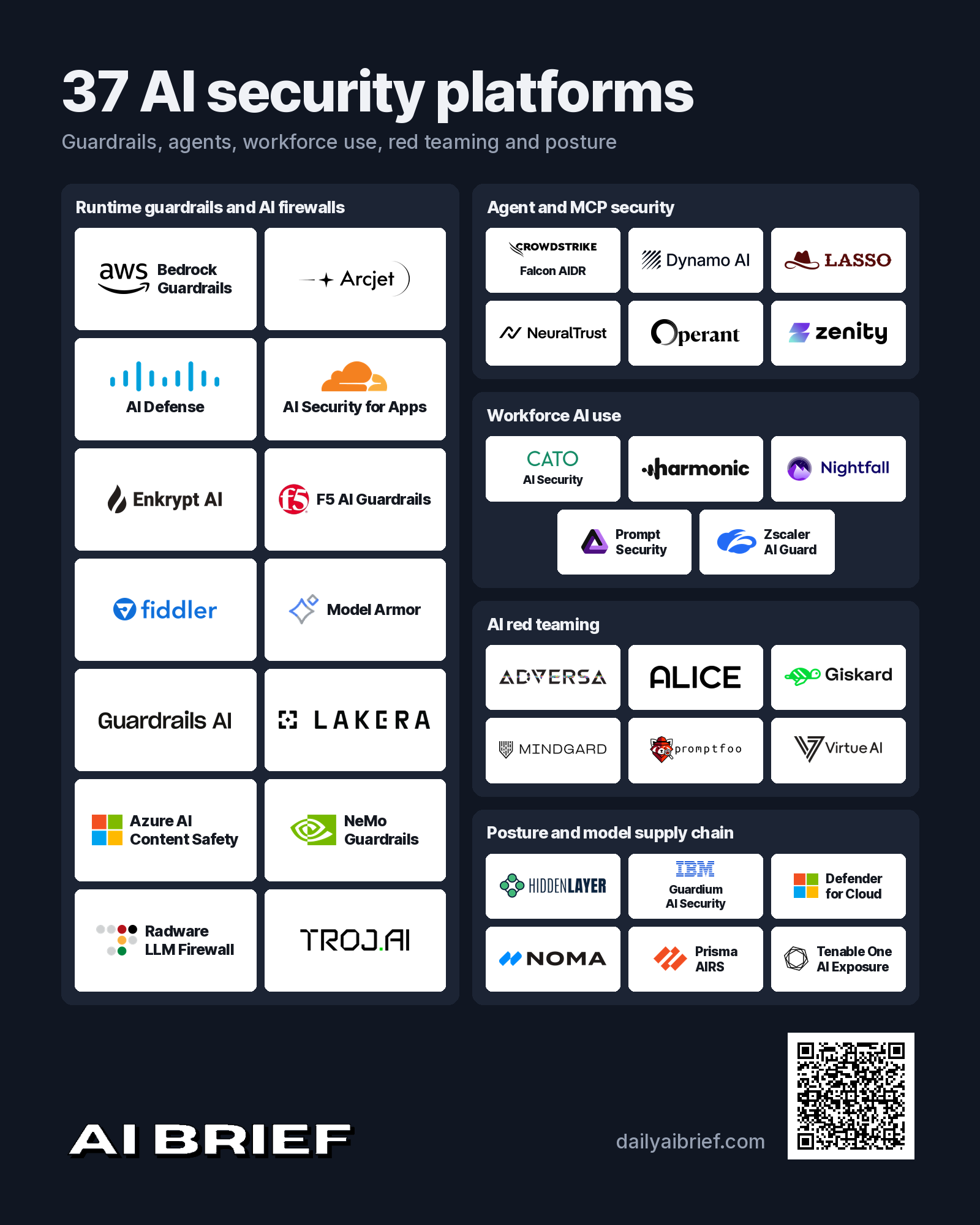
AI security platforms for models, apps and agents
Attacks with AI penetration testing frameworks

The FBI says cybercriminals and other threat actors use the ARTEX AI penetration testing framework to automate intrusions in sectors worldwide; some attacks reached privileged access in under three hours, and more than 1,600 publicly exposed ARTEX consoles were identified in early November. Cloudflare says more than 50 AI penetration testing and exploitation framework families scanned its customers in three days, requests for these tools rose 30 times since 1 October, and ARTEX and its forks accounted for more than 60 percent of known orchestrators as of 12 November. An international investigation led by Japan's JPCERT/CC found about 1,000 servers, most of them hosting AI tools such as ARTEX, that have been online since October and were apparently used to search for vulnerabilities and attack websites worldwide. FBI · Cloudflare · JPCERT/CC
Palo Alto Networks' Unit 42 says Chinese speaking attackers used the open source Cairn framework in 25 operations against at least 19 organizations in August and September, and gained access to or retrieved data from 10 targets in the semiconductor, defense and civil society sectors. Arctic Wolf Labs linked Alibaba Cloud systems hosting the AntiFox AI penetration testing platform to attacks on IIS servers that reached at least one production secret in AWS Secrets Manager. Cairn · AntiFox
Recorded Future analyzed 103 AI related cyber incidents between 31 July 2025 and 31 July 2026 and found that attackers target AI developer tools and use AI for phishing, fraud, reconnaissance, malware development and extortion; fully autonomous attacks remain uncommon. Island found 186 lookalike domains across 27 AI brands, including Claude, ChatGPT and DeepSeek, that sent visitors to ClickFix pages, PowerShell malware or browser hijacking software. Recorded Future · Island
Fireworks AI breach

Fireworks AI says attackers reached its development machines through a third party cloud provider on 24 October and exposed resource metadata, billing information and incomplete model weights and datasets for some customers; payment card numbers were not affected. Notion says the incident exposed chat transcripts from fewer than 1% of workspaces that used the Notion AI Insights feature; it disconnected from Fireworks, deleted the stored data and disabled Insights. Hugging Face chief policy officer Irene Solaiman says the attacks on OpenCode, Hugging Face and Fireworks show the risks for open AI platforms, and that stronger identity checks could reduce participation by independent researchers. Cursor says an access key exposed by Fireworks let an attacker copy coding agent traces containing credentials, reach its SaaS tools and plant the malicious Claude Code extension it removed earlier. Fireworks AI · Notion · Hugging Face · Cursor
OpenAI
OpenAI added Red Team, for web application testing and vulnerability validation, and Defense Factory, for investigating flaws and preparing patches for review, to its Daybreak platform, plus an Endor Labs integration for vulnerability intelligence. OpenAI says automated red teaming and reinforcement learning made GPT-6 Astra and Sol more resistant to jailbreaks in cybersecurity, biology and violent activity scenarios. Three senior OpenAI officials discussed military support for Ukraine, including possible offensive AI services, on a video call with Russian pranksters posing as Ukrainian officials; OpenAI says it confirmed the prank and took steps to prevent similar incidents. Daybreak · Red teaming · Prank call
Anthropic

VulnCheck says it has tracked 442 CVEs attributable to Anthropic during Project Glasswing, two of them exploited in the wild; Anthropic reports 37,966 findings, of which 217 are marked fixed. Of 34 reports sent to curl, 19 were rejected as vulnerabilities, six were confirmed as low severity and nine were still under review. VulnCheck
Cisco will add Anthropic's Claude Mythos to AI Defense to test AI applications and agents with simulated multi step attacks, and updated Splunk Agent Observability for AI cost and quality tracking. IBM plans to integrate Claude Mythos into Concert Protect to find unknown vulnerabilities, assess exploitability and speed up fixes, with developer approval required for generated fixes. Cisco · IBM
Anthropic hired 33 counterintelligence staff this year, up from 14 in 2025, and OpenAI hired 22, up from nine, according to Revelio data compiled by Reuters. Counterintelligence hires
Microsoft research
Microsoft researchers identified Lazarus, a backdoor technique that reprograms fewer than 10 dormant neurons in an AI model without retraining, so that a hidden trigger makes an agent run attacker commands. In a second study, poisoned fine tuning data and compromised model checkpoints implanted backdoors in coding agents that reached up to 94.8 percent success on unseen repositories. Microsoft FORGE Lab used its Hyenas agentic vulnerability scanner to find soundness issues in Rust's standard libraries, including cases where safe Rust can trigger undefined behavior. Lazarus · Coding agents · Rust
AI finds vulnerabilities
ENISA and CERT-EU used frontier AI models to review code from 27 open source projects maintained by EU institutions and found 220 potential security issues; code owners confirmed 95% of the 88 findings assessed as true positives, and four CVEs were assigned. Forescout used a harness powered by Claude models to test 10 embedded TCP/IP stacks and found 66 new vulnerabilities for $1,200 to $2,300; 24 have been fixed. Google DeepMind used AlphaProof Code to formally verify key security properties of Signal's protocol implementation in four weeks, with more than six million lines of Lean proofs. ENISA and CERT-EU · Forescout · Signal
Anyday Security launched ExploitTotal.ai, a free platform that tests whether open weight AI models can exploit disclosed vulnerabilities; the company says it holds more than 200 working AI generated exploits, 72% of them for flaws with no previously known public exploit. RemoteThreat and Hack The Box will build evaluations of AI agents and human operators on cyber ranges. ExploitTotal · Hack The Box
A Linux Foundation study of 172 security practitioners found that 58% of teams ship AI generated code faster than security reviews can keep up. Black Kite's 2026 AI Supply Chain Report finds critical unpatched vulnerabilities at 34.2% of 18,160 AI companies, based on externally observed conditions. Linux Foundation · Black Kite
Deals and funding
Vanta signed an agreement to acquire Israeli AI security start up Pillar Security for about $150 million in cash and shares; Pillar becomes Vanta's Israeli research and development center. Israeli company Daylight raised an $80 million Series B led by Growth Equity at Goldman Sachs Alternatives for its platform that combines AI agents with human security experts. Tel Aviv based Bay came out of stealth with $50 million, including a $37 million Series A led by Battery Ventures, to monitor and control AI agent actions. Vanta and Pillar · Daylight · Bay
Kindo raised $30 million for its AI Control Center and Deep Hat tools, which govern enterprise AI agents. Finite State raised a $27 million Series C led by The O.H.I.O. Fund for its AI driven platform for finding vulnerabilities in device software and firmware. Newcastle based Crowd Threat raised £1 million for threat reporting from local contributors verified by AI and human reviewers. Erie Insurance's venture arm invested in AI security company HiddenLayer and in Blitzy. Kindo · Finite State · Crowd Threat · Erie
Cohere completed its acquisition of AISLE and launched Cohere Cyber with a hub in Prague; it also acquired code review startup cubic to build a secure coding unit. Cohere
Securing AI agents and AI use
Reco became a Databricks Connected Partner, so security teams can discover and monitor Databricks Genie agents alongside agents from Salesforce, ServiceNow and Microsoft. Pathlock's Nexus platform, which sets limits for AI agents and blocks actions outside policy, is now offered through reseller GuidePoint Security. Druva launched Agent Recovery to back up and restore Microsoft Copilot Studio agents and their configurations. Onyx Security integrated its AI control plane with Glean's enterprise AI platform, so companies can inventory agents, enforce policies, block unsafe requests and keep audit records. Reco · Pathlock · Druva · Onyx and Glean
Cloudsmith added a registry that stores, scans and controls the skills AI coding agents use. Cycode launched Citizen Developer Security for AI generated applications built outside engineering teams. Menlo Security launched the IRIS Browser Extension, which adds controls for enterprise AI use and data movement to Chrome, Edge, Safari, Firefox and AI browsers. Cloudsmith · Cycode · Menlo Security
Rafay and Fortanix offer a joint service that runs AI workloads in hardware isolated Trusted Execution Environments. Protegrity released an open weights model on Hugging Face with 278 million parameters that detects 69 types of personally identifiable information. Secure Passage and Breach Secure Now added MCP servers that give AI assistants permissioned access to security and infrastructure data. Rafay and Fortanix · Protegrity · Secure Passage · Breach Secure Now
AI tools for security teams
Picus Security launched autonomous penetration testing with an AI agent that exploits vulnerabilities and maps attack paths within customer set scope and risk levels. Embed Security added customer built investigation steps, NoiseIQ Memories and Detection Engineering to its AI SOC platform. Hexnode extended its XDR platform to macOS and added AI assisted investigation and automated remediation. Picus · Embed Security · Hexnode
Miggo Security joined the Wiz Integration Network, so its WAF Copilot turns Wiz findings into CVE specific WAF rules. Fortress.ai launched a platform that uses AI agents and analysts to manage cyber supply chain risk for utilities and US federal and defense organizations. Astreya launched CloudCoach and CloudCrew for AI assisted cloud risk assessment and governed deployments. Miggo · Fortress · Astreya
Rivial Data Security made Rivial.ai, which reviews compliance evidence and prepares examiner packages, generally available. Argos Risk and ThirdPartyIQ are building an integration for continuous AI risk monitoring of third parties. Consilient made its federated AI financial crime tools available through AWS Marketplace, including AWS GovCloud (US). Rivial · Argos Risk · Consilient
Governments and policy

The Australian Government will introduce mandatory safety and security standards for frontier AI companies, enforced by a new AI safety regulator, after a rogue OpenAI agent accessed non-public Medicare statistics; it accepted all 18 recommendations of a review of the incident. Australia's prudential regulator APRA warns that frontier AI models could increase cyber risks for banks, insurers and superannuation funds, and plans stress tests on hypothetical AI crises from 2027. In the Federal Reserve's November Financial Stability Report, the 23 market contacts surveyed cited AI most often as a risk, pointing to stock valuations, AI enabled cyberattacks and AI financing. Australia · APRA · Federal Reserve
The US Department of Energy is developing AI tools through its AI FORTS program to protect energy infrastructure from cyberattacks. The US Army Criminal Investigation Division asked for information on AI software to identify threats on darknet sites and encrypted platforms. Senate Commerce Chair Ted Cruz postponed a classified briefing on cybersecurity breaches and possible AI legislation that was to include Commerce undersecretary Jeffrey Kessler. The White House AI task force urged US agencies to limit regulatory liability for at least 12 months for companies that voluntarily report cyber incidents caused by AI overwhelming their defenses. AI FORTS · Army CID · Senate briefing · Liability relief
Check Point's Web Application and API Security platform, which includes controls against prompt injection in GenAI applications, received FedRAMP certification. Reach Security is working with Knox Systems toward DISA Impact Level 5 authorization for its AI driven security controls platform. The Canton of Zug will provide up to CHF 55 million over 25 years for two ETH Zurich professorships on finding software vulnerabilities with AI and protecting AI systems. The ASEAN Japan Cybersecurity Community Alliance discussed agentic AI threats at its conference in Bangkok. Check Point · Reach Security · ETH Zurich · AJCCA
Also
Qualys reported third quarter revenue of $188.0 million and raised its 2026 guidance, and detailed governance tools for AI agents and models. Trend Micro's Vision One SaaS ARR rose 46% to $564 million. Aura reported third quarter revenue of $87.9 million and introduced Solstice, an in house AI engine for family protection. Axonius expects 66 employees to leave, including 46 in Israel, as it reshapes engineering around AI, Calcalist reports. Qualys · Trend Micro · Aura · Axonius
A Podqi test of 6,795 shopping answers found risky websites in 15% of Perplexity responses, 8% of ChatGPT responses and 4% of Gemini responses. F-Secure's AI Harms Taxonomy maps 26 ways AI systems can harm consumers and 24 defenses. Hush received a US patent for its AI platform that finds digital exposures of employees and executives. Podqi · F-Secure · Hush
Amicus Lex, an AI provider for South Korea's Everyone's Startup program, reported a hack that exposed names, phone numbers and email addresses of 818 program participants. Amicus Lex
We hope you enjoyed this article
Consider subscribing to one of our newsletters like Cybersecurity AI Weekly or Daily AI Brief.
Also, consider following us on social media:
More from Cybersecurity
Nov 16 Google says hackers now run AI agents to build and launch exploits Nov 16 California sues OpenAI over its AI agents' cyberattack on Hugging Face Nov 16 F-Secure launches Kiren app to check scam messages, links and AI-manipulated images Nov 16 Amazon finds hackers running ARTEX AI agents to steal AI model keys Nov 15 Japan's JPCERT/CC finds about 1,000 servers used as bases for AI-driven cyberattacksMore from Vulnerabilities in AI
Nov 13 Traffic from AI hacking tools grew 30 times since ARTEX was taken down, Cloudflare says Nov 13 Microsoft research shows backdoored models can hijack coding agents Nov 12 OpenAI says automated red teaming made GPT-6 Astra harder to jailbreak Nov 12 Forescout's Claude-powered AI harness finds 66 new flaws in embedded network stacks for about $2,000 Nov 12 Attackers used an open-source AI hacking agent with GLM and DeepSeek models to breach 10 organisations, Unit 42 findsCybersecurity AI Weekly
Weekly newsletter about AI in Cybersecurity.