Telekom's €100m Mistral stake, Ubuntu's AI patches, and more - AI in Europe #3
In this edition:
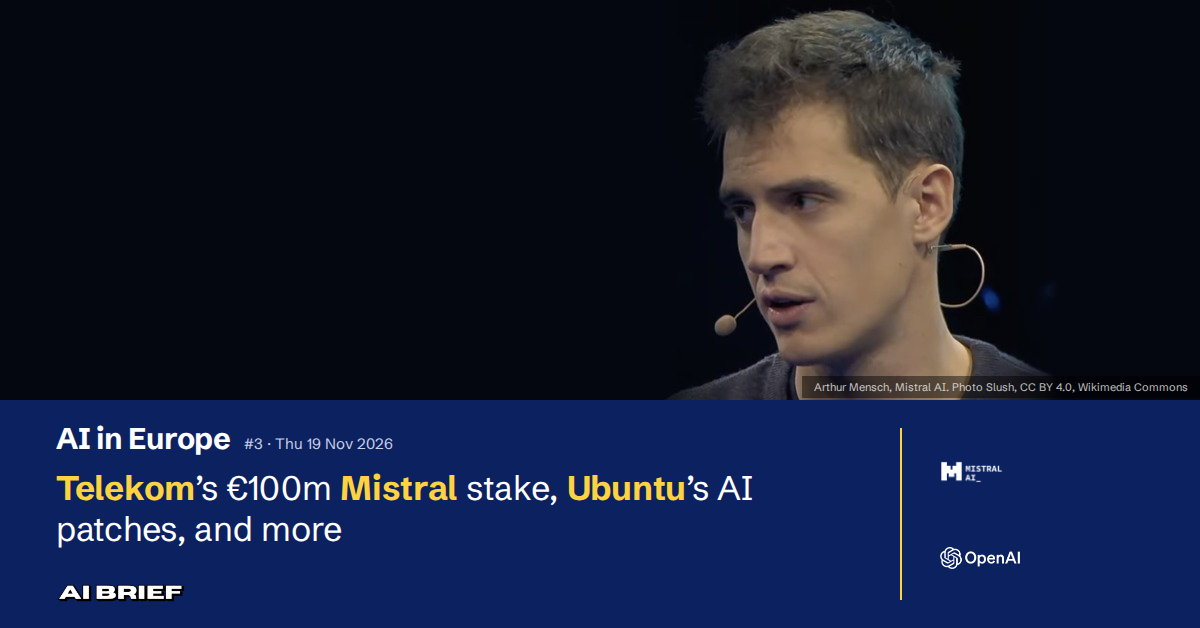
- Deutsche Telekom invested €100 million in Mistral AI in its September funding round, Reuters reports, and CEO Arthur Mensch says Mistral is getting ready for an IPO in Europe, though not this year.
- Canonical lets Ubuntu Pro customers opt into security patches written by its Surge AI system before its engineers finish reviewing them.
- UK safety work: London based Apollo Research embeds six evaluators at OpenAI, and the UK AI Security Institute found jailbreak regressions in two prerelease versions of GPT-6.2 Astra.
About AI in Europe
AI in Europe is edited by Rene van Pelt for AI Brief. Every weekday it brings the AI news that matters for Europe, chosen from the stories AI Brief publishes.
News and tips: news@dailyaibrief.com. Sponsoring this newsletter: stefan@dailyaibrief.com.
France
Mistral AI is getting ready for a listing, and Europe is the natural place for it, CEO Arthur Mensch said at the Semafor tech conference in California. "We won't be doing this this year," he said, giving no date. He expects Mistral to keep a lot of support in Europe whatever the result of France's presidential election. Mistral AI
Deutsche Telekom's T. Capital Tech Fund invested €100 million in Mistral AI in its September funding round, Reuters reports, citing Der Spiegel. The companies call it a first step toward a partnership to help German businesses and the public sector use tailored AI while keeping control of their data. Deutsche Telekom
Under the Paris Call, AI developers commit to evaluate advanced models, report serious incidents and keep mechanisms to restrict, pause or stop models under their control, ActuIA reports. The Élysée published the text on 9 November. It is not binding and sets no sanctions, and the shutdown commitment does not reach open weight models once they are downloaded. Paris Call
French retail technology company Vusion, which sells vision AI and store digitalisation systems, targets €3 billion in revenue by 2030 at constant exchange rates. Vusion
AI helps attackers find vulnerabilities and act faster, says the 2026 report of Wavestone's CERT-W, based on 121 incidents; intrusions stayed undetected for 141 days on average. Wavestone
The Fondation Sopra Steria, Institut de France opens applications for its €100,000 research prize for 2027 on AI and learning among young people. Applications close on 22 January 2027. Sopra Steria prize
European Union
The EU sets the rules for national AI regulatory sandboxes, adopted on 10 November: small and medium sized companies, including startups, get priority and free access to certain services such as regulatory guidance, though exceptional costs may be charged. Member States must open their sandboxes by 2 August 2027, and taking part does not lift companies' legal obligations. EU sandbox rules
United Kingdom
The Bank of England, the PRA and the FCA publish nonbinding practices for financial firms on AI related cyber risks: continuous checks of their exposure, attention to third party dependencies, governance and human oversight, and the use of AI for cyber defence. A separate consultation clarifies existing requirements, proposes no new rules and closes on 26 February 2027. UK AI cyber practices
A team of six from London based Apollo Research will work inside OpenAI for four months to test whether models try to subvert their own or their successors' alignment or control mechanisms. Apollo gets scoped access to training code, data and reasoning traces, and the right to describe the limits of its work publicly. Apollo Research
OpenAI's system card for GPT-6.2 Astra and Sol says the UK AI Security Institute found jailbreak regressions in two prerelease versions. OpenAI says later changes mitigate them, but UK AISI had not independently retested those changes when the card was published. UK AISI tests
Canonical lets Ubuntu Pro customers opt into a new Edge archive with security patches written by its Surge AI system, before its engineers finish reviewing and testing them. Surge fixes known vulnerabilities in userspace software; kernel fixes stay outside it. Customers who use Edge must judge whether the patches are safe for production. Canonical
VodafoneThree will test Nokia's AI native anyRAN software on Nvidia's Aerial RAN computer, first in a lab and then at a selected UK site. The trials look at network performance, capacity, spectrum use and energy efficiency. VodafoneThree and Nokia
Governments overlook about a third of the global AI supply chain, University of Cambridge researchers find. The 117 policy documents they examined focus on models, data and data centres, and leave out factories, chemicals, chip design software and packaging. The researchers point to key dependencies in Germany, the Netherlands and the UK, as well as Japan and South Korea. Cambridge study
Defence company Helsing is cutting several roles in Plymouth and scaling back its UK underwater drone work after it missed out on the Royal Navy's Atlantic Net deal, Briefs reports. The Navy chose Ocean Infinity for a framework that paves the way for £90 million of investment in new drones and sensors. Helsing
Helsing says it will move research and development closer to London and keeps its target of £350 million in UK investment by 2030. Helsing plans
Funding
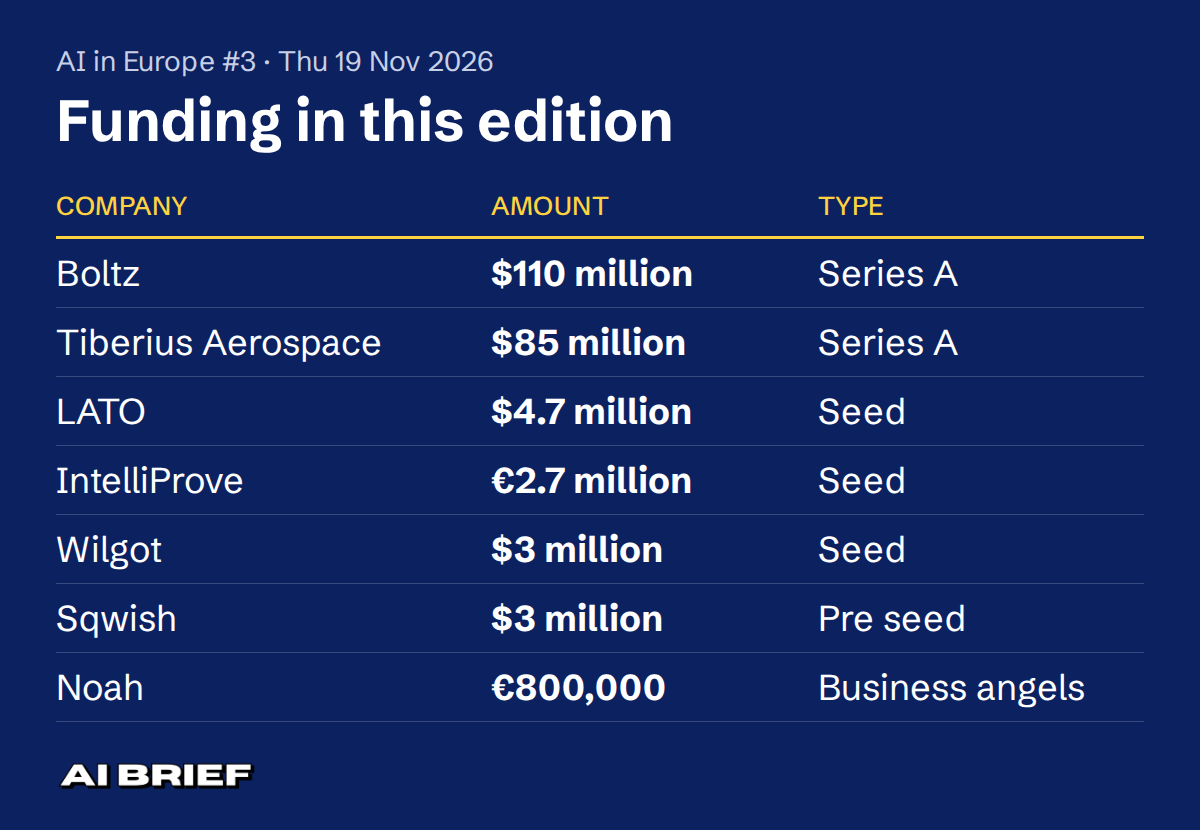
- Boltz, a London based MIT spinout, makes AI models and software for designing drug candidates; Bessemer Venture Partners led the round, which pays for compute, data and hiring.
- Tiberius Aerospace, with headquarters in the US and Switzerland, uses AI to design munitions and works with local partners to make them; Resilience Media reported the round, co led by Lakestar and Rochefort Asset Management, at a valuation of over $1 billion.
- LATO, a Y Combinator company hiring in Warsaw and London as well as San Francisco, builds AI agents that interview customers and experts for private equity firms.
- IntelliProve, in Belgium, says its camera based technology estimates health indicators; it is working on clinical validation and Class IIa certification.
- Wilgot, in Stockholm, rewrites product pages, feeds and FAQs for AI shopping agents.
- Sqwish, in the UK, makes a decision model customers can train on their own data, the company says.
- Noah, in Antwerp, uses AI to interview employees and find possible AI use cases.
Around Europe
Stockholm based Klarna opens an AI personal assistant to invited users from its waitlist. It books restaurants, drafts email replies, shops and sends birthday reminders over text message, WhatsApp and iMessage. Email drafts need the user's approval, and payments need the user's authorisation. Klarna
Amsterdam based speech recognition startup Reson8 releases Rumble-2-Flash, a 500 million parameter transcription model, as a free download with open weights under an Apache 2.0 licence. It supports more than 40 languages, and API access starts at €0.01 per hour of audio. Reson8
Swedish AI company Visage Technologies leads a €3.1 million project, €1.9 million of it co financed by the EU, for a platform that uses cameras, microphones, wearables and other sensors to assess cognitive and emotional states. Its team in Croatia works with the universities of Zagreb and Rijeka, starting with ship navigation training. Visage Technologies
Swiss staffing group Adecco surveyed 40,500 workers in 36 countries: those whose work has AI well integrated say it saves them 20% more time a day, a self reported figure. Adecco says involving workers in redesigning jobs helps. Adecco survey
Smaller items:
- SOFICO, founded in Ghent in 1988, launches SOFICO Intelligence, an AI division formed after it acquired US company Vinli. Its agents flag lease and finance contracts that need attention; a person approves every change.
- FlowForma (Dublin) launches Agent Trust, which finds the AI agents at work in an organisation, tracks their outcomes and costs, and lets leaders pause them or send their work for human review.
Header photo: Arthur Mensch by Slush via Wikimedia Commons, CC BY 4.0, cropped with background edited.

We hope you enjoyed this article
Consider subscribing to one of our newsletters like AI in Europe or Daily AI Brief.
Also, consider following us on social media:
More from AI in Europe
Nov 19 Spanish fintech Devengo raises €5 million for instant payments and AI agent transactions Nov 19 MPs call for a UK AI Safety and Security Bill and a regulator that can stop unsafe AI Nov 19 UK High Court lets self-represented litigants recover the cost of an AI legal research tool Nov 19 EU says an AI-assisted cyberattack targeted it in October Nov 19 Disseqt AI raises $8 million to test and police enterprise AI agentsAI in Europe
Daily AI news from Europe, chosen by Rene van Pelt: European companies, the EU and the UK, chips and data centres, deals and regulation, in a few minutes.