Sharpa Introduces D01 Robot, W02 Hand and AE01 Data Glove
Sep 29, 2026
Robotics
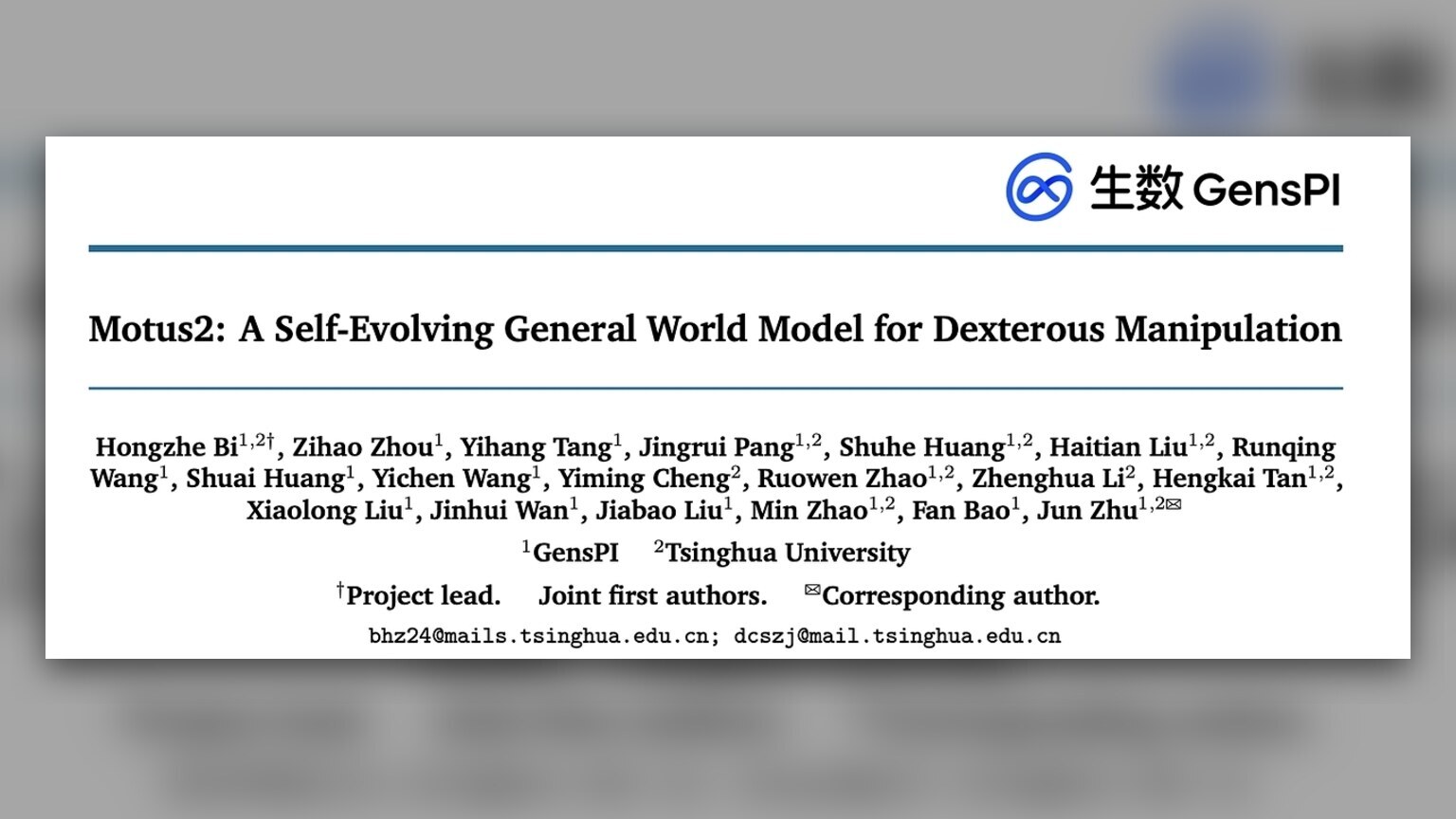
ShengShu Technology unveiled Motus2, a general world model for robotic dexterous manipulation, at the 2026 Inclusion Conference on the Bund on September 10, according to a company press release. The system combines action generation, consequence prediction and outcome evaluation in one video and action model.
Motus2 uses model based reinforcement learning to turn predicted and evaluated outcomes into signals that improve its action policy. It generates candidate actions from language instructions, robot states and visual history, then uses Best of N planning to compare options and select the highest scoring action.
The model recorded an average success rate of 84% across five physical robot tasks, including placing a ball, manipulating objects with multiple fingers and screwing in a light bulb. In separate tests, reinforcement learning and planning during inference increased average success from 65% to 75%, while a tactile component increased average success on two contact sensitive tasks from 60% to 72.5%.
Training data included about 130,000 hours of human recordings from a first person perspective and more than 100 hours of robot trajectories. Adding robot data during training increased average success across the five primary tasks from 51% to 84%. ShengShu Technology made the architecture, research paper and physical robot demonstrations publicly available.
Consider subscribing to one of our newsletters like Robotics Brief or Daily AI Brief.
Also, consider following us on social media:
Weekly coverage of AI-driven robotics advances in industrial automation, autonomous vehicles, and robotic systems.

This industry analysis by The Hackett Group explores the transformative impact of generative artificial intelligence (Gen AI) on global business services (GBS) in 2025. The study highlights the shift from exploration to acceleration of Gen AI initiatives, with 89% of executives advancing these projects to improve customer satisfaction, innovate products, and reduce costs. The report also discusses the challenges and strategies for successful Gen AI adoption, emphasizing the need for a technology-enabled operating model and the importance of reskilling the workforce.
Read moreDaily AI Brief: the AI news that matters, in your inbox.