Plaid launches Agent Detection to tell financial firms when an AI agent is in a session
Nov 17, 2026
FinTech
Klarna announced on 17 November a personal AI assistant that it describes as "a personal concierge". It is live with a small group of early users, and a waitlist is open, Payments Dive reports.
The assistant handles shopping, returns and bookings, from a table for two to a babysitter, drafts email replies for the user to approve, files receipts and flags upcoming birthdays with gift ideas. It works over text message and is also available on WhatsApp and Apple's iMessage. It will not complete purchases on its own: a person must authorise payments, which go through a Klarna payment method or the user's debit card, a spokesperson said. The company declined to say how many people have been invited so far.
"We are bringing AI and agentic commerce to the core of Klarna," chief executive Sebastian Siemiatkowski said on the company's quarterly earnings call. Klarna says users have spent about $34 billion since 2020 through the web browser feature in its existing app.
The assistant enters a crowded field of consumer AI agents with shopping features, including Meta's Muse, Google's Gemini and OpenAI's dots. Klarna is also expanding its longer-term instalment loans, its fastest-growing product, in the US and Europe; their volume has more than doubled over the past year to $12.5 billion in the US, according to Payments Dive.
Consider subscribing to one of our newsletters like Finance AI Weekly, AI in Europe or Daily AI Brief.
Also, consider following us on social media:
Daily AI news from Europe, chosen by Rene van Pelt: European companies, the EU and the UK, chips and data centres, deals and regulation, in a few minutes.
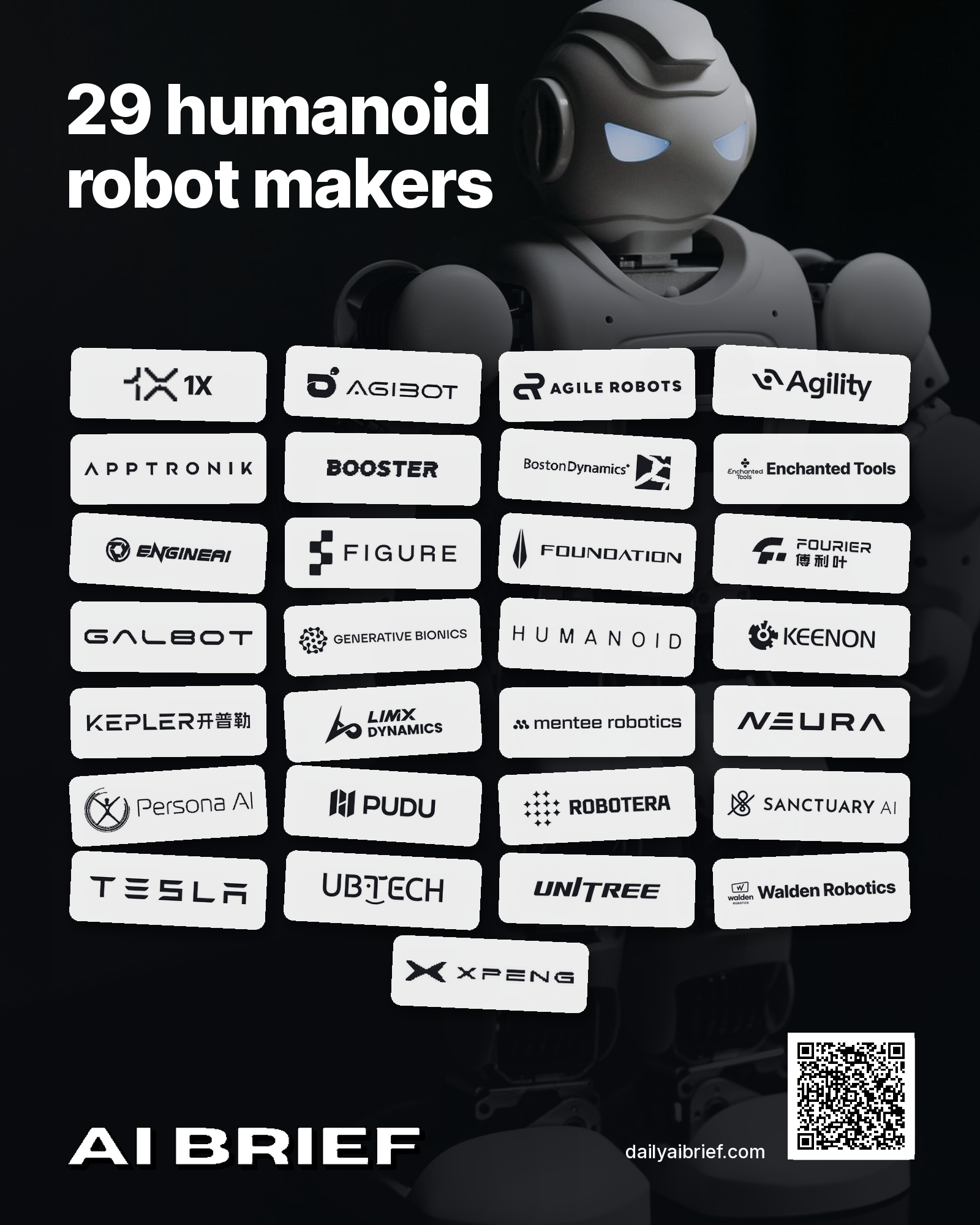
Companies building humanoid robots, from startups to Tesla and Boston Dynamics

 Tensordyne
This Tensordyne whitepaper presents Napier, an inference-focused AI processor and rack-scale system based on the company’s TDN Math logarithmic number system. It examines infrastructure requirements for large mixture-of-experts and agentic models, compares major inference architecture approaches, and details the TDN AIP processor, TDN72 pod, TDN Link fabric, and Napier Ultra configuration. The paper reports simulation-based performance, cost, and accuracy-validation results, including Tensordyne’s projected comparison of one Napier rack with a nine-rack Nvidia Rubin plus Groq deployment; the chip is reported as taped out and in fabrication.
Read moreDaily AI Brief: the AI news that matters, in your inbox.