Google Unveils Gemini 4 Carbon, Its Next Frontier Model
Oct 28, 2026
Cybersecurity
Google has released Gemini 4 Neon, a model it says brings frontier-level intelligence with fast end-to-end task completion across software engineering, knowledge work and science workflows.
Google says Neon ranks third overall on the Artificial Analysis Intelligence Index with a score of 61 at its highest thinking level, just behind larger, slower models, and first on the Artificial Analysis Coding Agent Index at 58.6. It ranks second on the Vals Index at 70.9% and second on Arena's new Agent Arena Index, and Google says it recorded its lowest fabrication rate yet in internal testing.
The model costs $3 per million input tokens and $15 per million output tokens, with a 95% discount on cached input and a 1 million-token context window. At its default thinking level, Google says it has a 32% lower cost per task than Gemini 4 Carbon. Neon is rolling out in the Gemini API in Google AI Studio, Gemini for business, the Antigravity coding tool for paid AI Pro and Ultra subscribers, and the Gemini app.
Google also highlights cyber defence: a version called Neon for cyber reaches state-of-the-art scores on several vulnerability-finding and exploitation benchmarks and is rolling out to trusted defenders in the coming days through its Fairwind Program. Google says Neon keeps Carbon-level safeguards against cyber and biosecurity misuse while refusing far less legitimate work, according to Google.
Consider subscribing to one of our newsletters like Cybersecurity AI Weekly or Daily AI Brief.
Also, consider following us on social media:
Weekly news about AI tools for software engineers, AI enabled IDE's and much more.
 Tensordyne
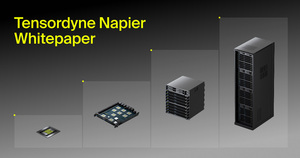
This Tensordyne whitepaper presents Napier, an inference-focused AI processor and rack-scale system based on the company’s TDN Math logarithmic number system. It examines infrastructure requirements for large mixture-of-experts and agentic models, compares major inference architecture approaches, and details the TDN AIP processor, TDN72 pod, TDN Link fabric, and Napier Ultra configuration. The paper reports simulation-based performance, cost, and accuracy-validation results, including Tensordyne’s projected comparison of one Napier rack with a nine-rack Nvidia Rubin plus Groq deployment; the chip is reported as taped out and in fabrication.
Read moreDaily AI Brief: the AI news that matters, in your inbox.