Plato raises $16 million for simulated AI workplaces
Oct 28, 2026
Funding
Energy Concepts announced Plato5X, a modular infrastructure platform for AI data centers that generates power, cooling, water, and captured carbon on site, stated in a press release.
Each 5 MW module is designed to produce 5,000 kilowatts of electricity, 12,000 gallons of water, and 11,000 gallons of food grade liquid CO₂ per day. The company says the system captures more than 90 percent of combustion generated carbon dioxide.
Plato5X combines natural gas cogeneration, absorption cooling, water recovery, and carbon capture. Energy Concepts says the system does not require utility power or municipal water and can be configured for smaller edge facilities or larger data center campuses.
For a 100 MW facility, the company says the platform could produce up to 240,000 gallons of water and 220,000 gallons of food grade liquid CO₂ per day. The system can be financed, built, and operated separately from the data center white space.
Consider subscribing to one of our newsletters like Silicon Brief or Daily AI Brief.
Also, consider following us on social media:
Weekly coverage of AI hardware developments including chips, GPUs, cloud platforms, and data center technology.

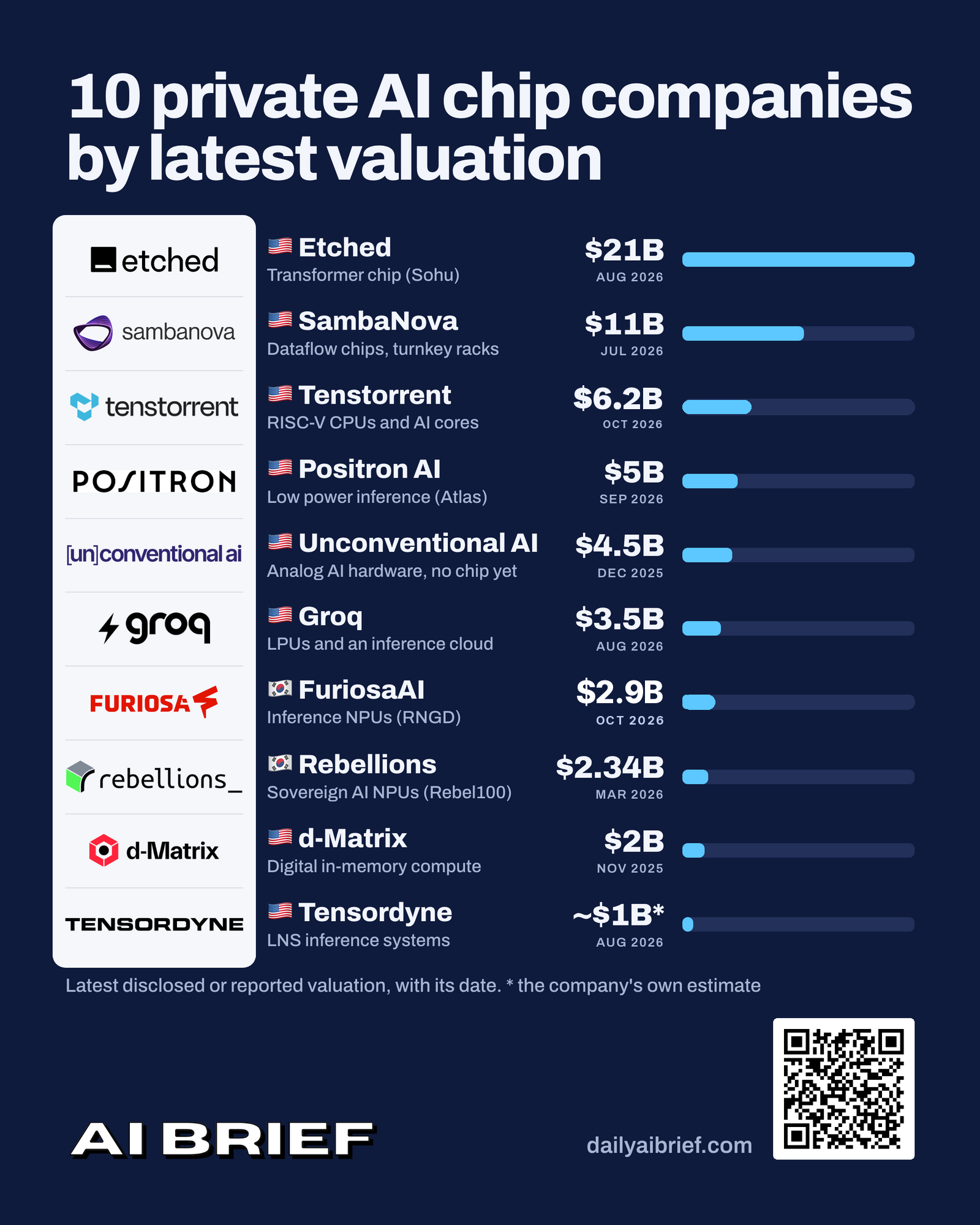
 Tensordyne
This Tensordyne whitepaper presents Napier, an inference-focused AI processor and rack-scale system based on the company’s TDN Math logarithmic number system. It examines infrastructure requirements for large mixture-of-experts and agentic models, compares major inference architecture approaches, and details the TDN AIP processor, TDN72 pod, TDN Link fabric, and Napier Ultra configuration. The paper reports simulation-based performance, cost, and accuracy-validation results, including Tensordyne’s projected comparison of one Napier rack with a nine-rack Nvidia Rubin plus Groq deployment; the chip is reported as taped out and in fabrication.
Read moreDaily AI Brief: the AI news that matters, in your inbox.