
Chinese unmanned vessel maker Cangchao Technology raises tens of millions of yuan in Angel++ round
Industrial Securities Capital and Gaohua Technology invested in the Lianyungang company's third round of 2026, taking its total to nearly 100 million yuan.
28 Nov 2026
Cangchao Technology, a Chinese company that builds self-driving systems for boats, has closed an Angel++ round worth tens of millions of yuan, 36Kr reports. Industrial Securities Capital, a subsidiary of Industrial Securities, and listed company Gaohua Technology invested. It is the company's third round this year and brings its total funding to nearly 100 million yuan.
Robotics Brief covers stories like this, every Thursday. Free.
The money will go into digital tools for offshore maintenance work, what the company calls "marine physics AI", certification with classification societies, and work on a world model of offshore waters.
Founded at the end of 2023 and based in Lianyungang, Cangchao sells two product lines. One is a standard self-driving kit that can be fitted to existing boats such as rescue and patrol craft in under an hour, which is in volume delivery. The other is its own unmanned vessels for maritime patrol and for maintenance at offshore wind and solar farms.
The company says it has delivered products to nearly 100 customers, including maritime, coast guard and border defence units, port operators and offshore wind developers. CEO Cheng Chen said the hardest part is getting approved sea areas for real-world testing.
Where this comes from
eu.36kr.com Waterborne Autonomous Driving Startup Secures Tens of Millions Yuan Financing to Accelerate Nearshore Unman...In this story
More from Robotics
Nov 27 Ant Group's Robbyant open-sources LingBot-Map 2.0 and LingBot-Navi robot mapping and navigation models Nov 27 Tsinghua spin-off Zerith raises several hundred million yuan for picking robots Nov 27 XCMG shows unmanned earthmoving fleet and embodied-intelligence machines at bauma CHINA 2026 Nov 26 Volvo Cars trains Hexagon AEON humanoid robots in Ghent for production from mid-2027 Nov 26 ROBOTERA runs 45 humanoid robots for parcel handling at China Post's Hangzhou hubMore from Funding
Nov 27 Zurich's nextesy raises €9.48 million seed led by Swisscom Ventures for AI business-administration agents Nov 27 Dunzo co-founder's AI household startup M raises $9 million seed extension led by RTP Global Nov 27 Dutch startup SPCTR raises €2.8 million for AI that checks tumour margins during cancer surgery Nov 27 Lampsy Health raises €1.1 million for AI bedside lamp that detects epileptic seizures Nov 27 India's Ripik secures commitments for $14 million round to bring AI vision to factories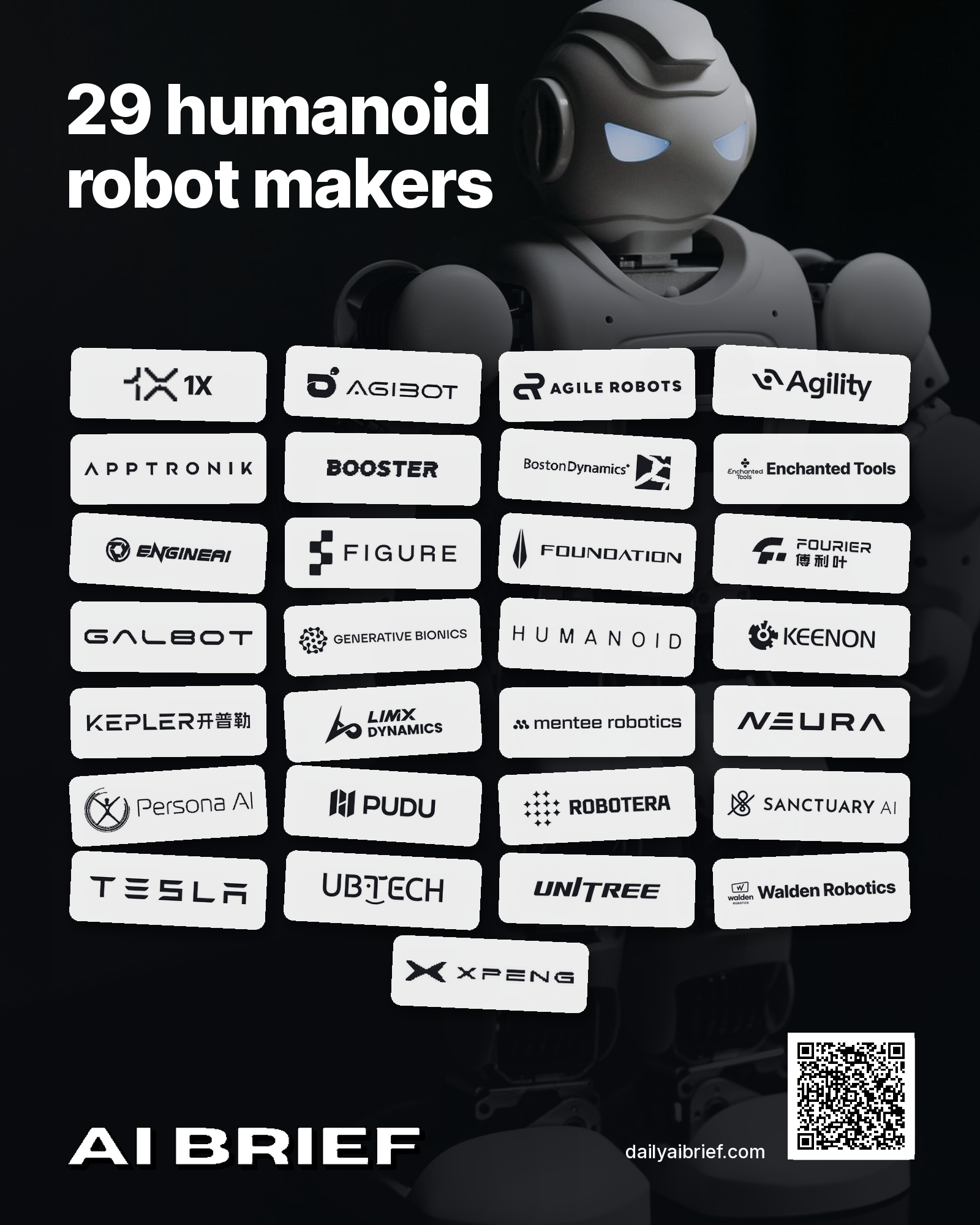
Humanoid Robot Makers
Companies building humanoid robots, from startups to Tesla and Boston Dynamics
Whitepaper

Tensordyne Napier: What If One Rack Could Do the Work of Nine?
 Tensordyne
This Tensordyne whitepaper presents Napier, an inference-focused AI processor and rack-scale system based on the company’s TDN Math logarithmic number system. It examines infrastructure requirements for large mixture-of-experts and agentic models, compares major inference architecture approaches, and details the TDN AIP processor, TDN72 pod, TDN Link fabric, and Napier Ultra configuration. The paper reports simulation-based performance, cost, and accuracy-validation results, including Tensordyne’s projected comparison of one Napier rack with a nine-rack Nvidia Rubin plus Groq deployment; the chip is reported as taped out and in fabrication.
Read moreYou may also like
Cyngn Q3 Revenue Rises to $156,000 on Autonomous Vehicle Subscriptions 12 Nov 2026 Corridian raises $38 million for autonomous underwater vehicles 4 Nov 2026 whereable.ai raises $2.26 million for world-model autonomous driving at industrial sites 24 Nov 2026 Helsing scales back UK underwater drone plans after missing out on £90 million Royal Navy deal 19 Nov 2026 AI acoustic perception startup HearWell raises two rounds totalling tens of millions of yuan 26 Nov 2026 Aqura Systems raises £2.1 million for AI fish-farm monitoring robot 25 Nov 2026Daily AI Brief: the AI news that matters, in your inbox.