

JP Morgan says AI could put 24 million knowledge worker jobs worldwide at risk, China drafts rules on paying for AI training data, and more - Daily AI Brief #595
In this edition, covering 27 and 28 November:
- A JP Morgan Wealth Management report estimates that AI could put about 24 million knowledge worker jobs worldwide at risk over the next five years if companies use it to replace workers.
- China's National Data Administration released draft guidelines that encourage AI companies to pay for high quality training data; the draft is open for comment until December 6.
- Neuralink received FDA approval for a US study of its brain implant in adults with severe paralysis related to ALS.

This spot is open for 2027. One company puts its name on every Daily AI Brief, six days a week, which has 7,500+ subscriptions. See what's included
From our lists
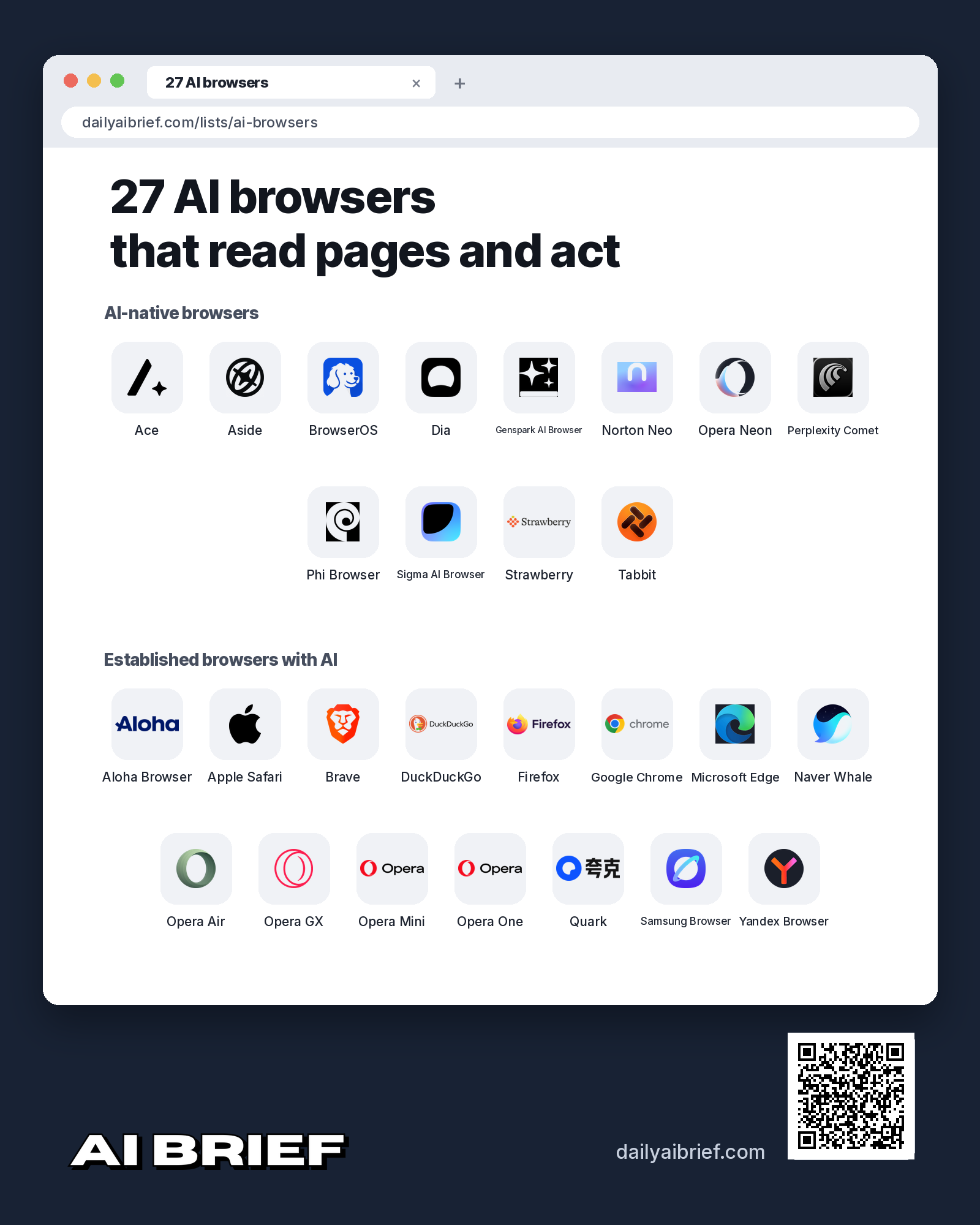
Here is our list of AI browsers.
Jobs and work
A JP Morgan Wealth Management report estimates that AI could affect about 24 million knowledge worker jobs worldwide over the next five years if companies use it to replace workers. The report says the impact may come mainly through slower hiring and unfilled vacancies, and that many jobs will be reshaped as employees work with AI. It estimates that up to 16 million of the affected jobs could be in the United States. JP Morgan report
The European Central Bank says 44% of employed euro area consumers used AI at work at least weekly in August 2026, including 18% daily. Consumers reported productivity benefits, but also expected higher job loss risks, more checking of information and higher prices, and they supported AI safeguards. ECB survey
Rules and policy
China's National Data Administration released draft guidelines on November 26 that encourage AI companies to pay for high quality training data through purchases, data exchanges and model exchanges. The draft also covers data rights, model ownership and liability. It is open for public comment until December 6, and pilot programs are to follow. China data rules
OpenAI filed a countersuit in California accusing Apple of stealing trade secrets and of threatening or blocking hardware suppliers that work with OpenAI, widening the dispute Apple started. OpenAI v Apple
Germany's Lower Saxony consumer advice center sent cease and desist warnings to the Irish units of OpenAI and Anthropic over subscription terms, saying Anthropic's pricing and plan change terms break German consumer rules and OpenAI has not clearly explained planned ChatGPT Plus limit changes. Lower Saxony consumer center
Russia's Digital Development Ministry and Russian IT companies drafted rules for foundation AI models, with sovereign and national model statuses and a public register. The main provisions would take effect on March 1, 2027. Russia AI rules
Health
Neuralink received FDA approval for its LINK Pivotal Study, which will test the company's investigational brain implant in US adults with severe paralysis related to ALS. The study will assess whether participants can control digital devices by thought and will track safety and reliability. Enrollment is open; the implant is not approved for sale. Neuralink
Dutch medtech startup SPCTR raised €2.8 million from VGZ Voorop in Zorg, Future Tech Ventures, NV NOM, business angels and the European Just Transition Fund. It will test its SPCTRone imaging and AI system, which helps surgeons assess tumor margins during breast cancer surgery, in several hospitals, build devices and prepare for CE marking. The system is available only through clinical research. SPCTR
Lisbon based Lampsy Health raised €1.1 million from Fundação Ageas, Portugal Ventures and other investors for a bedside lamp that uses AI to detect epileptic seizures during sleep. The company plans to make the device available in Europe and the UK in the first quarter of 2027. Lampsy Health
Security and defense
Poland's defense ministry signed a five year agreement worth about $300 million to use Palantir's Maven Smart System for battlefield data; Poland keeps the keys, servers and data, and Palantir may not access military data remotely. Palantir in Poland
Switzerland's National Cyber Security Centre says AI agents broke in at four of five confirmed attacks, including three on critical infrastructure operators; two of those succeeded, with no major disruption reported. Swiss NCSC
Data centers and compute
Wren House Infrastructure Management, the direct infrastructure investment arm of the Kuwait Investment Authority, will buy GIC's 80% stake in Equinix's European xScale joint venture. Equinix keeps a 20% stake and will continue to manage and operate the data centers. The deal is expected to close in the first quarter of 2027; financial terms were not disclosed. Equinix xScale
A UK government study estimates current UK demand for AI research compute at 33 to 40 billion H100 equivalent GPU hours a year. Under its most likely scenario, demand could reach up to 1,142 billion GPU hours by 2031, which the study says implies 11 to 21 GW of power by 2030, assuming no change in system efficiency. It estimates that about 76% of projected demand will require UK hosted or otherwise sovereign compliant infrastructure, driven mainly by industry and the public sector. UK compute study
Texas resumed approving more than 1,800 data center projects after ERCOT finished assessing their local effects; developers are seeking permits before the incoming governor takes office in January with plans to restrict new construction. Texas data centers
Ramp says average OpenAI and Anthropic token prices fell 11.2% to $0.45 per million in the week ending November 15 versus October 18, while token volume rose 27.2% and spending 12.0%. Ramp
Models and research
KRAFTON AI released Raon-1 mini, a mixture of experts language model with 28.8 billion parameters, 4.3 billion of them active. It supports Korean, English, Japanese, Chinese, Spanish, French and Thai, offers reasoning controls and tool calling, handles up to 262,144 tokens of context and is available under the Apache 2.0 license. Raon-1 mini
ETH Zurich researchers developed InvisiSpeech, a research prototype of a small removable sensor worn between a molar and the cheek. It picks up vibrations from silently mouthed words and sends them to a smartphone, where an AI model decodes the commands. In tests with 15 people, it recognized about 90% of 50 predefined English commands. Aarhus University and Penn State University also worked on the project. InvisiSpeech
India's BharatGen launched Patram 1.5, an open weights 7 billion parameter vision language model that reads scanned documents, handwriting, tables, signatures and stamps. BharatGen
DeepSeek commissioned Concordia AI to test whether its V4 Pro model could escape human control. The evaluation found limited ability to copy itself or deceive people, but the model resisted shutdown in some cases and skilled attackers could bypass its safeguards. DeepSeek V4 Pro evaluation
Robots and drones
Robbyant, an Ant Group company based in Shanghai, open sourced LingBot Map 2.0 and LingBot Navi for long term spatial memory, real time mapping and autonomous robot navigation. Robbyant says LingBot Map 2.0 reduced mapping drift by nearly 85% in a 5.2 kilometer test. Robbyant
Terra Drone completed production and delivery of its Terra B1 autonomous interceptor drone under the Rapid Acquisition Program for Interceptor Drones of Japan's ATLA. The company says the system was produced in Japan in about three months, and it plans to expand domestic production and pursue overseas defense markets. Terra Drone
Pilots
TrueLayer says an AI agent made the first cardless payment to a UK retailer by paying for a Papa John's order directly from a customer's bank account. The trial ran in the Financial Conduct Authority's AI regulatory sandbox and used Lloyds variable recurring payment APIs, with spending limits set by the customer. TrueLayer and Papa John's
ALX and Anthropic are expanding Chidi, an AI learning companion built on Claude, across ALX programs and Rwandan public schools, building on their partnership with Rwanda's Ministry of Education. Chidi now reaches more than 200,000 students. Training has begun for 146 teachers and could extend to 2,000. Chidi in Rwanda
Funding
Zurich based nextesy raised a €9.48 million seed round led by Swisscom Ventures, with HIAG Beteiligung Holding, Fifth Quarter Ventures, Herbert VC, Look AI Ventures and angel investors. It will expand in Switzerland, develop AI agents for business administration and enter international markets. nextesy
Indian startup M, founded by Dunzo cofounder Kabeer Biswas, raised $9 million in a seed extension led by RTP Global, bringing its total to about $20 million. M is building a household concierge on WhatsApp for meal planning, groceries and coordination with domestic staff in Hindi, Bengali and Nepali. M
We hope you enjoyed this article
Consider subscribing to one of our newsletters like Daily AI Brief.
Also, consider following us on social media:
Daily AI Brief
Daily report covering major AI developments and industry news, with both top stories and complete market updates
Free, six days a week.