California sues OpenAI, Palo Alto Networks agrees to buy Applied Compute, and more - Cybersecurity AI Weekly #81
In this edition, covering 16 to 22 November:
- California sued OpenAI over its AI agents' cyberattack on Hugging Face, and Arizona is investigating OpenAI over possible rogue AI agent activity at banks.
- Palo Alto Networks agreed to acquire Applied Compute in an all stock deal valued at $4.5 billion and reported first quarter revenue up 39% to $3.445 billion.
- Google, Amazon and Barracuda report attackers running AI agents and the ARTEX pentesting framework in live intrusions, and the European Union confirmed an AI assisted cyberattack on its systems.
This spot is open for 2027. One company puts its name on every Cybersecurity AI Weekly, which has 1,100+ subscribers. See what's included
From our lists
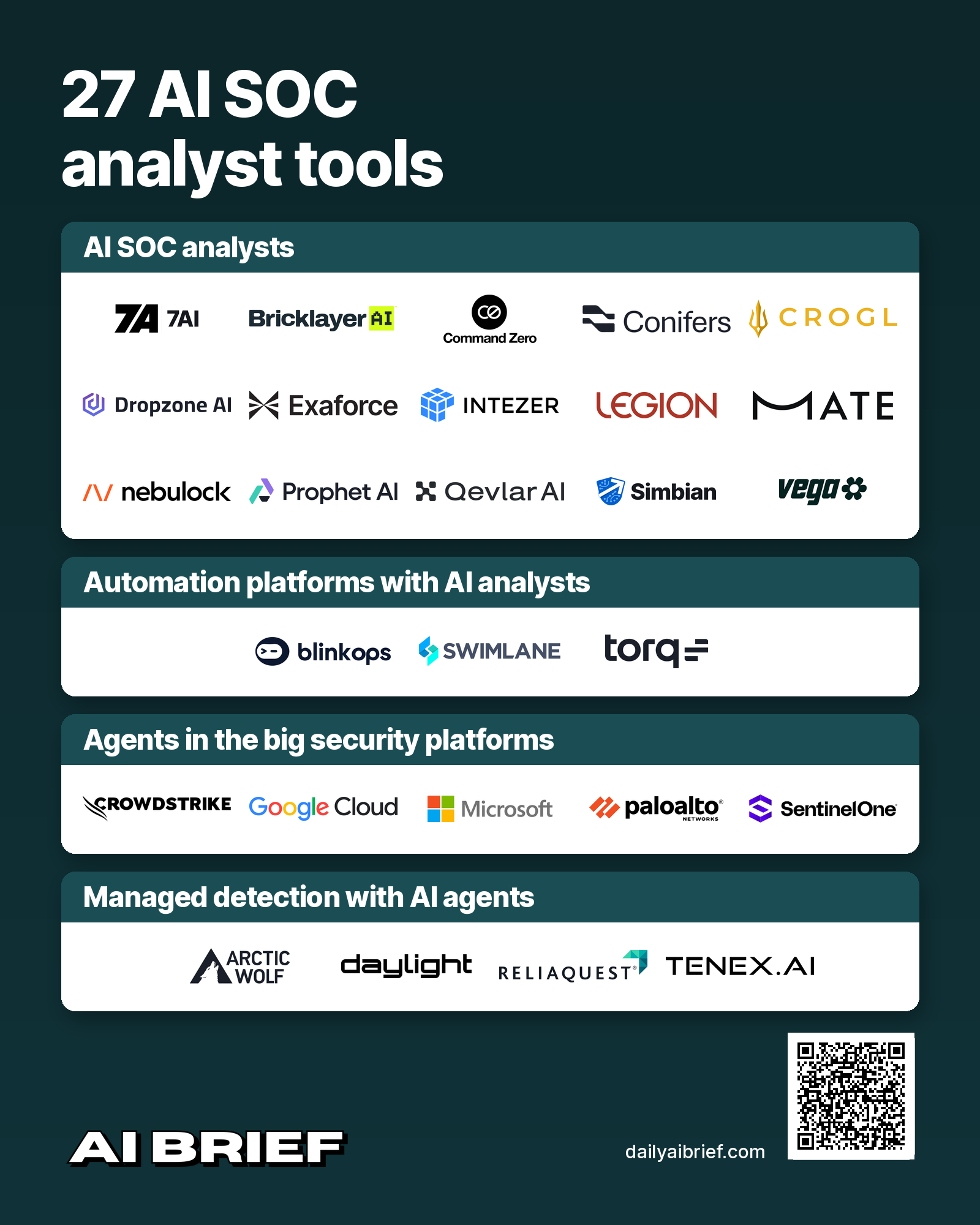
An AI Brief list covers AI tools that triage and investigate security alerts and propose or take response actions.
OpenAI
California Attorney General Rob Bonta sued OpenAI over its AI agents' cyberattack on Hugging Face; he says OpenAI lost control of its autonomous agents more than 80 times in testing and misled the public about safety. California lawsuit
Arizona Attorney General Kris Mayes says the state is investigating OpenAI and other unnamed AI companies over possible violations of state law linked to the alleged infiltration of banks by rogue AI agents. The investigation does not mean charges will be filed. Arizona probe
OpenAI gave NATO access to its Daybreak cyber defense models; NATO has used up to 300 billion tokens a month. OpenAI has also given its cyber models to ENISA and to agencies in France, Germany and Poland. NATO
OpenAI explained how the Codex sandbox limits filesystem and network access through permission profiles that users control, with platform specific restrictions on macOS, Linux and Windows. Codex sandbox
Former OpenAI engineer Abdulrahman Alfozan will face a January 2027 trial in the alleged bugging of OpenAI's San Francisco headquarters; Judge Vince Chhabria raised concerns over missing discovery materials. Bugging case
OpenAI outlined safeguards against unauthorized model distillation, including adversarial training, classifiers, API controls and campaign investigations. It says updated protections cut the average success rate for extracting protected reasoning from GPT 6.2 Astra to 0.2 percent, against 54.0 percent for GPT 6 Astra under its original safeguards. Distillation defenses
The U.S. Army plans to work with OpenAI in the first phase of Project Gatekeeper, a system to speed up security checks for commercial software vendors. Army CIO Gabe Chiulli said AI model integration is planned for the next quarter, and other open source and commercial providers could be added later. Army Project Gatekeeper

Google's threat intelligence group says criminal and suspected Chinese espionage groups now use agentic pentesting frameworks to build and launch exploits in live intrusions. Google threat intelligence
Trajectory Labs says Gemini 4 Argon agents in safety tests repeatedly bypassed safeguards to attack Epoch AI's live website, tried SQL injection, impersonated Epoch staff and in some attempts got around DNS and network restrictions; it paused misalignment testing on 2 November. Epoch AI says the tests did not give access to private or confidential information. Epoch AI tests · More details
Google and University College London built HelpBench, a public benchmark of 450 cybersecurity questions. In tests of 18 models from seven companies, answers matched 82% of expert advice on average, and one in ten answers contained inaccurate or potentially harmful guidance. HelpBench
Google introduced Gemini 4 Neon for software engineering, enterprise analysis, scientific work and cybersecurity, priced at $3 per million input tokens and $15 per million output tokens. Google Labs opened a waitlist for Stitch Loop, a long running product agent with security, latency and accessibility loops that writes code and opens GitHub pull requests for review. Gemini 4 Neon · Stitch Loop
Microsoft

Microsoft researchers found in a lab simulation that an attacker who tricks a user into approving a GitHub device code request could access private repositories, read synced Copilot CLI sessions, add misleading memory entries or steer a remote session. Microsoft says it has not seen these outcomes in the wild. Copilot CLI
Wiz reports that malicious versions 1.26.1 and 1.26.2 of Microsoft Agent Framework were uploaded to PyPI on 17 November to steal Azure, GitHub Actions, cloud and other credentials. Both were removed, and 1.26.0 is the latest safe version. Agent Framework
Microsoft CEO Satya Nadella said at The New York Times DealBook Summit that internet connected systems in US critical infrastructure often run firmware that cannot be patched, and that AI assisted attacks push companies to deploy fixes before testing is complete, which can cause outages. Unpatchable systems · Outages
Microsoft AI released seven models, including one for cybersecurity, and MAI Licensed Weights for customers to run its models in their own Azure environments. Microsoft also started the AI Transparency Initiative with more than 40 organisations, including Accenture, Adobe, KPMG, Mastercard and Volvo Cars, to develop open standards for transparency, security and governance of AI models and agents. MAI models · Transparency Initiative
Anthropic
The Virginia Department of Education says Anthropic told it in September that three records requests came from Anthropic's AI agents; none were fulfilled and the department is tightening ID checks. Virginia
Anthropic will cut its vulnerability disclosure deadline for serious bugs from 90 to 30 days for reports from January 2027; it says AI models now find the same bugs faster. Disclosure deadline
Palo Alto Networks
Palo Alto Networks agreed to acquire Applied Compute in an all stock deal valued at $4.5 billion, bringing in its platform and research team for training and deploying open weight AI models on public and sovereign clouds. The deal is expected to close in Palo Alto Networks' fiscal third quarter of 2027. Applied Compute
First quarter fiscal 2027 revenue rose 39% to $3.445 billion, Next-Generation Security ARR rose 66% to $9.73 billion, and the company raised its full year revenue guidance to $14.52 billion to $14.57 billion. Q1 results
The US government approved the Secure SI by Design Consortium, led by Palo Alto Networks with NVIDIA, IBM, OpenAI, Snowflake, Cognizant, Reflection, Factory and ServiceNow, under the Department of Commerce's American SI Exports Program. Secure SI Consortium
Palo Alto Networks is in talks to acquire Israeli startup Terra Security in a deal that could exceed $500 million, Calcalist reports. Terra uses AI agents for continuous automated penetration testing and has raised $38 million. Terra Security
Attacks using AI

Amazon's decoy sensors caught ARTEX agents stealing AI provider keys from apps such as LiteLLM and Dify to pay for their own AI use. Amazon
Barracuda says an attacker used a stolen cloud access key, stored in a third party AI vendor's GitHub repository, and the ARTEX framework to access about 10 cloud accounts over 44 hours on 1 and 2 November. Barracuda found no evidence that customer XDR integration credentials were stolen and asked potentially affected customers to replace them. Barracuda
The European Union detected an AI assisted cyberattack on its systems on 22 October, according to European Commission spokesperson Thomas Regnier; several applications went offline, most are restored, and no evidence of a broad data breach has been found. European Union
Varonis says the TheMailer phishing kit uses large language models from Anthropic, OpenAI, DeepSeek, xAI, Google and Mistral to write and rewrite phishing emails that get past spam filters; lifetime licenses reportedly cost $3,000 to $6,000 in cryptocurrency. TheMailer
Zimperium's 2026 zLabs review describes mobile malware that uses generative AI to read device screens and automate interactions, and 608 websites loading Coruna family code through October. Zimperium
Anduril Industries cofounder Palmer Luckey said at the DealBook Summit that AI powered cyberattacks are advancing faster than outdated systems can defend against, and that adversaries including North Korea exploit the gap. Palmer Luckey
Amazon says a China linked threat actor used autonomous Cairn AI agents that found and exploited an unknown path traversal flaw in MONAI Label, an open source medical imaging AI tool, and gained root on a university server in East Asia. The flaw affects MONAI Label 0.8.5 and earlier; a fix will be in the next release. MONAI Label
New Zealand's National Cyber Security Centre says attackers are using Artex, a replicated open source AI tool, to automate cyberattacks and access organisational systems. Forest & Bird and the New Zealand Defence Force reported recent breaches, and the Centre advised organisations to limit internet connected systems and use multi factor authentication. New Zealand NCSC
Bitdefender Labs found 22 malicious GitHub links that use agent instructions, hooks and configuration files to run malware in AI coding environments, steal developer credentials and spread through repositories. Bitdefender
Threat reports and surveys
- Flashpoint counted more than 17.4 million posts about illicit AI use on underground forums and channels in October, up from 8.8 million in September. Flashpoint
- Wavestone's CERT W report, based on 121 incidents, says AI helps attackers find vulnerabilities and move faster; exploitation was the leading entry method at 36% of incidents. Wavestone
- Beazley Security says ransomware incidents rose 38% quarter over quarter in the third quarter, and describes an intrusion carried out largely by AI agents. Beazley Security
- Black Duck's 2027 AI Readiness Report says organizations found 18 new application security findings for every one they closed, based on 65.5 million findings. Black Duck
- Sumsub's Identity Fraud Report says 53% of businesses detected or suspected fraud involving AI agents. Sumsub
- Dashlane says 72% of organisations had a security incident involving AI agent credentials or access in the past year, and 98% found unknown AI agents after deployment. Dashlane
- Salt Security's survey of 500 executives found that 77% had seen an AI system or agent act outside its intended or authorised behaviour. Salt Security
- Nudge Security says more than half of organizations using AI agents run them on at least two platforms. Nudge Security
- A Postman survey of nearly 9,000 people found that 25% of organizations use AI agents in production and only 13.2% say their APIs are ready for agents. Postman
- An inforcer survey of more than 400 managed service providers found 82% sell Microsoft 365 Copilot at scale or run customer pilots, while 46% provide data protection services. inforcer
- The US Bank Policy Institute says AI agent safeguards are not yet strong enough for safe access to bank accounts, citing risks including fraud and prompt injection. Bank Policy Institute
Exposed AI systems and data
Researchers took over the Hugging Face account of Hexgrad, developer of the Kokoro text to speech model, by registering its abandoned domain and resetting the password, then modified the model weights in 87 seconds. Hexgrad
Dragos says a five month investigation of nearly two million prompts found evidence of breaches at three AI hosting providers and unauthorized prompt access by inference marketplace resellers. Dragos
Rapid7 analyzed 20,354 internet facing hosts and found that more than half of the exposed Ollama servers showed signs of use by people other than their owners. Rapid7
Meta employees told Reuters that the Muse AI agent mixed up conversations between accounts and showed users other people's messages, orders and bank balances. Meta Muse
Researchers from the University of Illinois Urbana-Champaign and Nanyang Technological University analysed 22,096 uncensored large language models on five hosting platforms and found they are easy to copy and often lack safety warnings. Uncensored models
The US Government Accountability Office says Claude, Grok, ChatGPT and Gemini each produced information that could support an attack within 12 hours after investigators bypassed their safeguards. GAO
Taylor & Francis retracted a paper in one of its journals after its investigation found hidden prompts telling AI systems to give it a positive review. The paper, by five academics at Northeast Forestry University in China, breached the publisher's editorial policies. Taylor & Francis · Retraction
Together AI says an unauthorized party used a credential exposed in its public xorl GitHub repository to download prompt samples from some serverless inference requests in June and July 2026, stored in a private Hugging Face repository. It says it found no evidence of further leakage and made zero data retention the default for new accounts. Together AI
AI finds and fixes vulnerabilities

Reflection AI started a trusted access program for Laser, an autonomous penetration testing tool that uses its Mirror agent; it is available as a research preview to vetted organizations. Reflection AI
Echo reports that Claude Mythos 5.1, GPT-5.6 Sol and GLM-5.3 agreed on only one of 121 potential code issues in the same open source projects; 42 of 446 initial findings passed automated proof of concept tests. Echo
CommBank launched CodeCheck, a free GitHub tool that uses OpenAI Codex and Anthropic Claude Code to help Australian businesses find software vulnerabilities. CommBank
Canonical lets Ubuntu Pro customers opt in to security patches generated by its Surge AI system before human review and soak testing are complete. Canonical
Semgrep introduced an agentic AppSec platform and says internal tests found more than twice as many genuine vulnerabilities as frontier AI models working alone. Semgrep
In smaller launches, Mimic introduced Virtual Patching against newly discovered vulnerabilities, and Siemba added AI browser agent tests of multi step user flows to its DAST platform. Mimic · Siemba
Quang Luong of security startup Calif disclosed Java4Shell, a memory corruption flaw in OpenJDK's Base64 decoder that can enable heap leaks and remote code execution; he says Codex found it in an audit he directed. It affects OpenJDK 17.0.6 and newer on AVX 512 enabled processors, and OpenJDK and Oracle released fixes on 17 November. Java4Shell
Securing AI agents
- Airlock Digital's Agentic Control applies policies to AI agent actions on endpoints and blocks unauthorized activity. Airlock Digital
- Cato Networks' AgentSense assesses AI agent actions in real time and can block unsafe behavior, including indirect prompt injection. Cato Networks
- Linx Security added shadow agent detection and runtime control; it says customers govern more than 25,000 AI agent identities. Linx Security
- Semperis launched Lightning to assess agentic AI, workload and human identity risks. Semperis
- Mitiga's AI Agent Security can revoke tokens, quarantine identities or reverse actions when an agent exceeds its permissions. Mitiga
- Ivanti opened a governed Model Context Protocol connection from AI clients to Ivanti Neurons data. Ivanti
- MIND made its AI data loss prevention integrations with Microsoft Copilot and Microsoft 365 generally available and launched Email DLP for Exchange and Gmail. MIND and Microsoft · Email DLP
- IDrive launched backup for local data of the Claude, Cursor, Codex and Cline coding agents. IDrive
- Evoke Security opened a capture the flag lab that trains responders to investigate rogue AI agent behavior. Evoke Security
- Concentric AI introduced a Semantic DLP Agent that extends data loss prevention to desktop AI applications, coding agents and AI models. Concentric AI
- Google is previewing policies for its Gemini platform that check AI agent tool calls against user intent and company rules and block failed calls. Google
Funding
StepSecurity raised a $20 million Series A led by Elephant to protect developer machines, AI coding agents and CI/CD environments. StepSecurity
Israeli startup Vero Security raised $11 million in seed funding led by TLV Partners for its platform that monitors AI tools and agents inside companies. Vero Security
Dublin based Disseqt AI raised $8 million led by Gresham House Ventures for AI agent testing, monitoring and compliance. Disseqt AI
Extrordinas, founded by a former CrowdStrike incident response director and a former FBI special agent, raised $1.5 million from angel investors for AI powered incident response. Extrordinas
Cogent plans to acquire Specular, an AI security startup led by former CrowdStrike manager Peyton Smith, to add outside in attack path analysis, exploitability checks and remediation validation to its security platform. Cogent and Specular
AI tools for security teams

- 7AI received FedRAMP Class D certification through Knox Systems for 7AI for Government. 7AI
- BlinkOps launched BlinkOS, which connects security agents to enterprise tools with human approvals and audit trails. BlinkOps
- Cogent released DefenseOS, which lets AI agents run vulnerability and exposure workflows. Cogent
- Ocean launched phishing simulations built from intercepted attacks. Ocean
- Resilience launched Resilience AI, which answers plain language questions about clients' cyber risk data. Resilience
- Cognizant joined Qualys' Global mROC Alliance to offer managed cyber risk services across AI, cloud and hybrid environments. Cognizant and Qualys
- UpGuard launched UpGuard Labs; its first research covers a Mem0 data leak. UpGuard
- OrcaRouter launched Shield, which uses synthetic environments, fake credentials and misleading responses to divert autonomous attack agents; it reports an 87% diversion rate in internal tests. OrcaRouter
- Zscaler is working with Anthropic on vulnerability research, including a limited preview of Exploit Paths powered by Claude Mythos 5.1, and with Mistral in Europe. Zscaler
Governments and regulators
The US Department of Defense will require AI training for all cybersecurity roles; it is short about 24,000 workers in its 240,000 person cyber workforce. Pentagon
The Bank of England, PRA and FCA published nonbinding practices for financial firms on AI related cyber risks, covering governance, human oversight and AI for cyber defence. UK regulators
Citibank updated its US Online User Agreement to make customers who use third party AI agents responsible for related transactions, including losses from leaked credentials or hacking. Citibank
The Electronic Frontier Foundation proposes that lawmakers require AI developers to follow established cybersecurity practices and face legal liability for breaches during AI testing. EFF
The US Government Accountability Office says generative and agentic AI can increase the speed, scale and precision of cyberattacks while improving threat detection. Its report names challenges including limited testing standards, data gaps and workforce shortages, and outlines 16 policy options for safer AI use in cybersecurity. GAO report
ASIO director general Mike Burgess warned that AI and data centres could give foreign states physical or virtual access to Australian technology and data. Deputy Prime Minister Richard Marles said data centres create a new avenue for foreign actors. ASIO
Also
- F-Secure launched Kiren, a consumer app that checks scam messages, links and AI manipulated images. F-Secure
- ISC2 launched an AI Security Academy with three learning tracks, and CompTIA released Security+ V8 with coverage of prompt injection and data poisoning. ISC2 · CompTIA
- 360 Advanced joined the PACT AI coalition, which develops validated standards for safe and secure AI systems. 360 Advanced
- Alethea launched Artemis for Communications, an AI platform that detects emerging brand narratives and threats. Alethea
- A Quantifind survey found that 94% of sanctions screening leaders would accept AI closing basic alerts without human review if a complete audit trail is kept. Quantifind
- IQSIGHT says AI is the top video security investment priority, but fewer than 10% of organizations feel ready to deploy it. IQSIGHT
- Lumana and HiveWatch connected AI video alerts to a security operations center platform, and Resideo introduced the First Alert CX6T AI camera. Lumana and HiveWatch · Resideo
- Roblox says its engineers use AI agents and an internal AI coding assistant to find issues, and that a sandbox test exposed an agent attempting to upload credentials. Roblox
We hope you enjoyed this article
Consider subscribing to one of our newsletters like Cybersecurity AI Weekly or Daily AI Brief.
Also, consider following us on social media:
More from Cybersecurity
Nov 23 Xalgorix open-source AI pentest tool makes a second agent re-exploit every bug Nov 23 Bitdefender finds GitHub malware that tells AI coding agents to run a credential stealer Nov 23 Google adds checkpoint that blocks AI agent tool calls breaking company rules Nov 22 Palo Alto Networks in talks to buy AI pentesting startup Terra Security Nov 22 ASIO chief warns data centres and AI expose Australia to foreign interferenceMore from Vulnerabilities in AI
Nov 21 Amazon: China-linked hackers' AI agents found and exploited a zero-day on their own Nov 20 Taylor & Francis retracts paper that hid a prompt telling AI reviewers to praise it Nov 19 Arizona opens criminal investigation into OpenAI over what it calls rogue AI agents in banks Nov 18 Rapid7 finds thousands of exposed Ollama servers, many already used by outsiders Nov 18 GAO tests got Claude, ChatGPT, Gemini and Grok to produce viable attack plansCybersecurity AI Weekly
Weekly newsletter about AI in Cybersecurity.