
ECB's Lagarde says EU money should take first losses on chip plants, hackajob raises $10 million, and more - AI in Europe #5
In this edition:
- European Central Bank President Christine Lagarde says EU public money should take the first losses on European chip plants and data centres to draw in private capital.
- The UK government makes no commitment to an AI Bill or a new AI regulator and says it will keep AI regulation under review.
- Archer, the AI recruiting agent from hackajob, raises $10 million in a round led by Volition Capital.
About AI in Europe
AI in Europe is edited by Rene van Pelt for AI Brief. Every weekday it brings the AI news that matters for Europe, chosen from the stories AI Brief publishes.
News and tips: news@dailyaibrief.com. Sponsoring this newsletter: stefan@dailyaibrief.com.
Funding
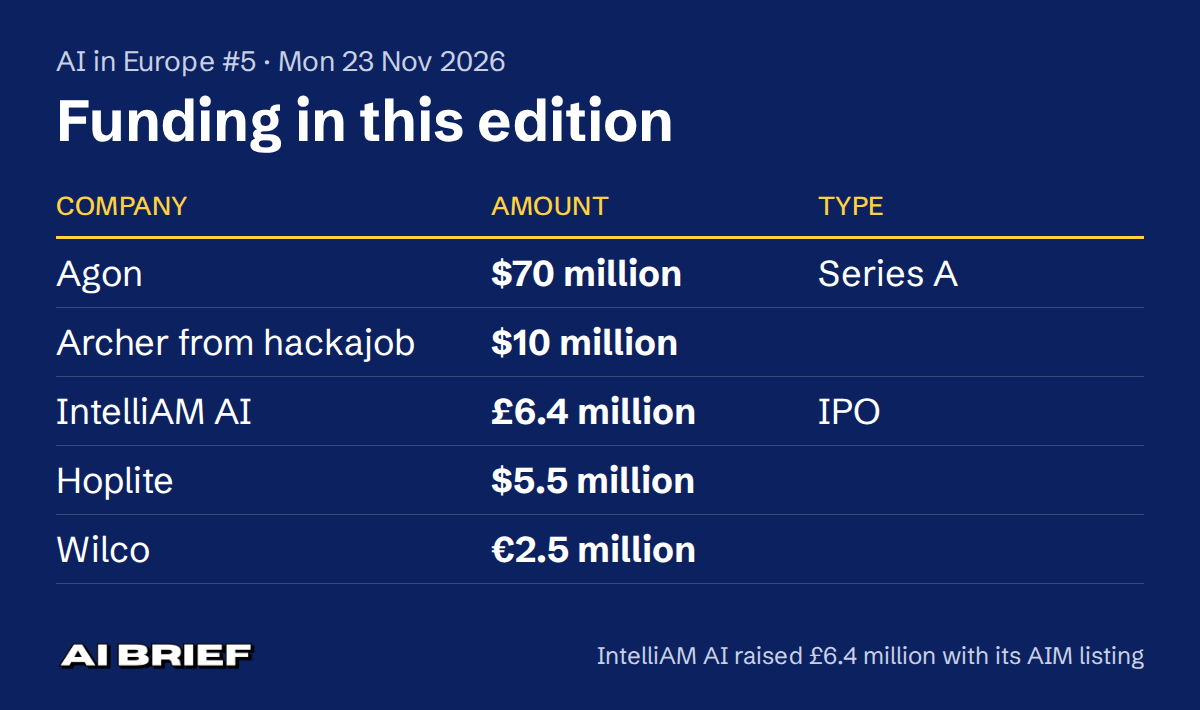
UK and Berlin based defence AI startup Agon raised a $70 million Series A at a $450 million valuation, led by Northzone, with the UK Sovereign AI Fund, NSSIF and Roelof Botha. It will build AI models and a virtual training platform for autonomous defence systems. Agon
Archer, the AI agent from hackajob, raises $10 million in a round led by Volition Capital, with AVP. Archer sources and qualifies candidates for recruiters and suggests roles to job seekers. The company says its annual recurring revenue grew five times this year and that more than 700,000 candidates signed up in the last 12 months. Archer from hackajob
Co founder and CEO Mark Chaffey says the money goes into a launch for candidates planned for January and Archer OS for recruiting teams, due for general release in the first quarter of 2027. The company started at King's College London and has offices in London, New York and Iasi, Romania. Archer's plans
Stripe founders Patrick and John Collison lead a $5.5 million round in Hoplite, an AI startup founded by Irish entrepreneurs Ryan Morrissey and Bence Redmond and based in San Francisco and Dublin, Tech.eu reports. Its cloud platform lets software teams run several AI coding agents, such as Claude Code or Codex, each in its own workspace. Hoplite
Relational Capital, Upside Ventures, Y Combinator, Paul Graham and Des Traynor also joined the Hoplite round. Hoplite investors
UK industrial AI company IntelliAM AI lists on the London Stock Exchange's AIM market under the ticker INT and raises £6.4 million alongside the listing. Founded in 2013 and based in Sheffield, it uses AI and machine learning to help manufacturers improve equipment reliability. The company says it serves more than 90 customers, including Muller, Mars and Knauf. IntelliAM
Spanish startup Wilco raises €2.5 million in a round led by Samaipata, with ABAC Nest Ventures and executives from technology and healthcare. Its AI agents follow up with each patient until they visit the clinic and accept a treatment plan. Clients include Vitaldent and Baviera. It plans to expand to the rest of Europe, the United States and Hispanic America. Wilco
United Kingdom
The UK government makes no commitment to an AI Bill or a single independent AI regulator in its response to a report by Parliament's Joint Committee on Human Rights. It says it will keep AI regulation under review and that "nothing is off the table". Committee chair Alex Sobel MP calls this a "wait and see approach". UK AI regulation
The Financial Conduct Authority launches the AI Spotlight Observatory, an open online platform with AI use cases from more than 200 organisations across 150 areas of financial services. The FCA calls it the first resource of its kind for a regulator globally. CFTE created the taxonomy and repository, and NayaOne built the platform. FCA AI Observatory

Photo Shadowssettle, CC BY-SA 4.0, Wikimedia Commons
Chelsea and Westminster Hospital launches an AI platform powered by OcciAI for patients investigated for possible lung cancer. Videos with AI avatars of clinicians, written information and an AI question and answer function explain tests and scans. It is in English and will first roll out in the 10 most translated languages. MSD funded the project. Chelsea and Westminster
The £11 million EDITH trial will test whether AI can replace one of the two specialists who review mammograms, across 30 UK sites. It is led by the universities of Warwick and Cambridge with Cambridge University Hospitals and NHS England, and will look at early detection, recalls and overdiagnosis. EDITH trial
European Union

Photo Dr. Thomas Liptak, CC BY-SA 4.0, Wikimedia Commons
European Central Bank President Christine Lagarde says EU public money should take the first losses on European chip plants and data centres to draw in private capital. She cites a KIRA Center estimate that raising Europe's share of global AI computing capacity from about 5% to 15% by 2030 would need around €1.3 trillion. Lagarde on AI computing
Lagarde spoke at the Frankfurt European Banking Congress on 20 November, her last address there before she steps down as head of the ECB in February, CNBC reports. She warned that once a dependency on foreign technology has been used against Europe, its sovereignty is already exposed. Lagarde's speech
Data centres

Photo Mount10-wiki, CC BY-SA 3.0, Wikimedia Commons
Data centres in Switzerland could use 2.5 to 7 TWh of electricity a year by 2050, up to 10% of national demand, according to a study by the Association of Swiss Electricity Companies (AES) and Deloitte, swissinfo.ch reports. They used about 2.1 TWh in 2024, 3.6% of demand. Swiss data centres
The study names grid capacity, local connections and winter electricity imports as key challenges. swissinfo.ch writes that the growth of AI and digitalisation will significantly increase the energy needs of data centres. Swiss power study
Estonia's grid operator Elering has received seven connection applications for data centres totalling 2,900 megawatts, nearly double the country's peak demand, ERR News reports. Most of the proposed AI and cloud capacity is in western Estonia. The Ministry of Justice and Digital Affairs warns that campuses built for a single foreign tech company bring little economic benefit. Estonia data centres
Nscale's planned $35 billion US listing faces more scrutiny over its deal to sell data centre services to ByteDance, The Observer reports. The UK AI infrastructure company may need a US licence to keep supplying Nvidia chips to Spring, a ByteDance subsidiary that once accounted for 73% of its sales. Its updated prospectus does not mention Spring. Nscale IPO
Defence
Germany's armed forces test loitering munitions from Helsing and Stark Defence at the Rūdninkai training area in Lithuania, near the Belarusian border, Euronews reports, citing Reuters. In the Freedom Shield exercise the drones carry inert warheads against simulated armoured targets. Soldiers also evaluate Clarity, Helsing's AI supported intelligence and targeting platform. Bundeswehr in Lithuania
Auterion, a defence software company based in Arlington, Virginia and Munich, and Ukrainian drone maker SkyFall plan a joint venture to build drones for Ukraine in a new factory in Germany. Each drone combines a SkyFall airframe with Auterion's avionics and AuterionOS autonomy software. The companies say they have delivered more than 50,000 Shrike drones together. SkyFall x Auterion
Swedish startup Nordic Air Defence unveils the K200, an autonomous interceptor for faster attack drones such as Russia's jet powered Geran-3A and Geran-4, and plans tests in Ukraine, Tectonic Defense reports. CEO Karl Rosander says it hit nine out of 10 targets in testing. The company says it can make 1,000 interceptors a month in house. Nordic Air Defence K200
Around Europe
The Dutch Data Protection Authority advises consumers not to buy AI camera glasses after testing six models, The Register reports. In one test, glasses told a wearer during a simulated CPR emergency that emergency services were on their way, though nobody had called them. People nearby could in some cases view recordings or operate the camera. AI glasses warning
Estonia's AI-Leap Foundation opens a tender worth up to €2 million, excluding VAT, for a new provider of ITI, its AI learning platform for students and teachers, ERR News reports. Its agreement with OpenAI to build the platform, signed last year, expires in February. The new provider may not use user data to train AI models. AI-Leap tender
In Greece, 60.2% of people aged 16 to 74 have used AI tools such as ChatGPT, Copilot, Gemini or Midjourney to create text, images, code or video, according to ELSTAT's 2026 survey on the use of information and communication technologies, Kathimerini reports. Of those users, 38.1% used them for work and 24.1% for formal education. Greece AI use
Technology consulting firm SEIDOR launches SEIDOR Autonomous Enterprise Factory, a global unit with more than 50 specialists that builds AI agents for SAP ERP systems. It already supports 10 projects, Portal ERP reports. SEIDOR
Robotics startups raised $9.9 billion worldwide in the third quarter of 2026, more than double a year earlier, Robot Magazine reports, citing Crunchbase figures that exclude defence companies. The European rounds it names include Munich based Agile Robots, which raised a $500 million Series F on 12 November. Robotics funding
NiCE Cognigy connects its AI agents with Microsoft Teams, Azure and Dynamics 365 Customer Service, so an agent on a customer call can ask a human colleague in Teams for guidance and relay the answer. NiCE says this can reduce blind transfers, hold times and repeated explanations. NiCE Cognigy
Munich based robotics AI company microagi will train models for industrial robots at Deutsche Telekom's AI factory in Munich, Telekom says. microagi
We hope you enjoyed this article
Consider subscribing to one of our newsletters like AI in Europe or Daily AI Brief.
Also, consider following us on social media:
More from AI in Europe
Nov 23 AI data center orders push UK factory growth to fastest pace since July 2024 Nov 23 French startup MountAIn raises €7.3 million to run AI on sub-$10 chips Nov 23 Swiss grocery robot startup Theseus Robotics gets €455,000 from Y Combinator Nov 23 Lithuanians' spending on Claude rose 16-fold in a year, SEB data show Nov 23 University of Oslo opens Claude and Claude Code to staff and PhD candidatesAI in Europe
Daily AI news from Europe, chosen by Rene van Pelt: European companies, the EU and the UK, chips and data centres, deals and regulation, in a few minutes.