
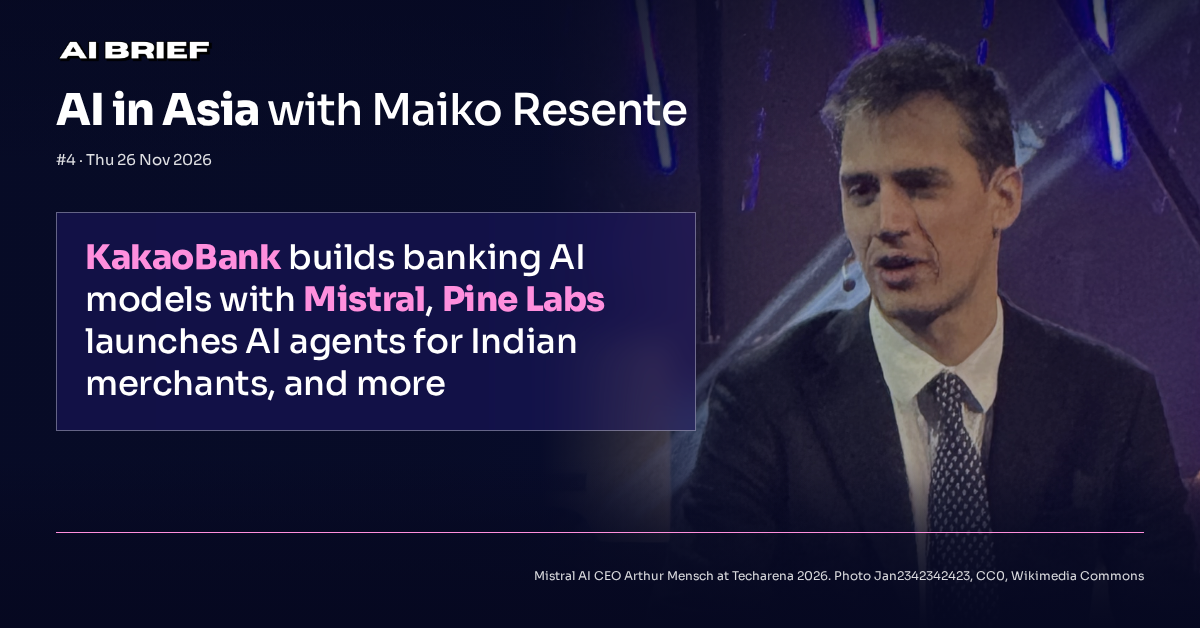
KakaoBank builds banking AI models with Mistral, Pine Labs launches AI agents for Indian merchants, and more - AI in Asia with Maiko Resente #4
Every weekday I pick the AI news that matters for Asia and the Pacific from the stories AI Brief publishes. Today covers the news since Wednesday 25 November.
In this edition:
- KakaoBank signs a partnership with Paris based Mistral to build banking specific large language models for its internal systems and customer services.
- Pine Labs rolls out two AI agents to merchants in India and plans an Agent App Store for specialist agents by 15 December.
- 76% of Australian adults in a University of Canberra survey say they have mistaken AI generated content for real.
About AI in Asia with Maiko Resente
AI in Asia with Maiko Resente is edited by Maiko Resente for AI Brief. Every weekday it brings the AI news that matters for Asia, chosen from the stories AI Brief publishes.
News and tips: news@dailyaibrief.com. Sponsoring this newsletter: stefan@dailyaibrief.com.
South Korea
South Korean digital bank KakaoBank signed a partnership with Paris based AI company Mistral in Seongnam on 25 November to build banking specific large language models for its internal systems and customer facing services, Tech in Asia reports. The companies say the work covers model tuning, testing, deployment and joint research and development. KakaoBank previously launched a service based on Azure OpenAI. KakaoBank and Mistral
Korea Credit Information Services showed seven AI models and solutions for the financial sector at a seminar at the aT Center in Seoul during Korea Fintech Week 2026, Financial News reports. They include a credit scoring model for small businesses, a corporate growth model, an insurtech platform, K-Finance Synapse, a data infrastructure for agentic finance, an AI pseudonymisation guidance model, a roadmap for synthetic data and MyChat.LM, a language model that financial companies can run locally. Korea Credit Information Services
Japan
Japan's government will add the goal of becoming the world's third leading AI nation, after the US and China, to three revised national security documents later this year, The Japan Times reports. The documents will call for less reliance on foreign AI, investment in automated driving and physical AI, and stronger supply chains for strategic goods. Japan
India
Pine Labs rolled out two AI agents to its merchants in India in its Pine Labs One app, Business Standard reports. Guide answers questions about sales and payments data in natural language. Marketer Agent, built with Google Gemini, creates and publishes Google ad campaigns, and merchants approve each campaign before any money is spent. Pine Labs plans an Agent App Store for specialist agents in India by 15 December. Pine Labs
Bengaluru robotics startup Cosine Robots raised Rs 22.36 crore in a round led by Avaana Capital, with WEH Ventures and angel investors, India Today reports. It makes integrated servo actuators, the joints that move robots, with motors, gearboxes, sensors, electronics and control software in one unit. The money goes into a research and production facility, engineering hires and more actuator production. Founders Kiran Mathew Koshy and Delip Thomas, both IIT Patna alumni, set out to build affordable humanoid robots and sell actuators first. Cosine Robots
Chips

Photo Daderot, CC0, Wikimedia Commons
A National Taiwan University team led by electrical engineering professor Yang Chia-hsiang developed two generations of energy efficient transformer processors that run generative AI on devices, Taiwan's National Science and Technology Council says. The second generation chip reaches a peak of 157 TOPS per watt, which the council puts at 1.6 to 7.6 times that of comparable transformer learning processors. A next generation chip on a 16 nanometer process was fabricated last month, the Taipei Times reports. National Taiwan University
Sellers have put an unusually large number of Nvidia GPUs on the market, including thousands of B300 chips, since a US rule against Chinese companies renting remote access to advanced Nvidia chips in overseas data centres took effect on 19 November, CNBC reports. GPU Mart president Jack Duhamel and two people who asked not to be named say the chips were meant for data centres where Chinese companies would rent access. Nvidia GPU sellers
China
Shenzhen based RoboSense sold about 427,800 robotics LiDAR units in the first nine months of 2026, up 423% from a year earlier, according to its unaudited results; the company says that makes it the world's largest seller by robotics LiDAR volume. It also sold about 866,900 LiDAR units for driver assistance systems. RoboSense
XPENG unveiled its Turing Physical AI Architecture, also called VLA 3.0, at its AI Day in Guangzhou. The company says it connects AI cognition, real time decision making and physical execution across vehicles and humanoid robots. Its IRON humanoid robot will train as a store assistant in the first quarter of 2027, with public release targeted for the second quarter of 2027. XPENG
Apple removed MiniMax's Talkie AI companion app from App Stores worldwide after investigations reported inappropriate interactions between its AI characters and minors, including abusive, violent and controlling language, 9to5Mac reports. Apple said the removal involved sexual content. The investigations also raised concerns about Talkie's handling of user data. Talkie
Singapore
At the Singapore FinTech Festival, Tencent showed TenPayGo, its payment and lifestyle app for international visitors to China with AI assisted travel services, along with Weixin Pay's Smart Business Robot and the AI AgentPay Card. Tencent says its AI productivity agent WorkBuddy has more than 10 million daily active users and that more than 60 overseas wallets from 16 countries and regions are linked to Weixin Pay. Tencent at SFF
Australia

Photo Jtneill, CC BY 4.0, Wikimedia Commons
76% of Australian adults in a representative University of Canberra survey of 2,000 people say they recently took content for real and later found out it was made by AI. A minority say they trust ChatGPT (34%), Microsoft Copilot (24%), Google Gemini (24%) or Claude (17%). Few people look for AI labels or check a trusted news source. The survey ran in August and September 2026, the authors write in The Conversation. University of Canberra
We hope you enjoyed this article
Consider subscribing to one of our newsletters like Daily AI Brief.
Also, consider following us on social media:
AI in Asia with Maiko Resente
Daily AI news from Asia and the Pacific, chosen by Maiko Resente: China, India, Korea, Japan, Southeast Asia and Australia. Companies, chips, models, deals and policy, in a few minutes.
Free, on Mondays, Tuesdays, Wednesdays, Thursdays, and Fridays.