Google Expands AI Tuberculosis Screening Across Africa and Indonesia
Oct 24, 2026
Healthcare
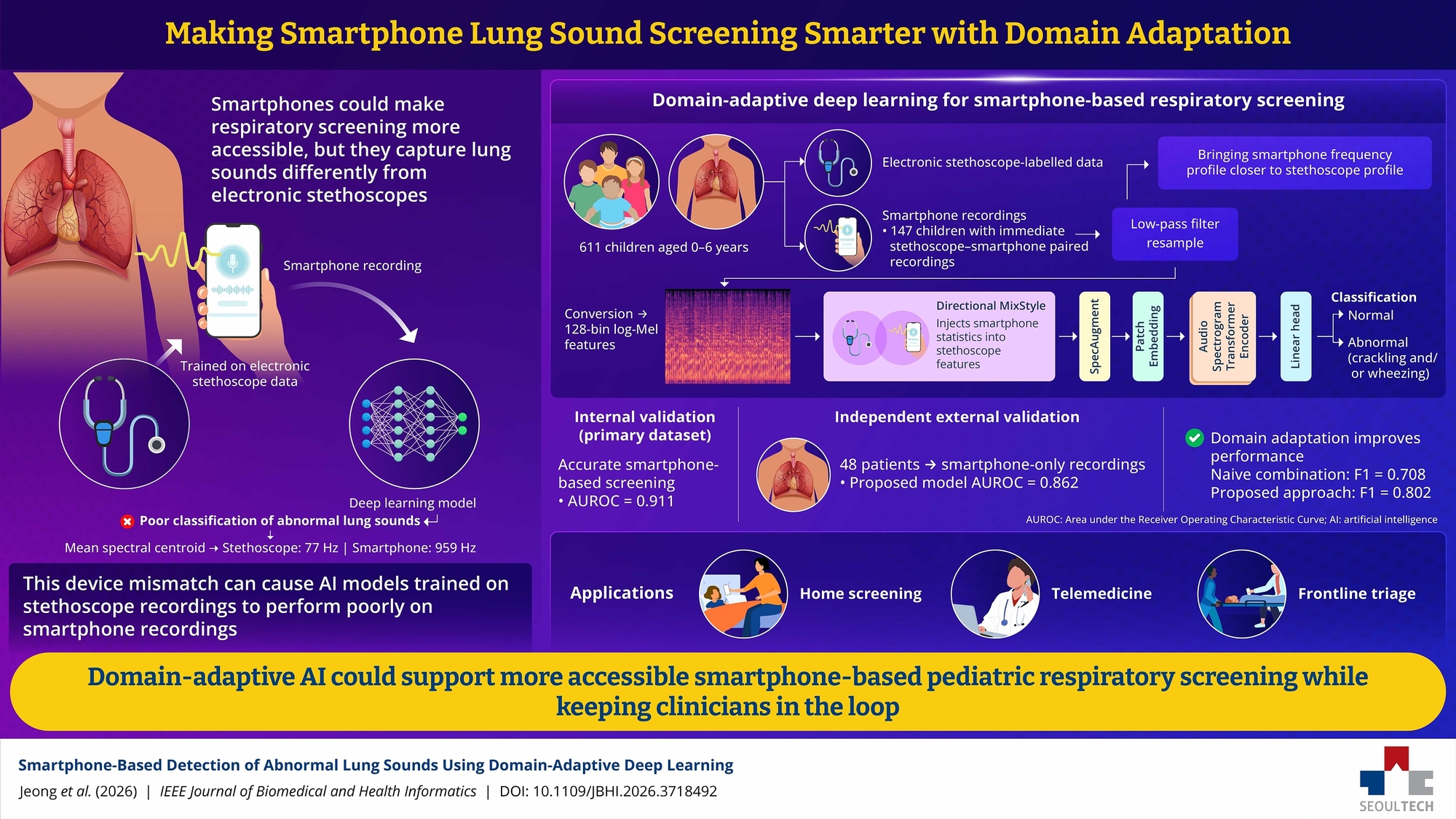
Researchers at Seoul National University of Science and Technology developed a deep learning framework that detects abnormal lung sounds in children from smartphone recordings, the university said in a press release. The study was published in the IEEE Journal of Biomedical and Health Informatics on July 30, 2026.
The researchers studied 611 children aged 0 to 6, with paired smartphone recordings available for 147 participants. They also used smartphone recordings from an independent group of 48 children for validation. The system filters and resamples smartphone audio, then uses a directional MixStyle module with an Audio Spectrogram Transformer to adapt electronic stethoscope data to smartphone audio.
On smartphone recordings in the primary dataset, the model recorded an F1 score of 0.802 and an AUROC of 0.911. A model trained only on smartphone data recorded an F1 score of 0.732, while pooling smartphone and stethoscope data produced 0.708. On the independent group, the proposed model recorded an F1 score of 0.744 and an AUROC of 0.862. The researchers said larger and more diverse studies in clinical settings are still needed.
Consider subscribing to one of our newsletters like Life AI Weekly or Daily AI Brief.
Also, consider following us on social media:
Weekly coverage of AI applications in healthcare, drug development, biotechnology research, and genomics breakthroughs.
This industry analysis by The Hackett Group explores the transformative impact of generative artificial intelligence (Gen AI) on global business services (GBS) in 2025. The study highlights the shift from exploration to acceleration of Gen AI initiatives, with 89% of executives advancing these projects to improve customer satisfaction, innovate products, and reduce costs. The report also discusses the challenges and strategies for successful Gen AI adoption, emphasizing the need for a technology-enabled operating model and the importance of reskilling the workforce.
Read moreDaily AI Brief: the AI news that matters, in your inbox.